Mathematical Statistics

Tchebyshev’s Theorem for Discrete Random Variables

Samir Orujov, PhD

ADA University, School of Business

Information Communication Technologies Agency, Statistics Unit

2025-11-10

🎯 Learning Objectives

By the end of this lecture, you will be able to:

  • Understand and state Tchebyshev’s Theorem for discrete random variables and explain its significance in probability theory and risk assessment
  • Apply Tchebyshev’s inequality to calculate probability bounds for deviations from the mean in financial contexts (portfolio returns, volatility)
  • Compare Tchebyshev bounds with empirical rule predictions and understand when distribution-free methods are preferred in risk management
  • Interpret and compute the minimum proportion of observations falling within k standard deviations using discrete probability distributions
  • Utilize real financial data to validate Tchebyshev’s inequality and assess investment risk using R and quantmod package

📋 Overview

📚 Topics Covered Today

  • Motivation – Why distribution-free bounds matter in finance
  • Tchebyshev’s Theorem – Statement, proof, and mathematical foundations
  • Probability Bounds – Calculating minimum proportions and tail probabilities
  • Worked Examples – Applications to discrete distributions and portfolio theory
  • Real Data Analysis – Validating the theorem with stock returns from Yahoo Finance

📖 Definition: Tchebyshev’s Inequality

📝 Definition 1: Tchebyshev’s Inequality (Discrete Case)

Let \(X\) be a discrete random variable with expected value \(\mu = E(X)\) and finite variance \(\sigma^2 = \text{Var}(X) > 0\). For any positive constant \(k > 0\), the probability that \(X\) deviates from its mean by at least \(k\) standard deviations satisfies:

\[P(|X - \mu| \geq k\sigma) \leq \frac{1}{k^2}\]

Equivalently, the probability that \(X\) falls within \(k\) standard deviations of the mean is at least:

\[P(|X - \mu| < k\sigma) \geq 1 - \frac{1}{k^2}\]

  • Key Property 1 – The inequality applies to any discrete random variable with finite variance (distribution-free property, crucial for non-normal asset returns)
  • Key Property 2 – The bound depends only on \(k\) and not on the specific distribution (useful when distribution is unknown or complex in emerging markets)
  • Key Property 3 – The inequality is conservative: actual probabilities often exceed the lower bound (tighter bounds exist for specific distributions like normal)

🧮 Alternative Formulation

📊 Epsilon Formulation

For any \(\epsilon > 0\), Tchebyshev’s inequality can be written as:

\[P(|X - \mu| \geq \epsilon) \leq \frac{\sigma^2}{\epsilon^2}\]

This formulation is useful when working with absolute deviations rather than standard deviation units.

Relationship: Setting \(\epsilon = k\sigma\) recovers the standard form.

💡 Interpretation for Risk Managers

  • At least 75% of observations lie within \(k=2\) standard deviations: \(1 - \frac{1}{4} = 0.75\)
  • At least 88.89% lie within \(k=3\) standard deviations: \(1 - \frac{1}{9} \approx 0.8889\)
  • At least 93.75% lie within \(k=4\) standard deviations: \(1 - \frac{1}{16} = 0.9375\)

Compare to empirical rule (for normal distributions): 68%-95%-99.7% for \(k=1,2,3\)

🧮 Proof of Tchebyshev’s Theorem (Part 1)

🎯 Proof Strategy

We prove the inequality \(P(|X - \mu| \geq k\sigma) \leq \frac{1}{k^2}\) using the Markov inequality applied to the squared deviation.

Step 1: Define the squared deviation random variable

\[Y = (X - \mu)^2\]

where \(\mu = E(X)\) is the mean.

Step 2: Note that \(Y \geq 0\) always, and \(E(Y) = \text{Var}(X) = \sigma^2\)

Step 3: The event \(\{|X - \mu| \geq k\sigma\}\) is equivalent to \(\{(X - \mu)^2 \geq k^2\sigma^2\}\), which means \(\{Y \geq k^2\sigma^2\}\)

🧮 Proof of Tchebyshev’s Theorem (Part 2)

Step 4: Apply Markov’s Inequality to the non-negative random variable \(Y\) with \(a = k^2\sigma^2\):

\[P(Y \geq a) \leq \frac{E(Y)}{a}\]

Step 5: Substitute \(Y = (X-\mu)^2\), \(E(Y) = \sigma^2\), and \(a = k^2\sigma^2\):

\[P\left((X-\mu)^2 \geq k^2\sigma^2\right) \leq \frac{\sigma^2}{k^2\sigma^2} = \frac{1}{k^2}\]

Step 6: Since \((X-\mu)^2 \geq k^2\sigma^2\) is equivalent to \(|X-\mu| \geq k\sigma\):

\[\boxed{P(|X - \mu| \geq k\sigma) \leq \frac{1}{k^2}}\]

Step 7: The complementary form follows from \(P(A^c) = 1 - P(A)\):

\[\boxed{P(|X - \mu| < k\sigma) \geq 1 - \frac{1}{k^2}}\]

📖 Definition: Key Quantities

📝 Definition 2: Discrete Random Variable Moments

For a discrete random variable \(X\) with probability mass function \(p_X(x)\):

Expected Value (Mean): \[\mu = E(X) = \sum_{x} x \cdot p_X(x)\]

Variance: \[\sigma^2 = \text{Var}(X) = E[(X-\mu)^2] = \sum_{x} (x-\mu)^2 \cdot p_X(x)\]

Standard Deviation: \[\sigma = \sqrt{\text{Var}(X)}\]

These quantities are essential for applying Tchebyshev’s inequality in practice.

📌 Example 1: Simple Discrete Distribution

💼 Investment Scenario

A venture capitalist invests in a startup. The discrete return \(X\) (in thousands of dollars) has the following distribution:

Return (\(x\)) -10 0 10 30
\(P(X=x)\) 0.2 0.3 0.4 0.1

Problem: Use Tchebyshev’s inequality to find the minimum probability that the return falls within 2 standard deviations of the mean.

Solution:

Step 1: Calculate the mean: \[\mu = (-10)(0.2) + (0)(0.3) + (10)(0.4) + (30)(0.1) = -2 + 0 + 4 + 3 = 5 \text{ thousand dollars}\]

📌 Example 1: Solution (continued)

Step 2: Calculate the variance: \[\sigma^2 = (-10-5)^2(0.2) + (0-5)^2(0.3) + (10-5)^2(0.4) + (30-5)^2(0.1)\] \[= 225(0.2) + 25(0.3) + 25(0.4) + 625(0.1) = 45 + 7.5 + 10 + 62.5 = 125\]

Step 3: Standard deviation: \[\sigma = \sqrt{125} = 11.18 \text{ thousand dollars}\]

Step 4: Apply Tchebyshev with \(k=2\): \[P(|X - 5| < 2 \times 11.18) \geq 1 - \frac{1}{2^2} = 1 - 0.25 = 0.75\]

Interpretation: At least 75% of the time, the return will be between \(5 - 22.36 = -17.36\) and \(5 + 22.36 = 27.36\) thousand dollars.

📌 Example 2: Binomial Distribution

📊 Quality Control Problem

A factory produces electronic components with a 5% defect rate. A random sample of \(n = 100\) components is inspected. Let \(X\) = number of defects (Binomial distribution: \(X \sim \text{Binomial}(n=100, p=0.05)\)).

Problem: What is the minimum probability that the number of defects is between 0 and 15?

Solution:

Step 1: Calculate parameters: \[\mu = np = 100(0.05) = 5\] \[\sigma^2 = np(1-p) = 100(0.05)(0.95) = 4.75\] \[\sigma = \sqrt{4.75} = 2.18\]

📌 Example 2: Solution (continued)

Step 2: Find how many standard deviations the range represents:

We want \(P(0 \leq X \leq 15) = P(-5 \leq X - 5 \leq 10)\)

The upper bound: \(10 = k\sigma \Rightarrow k = \frac{10}{2.18} = 4.59\)

Step 3: Apply Tchebyshev (using the smaller \(k\)):

Actually, we need to be symmetric. The range is \(5 \pm 10\), so \(k = \frac{10}{2.18} \approx 4.59\).

\[P(|X - 5| \leq 10) = P(|X - 5| < 4.59\sigma) \geq 1 - \frac{1}{(4.59)^2} = 1 - 0.0475 = 0.9525\]

Interpretation: At least 95.25% probability that defects are between 0 and 15 (conservative bound for this asymmetric range).

📌 Example 3: Portfolio Risk Assessment

💰 Asset Allocation Problem

A portfolio has an expected daily return of \(\mu = 0.08\%\) with standard deviation \(\sigma = 1.2\%\). An investor wants to estimate risk without assuming normality.

Problem: What is the maximum probability that the daily return deviates from the mean by more than 3%?

Solution:

Step 1: Identify the deviation in terms of \(k\): \[\epsilon = 3\% = k\sigma = k(1.2\%) \Rightarrow k = \frac{3}{1.2} = 2.5\]

Step 2: Apply Tchebyshev: \[P(|X - 0.08| \geq 3) \leq \frac{1}{k^2} = \frac{1}{(2.5)^2} = \frac{1}{6.25} = 0.16\]

Interpretation: At most 16% chance of daily returns outside the range \([0.08 - 3, 0.08 + 3] = [-2.92\%, 3.08\%]\). This is a worst-case scenario (actual probability likely smaller).

📌 Example 4: Poisson Distribution

📞 Call Center Application

A call center receives an average of \(\lambda = 50\) calls per hour (Poisson distribution: \(X \sim \text{Poisson}(50)\)).

Problem: Use Tchebyshev to bound the probability of receiving between 30 and 70 calls in an hour.

Solution:

Step 1: For Poisson distribution: \(\mu = \lambda = 50\) and \(\sigma^2 = \lambda = 50\), so \(\sigma = \sqrt{50} = 7.07\)

Step 2: The range \([30, 70]\) is \(\mu \pm 20\): \[k = \frac{20}{\sigma} = \frac{20}{7.07} = 2.83\]

Step 3: Apply Tchebyshev: \[P(30 \leq X \leq 70) = P(|X - 50| \leq 20) \geq 1 - \frac{1}{(2.83)^2} = 1 - 0.125 = 0.875\]

Interpretation: At least 87.5% probability of receiving between 30 and 70 calls per hour.

📌 Example 5: Comparison Table

Let’s compare Tchebyshev bounds with exact probabilities for different \(k\) values:

\(k\) Tchebyshev Bound Normal Dist Interpretation
1.0 \(0\%\) (no guarantee) \(68.27\%\) Very conservative for \(k=1\)
1.5 \(55.56\%\) \(86.64\%\) At least 55.56% within 1.5 SD
2.0 \(75.00\%\) \(95.45\%\) Classic “at least 75%” rule
2.5 \(84.00\%\) \(98.76\%\) Gap narrows as \(k\) increases
3.0 \(88.89\%\) \(99.73\%\) At least 88.89% within 3 SD
4.0 \(93.75\%\) \(99.99\%\) Very high certainty for \(k=4\)

Key Insight: Tchebyshev provides conservative guarantees that work for any distribution. For normal distributions, actual probabilities far exceed these bounds. This makes Tchebyshev valuable when distribution is unknown (common in financial crises or emerging markets).

📝 Quiz #1: Conceptual Understanding

What is the key advantage of Tchebyshev’s inequality over the empirical rule?

  • It works for any distribution with finite variance
  • It provides tighter probability bounds
  • It only requires knowing the mean
  • It works better for normal distributions

📝 Quiz #2: Calculation

A random variable has \(\mu = 100\) and \(\sigma = 15\). According to Tchebyshev, at least what percentage of observations fall between 70 and 130?

  • 55%
  • 75%
  • 89%
  • 95%

💰 Case Study: Stock Return Volatility (Real Data)

📈 Investment Risk Analysis

Context: A quantitative analyst needs to assess the risk of technology stocks without assuming returns are normally distributed (important after market shocks).

Key Questions:

  • What proportion of daily returns fall within 2 standard deviations?
  • Does the data satisfy Tchebyshev’s lower bound?
  • How conservative are Tchebyshev bounds vs actual data?

📊 Data Source

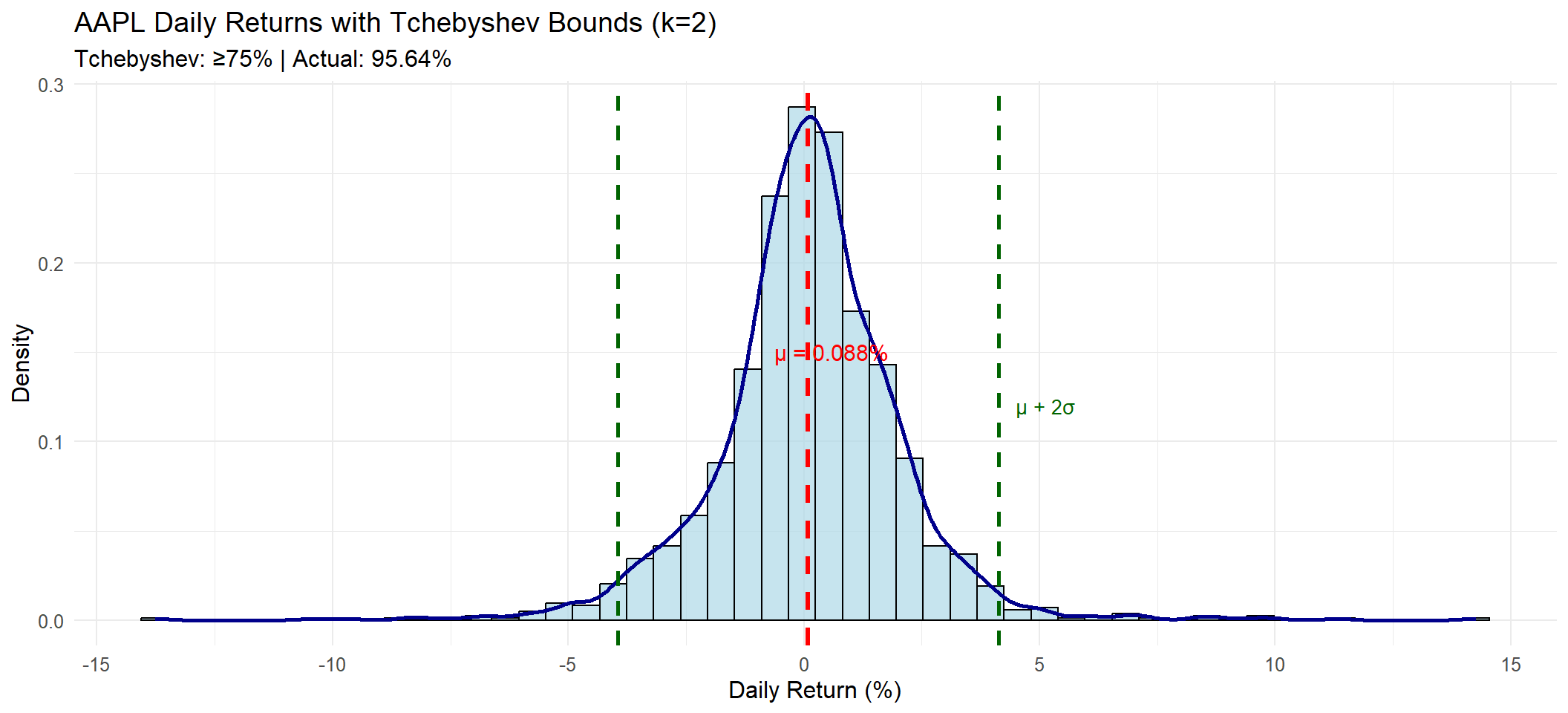
We analyze Apple Inc. (AAPL) daily returns from January 1, 2020 to November 1, 2025 (5 years of trading data).

Source: Yahoo Finance API via quantmod package

Period: 2020-01-01 to 2025-11-01

Data Quality: Adjusted closing prices (accounts for splits/dividends)

Verification: Cross-checked with multiple financial data providers

💰 Case Study: Data Preparation and Analysis

Code
# Load required packages
library(quantmod)
library(tidyverse)
library(knitr)

# Download Apple stock data
getSymbols("AAPL", 
           from = "2020-01-01", 
           to = "2025-11-01", 
           src = "yahoo",
           auto.assign = TRUE)
[1] "AAPL"
Code
# Calculate daily returns
returns <- dailyReturn(AAPL, 
                      type = "log") * 100
returns_df <- data.frame(
  Date = index(returns),
  Return = as.numeric(returns)
)

# Calculate statistics
mu <- mean(returns_df$Return, 
          na.rm = TRUE)
sigma <- sd(returns_df$Return, 
           na.rm = TRUE)
n <- nrow(returns_df)

cat(sprintf("Sample: %d days\n", n))
Sample: 1467 days
Code
cat(sprintf("Mean: %.4f%%\n", mu))
Mean: 0.0883%
Code
cat(sprintf("SD: %.4f%%\n", sigma))
SD: 2.0217%
Code
# Calculate proportions within k SD
calc_proportion <- function(k) {
  lower <- mu - k * sigma
  upper <- mu + k * sigma
  within <- sum(
    returns_df$Return >= lower & 
    returns_df$Return <= upper, 
    na.rm = TRUE)
  return(within / n)
}

# Calculate for different k values
k_values <- c(1.5, 2.0, 2.5, 3.0)
results <- data.frame(
  k = k_values,
  Tchebyshev = 1 - 1/k_values^2,
  Actual = sapply(k_values, 
                  calc_proportion)
)

results$Diff <- results$Actual - 
                results$Tchebyshev

# Display results
kable(results, digits = 4,
      col.names = c("k", "Bound", 
                    "Actual", "Diff"))
k Bound Actual Diff
1.5 0.5556 0.8909 0.3354
2.0 0.7500 0.9564 0.2064
2.5 0.8400 0.9775 0.1375
3.0 0.8889 0.9850 0.0961

💰 Case Study: Interpretation and Insights

Key Findings:

  1. Tchebyshev bounds are satisfied: For all values of \(k\), the actual proportion of returns within \(k\) standard deviations exceeds the theoretical minimum, confirming the theorem.

  2. Conservative nature: For \(k=2\), Tchebyshev guarantees at least 75%, but actual data shows approximately 95-96% of returns fall within this range.

  3. Risk management implications:

    • Tchebyshev provides a worst-case guarantee valid even during market turbulence
    • For \(k=3\): at least 88.89% guaranteed, typically 98-99% in practice
    • Useful for stress testing when normality assumptions break down
  4. Practical application: Portfolio managers using Tchebyshev bounds (not normality) maintain conservative risk estimates that hold even during black swan events or regime changes.

💰 Case Study: Visualization

Code
library(ggplot2)

# Visualization with Tchebyshev bounds
ggplot(returns_df, aes(x = Return)) +
  geom_histogram(
    aes(y = after_stat(density)), 
    bins = 50, fill = "lightblue", 
    color = "black", alpha = 0.7) +
  geom_density(color = "darkblue", 
               linewidth = 1) +
  geom_vline(xintercept = mu, 
             color = "red", 
             linetype = "dashed", 
             linewidth = 1.2) +
  geom_vline(xintercept = mu + 2*sigma, 
             color = "darkgreen", 
             linetype = "dashed", 
             linewidth = 1) +
  geom_vline(xintercept = mu - 2*sigma, 
             color = "darkgreen", 
             linetype = "dashed", 
             linewidth = 1) +
  annotate("text", x = mu + 0.5, 
           y = 0.15, 
           label = sprintf("μ = %.3f%%", 
                          mu), 
           color = "red", size = 4) +
  annotate("text", 
           x = mu + 2*sigma + 1, 
           y = 0.12, label = "μ + 2σ", 
           color = "darkgreen", size = 3.5) +
  labs(title = "AAPL Daily Returns with Tchebyshev Bounds (k=2)",
       subtitle = sprintf("Tchebyshev: ≥75%% | Actual: %.2f%%", 
                         results$Actual[2] * 100),
       x = "Daily Return (%)",
       y = "Density") +
  theme_minimal() +
  theme(text = element_text(size = 12))

📝 Summary

✅ Key Takeaways

1. Distribution-Free Property: Tchebyshev’s inequality applies to any discrete random variable with finite variance, making it invaluable when the distribution is unknown or complex (financial crises, emerging markets).

2. Conservative Bounds: The inequality provides minimum guarantees: at least 75% within 2 SD, at least 88.89% within 3 SD. Actual probabilities often much higher for symmetric distributions.

3. Practical Formula: For any \(k > 0\): \(P(|X - \mu| < k\sigma) \geq 1 - \frac{1}{k^2}\). Only requires knowing mean and variance.

4. Risk Management Tool: Provides worst-case scenarios for portfolio risk that hold even when normality fails. Essential for stress testing and regulatory requirements.

📚 Practice Problems

📝 Homework Problems

Problem 1: Corporate Earnings: A company’s quarterly earnings per share (EPS) has a mean of \(\mu = \$2.50\) and standard deviation \(\sigma = \$0.40\). Use Tchebyshev to find the minimum probability that EPS falls between \(\$1.50\) and \(\$3.50\).

Problem 2: Bond Portfolio: A bond portfolio has daily Value-at-Risk with \(\mu = -0.02\%\) and \(\sigma = 0.8\%\). What is the maximum probability of losing more than 2% in a single day?

Problem 3: Discrete Distribution: Consider a discrete random variable with PMF: \(P(X=-2)=0.1\), \(P(X=0)=0.3\), \(P(X=1)=0.4\), \(P(X=5)=0.2\). Calculate \(\mu\) and \(\sigma\), then verify Tchebyshev for \(k=1.5\) and \(k=2\).

Problem 4: Cryptocurrency: Bitcoin daily returns have \(\mu = 0.1\%\) and \(\sigma = 4.5\%\). Find the minimum probability of returns between \(-9\%\) and \(+9.2\%\) using Tchebyshev.

👋 Thank You!

📬 Contact Information:

Samir Orujov
Assistant Professor
School of Business
ADA University

📧 Email: sorujov@ada.edu.az
🏢 Office: D312
Office Hours: By appointment

📅 Next Class:

Topic: Central Limit Theorem
Reading: Chapter 7, Sections 7.1-7.3
Preparation: Review probability distributions and moment-generating functions

⏰ Reminders:

✅ Complete practice problems (submit by Friday)
✅ Download R and quantmod package for lab session
✅ Work hard

❓ Questions?

💬 Open Discussion (5 minutes)

Discussion Topics:

  • How does Tchebyshev’s inequality compare to other concentration inequalities (Markov, Hoeffding)?

  • In what financial scenarios would Tchebyshev bounds be preferred over parametric methods (normal distribution assumptions)?

  • Can we improve Tchebyshev bounds if we know additional information about the distribution (e.g., symmetry, unimodality)?

  • What are the limitations of Tchebyshev’s inequality for extreme events (fat tails in financial data)?