Mathematical Statistics

Expected Values for Continuous Random Variables

Samir Orujov, PhD

ADA University, School of Business

Information Communication Technologies Agency, Statistics Unit

2025-11-30

๐ŸŽฏ Learning Objectives

By the end of this lecture, you will be able to:

  • Define and compute expected values for continuous random variables using integration techniques

  • Apply theorems on expectations to calculate means and variances for continuous distributions

  • Recognize and work with the continuous uniform distribution, including its density function and parameters

  • Calculate probabilities for uniformly distributed random variables in business contexts (e.g., service arrival times, waiting times)

  • Derive and apply formulas for mean and variance of the uniform distribution in financial and operational scenarios

๐Ÿ“‹ Overview

๐Ÿ“š Topics Covered Today

  • Expected Values โ€“ Definition and computation for continuous random variables
  • Expectation Theorems โ€“ Linearity properties and variance calculations
  • Uniform Distribution โ€“ Definition, parameters, and empirical interpretation
  • Uniform Applications โ€“ Poisson-arrival conditioning and service time modeling
  • Statistical Properties โ€“ Mean and variance derivations for uniform distributions

๐Ÿ“– Definition: Expected Value

๐Ÿ“ Definition 1: Expected Value of a Continuous Random Variable

The expected value (or mean) of a continuous random variable \(Y\) with probability density function \(f(y)\) is:

\[\boxed{E(Y) = \int_{-\infty}^{\infty} yf(y) \, dy}\]

provided that the integral exists (i.e., converges absolutely).

  • Interpretation โ€“ The expected value represents the โ€œcenter of massโ€ or long-run average of the distribution

  • Financial Context โ€“ For a continuous return distribution, \(E(Y)\) represents the expected return on an investment

  • Existence Condition โ€“ The integral must converge; distributions with โ€œheavy tailsโ€ may not have finite expected values

๐Ÿงฎ Theorem: Expected Value of Functions

Theorem 1: Expectation of Transformed Variables

Let \(g(Y)\) be a function of a continuous random variable \(Y\) with density \(f(y)\). Then:

\[\boxed{E[g(Y)] = \int_{-\infty}^{\infty} g(y) f(y) \, dy}\]

provided the integral exists.

Key Insight: You do NOT need to find the distribution of \(g(Y)\) first โ€“ you can compute expectations directly using the original density \(f(y)\).

Example Applications:

  • \(g(Y) = Y^2\) gives \(E(Y^2)\), used to compute variance: \(V(Y) = E(Y^2) - [E(Y)]^2\)

  • \(g(Y) = e^{tY}\) gives the moment generating function \(M(t) = E(e^{tY})\)

  • \(g(Y) = (Y - \mu)^2\) gives variance directly: \(V(Y) = E[(Y - \mu)^2]\)

๐Ÿงฎ Theorem: Properties of Expectations

Theorem 2: Linearity of Expectations

Let \(c\) be a constant, and let \(g(Y), g_1(Y), g_2(Y), \ldots, g_k(Y)\) be functions of continuous random variable \(Y\). Then:

Property 1 (Constant): \[E(c) = c\]

Property 2 (Scalar Multiplication): \[E[cg(Y)] = cE[g(Y)]\]

Property 3 (Additivity): \[E[g_1(Y) + g_2(Y) + \ldots + g_k(Y)] = E[g_1(Y)] + E[g_2(Y)] + \ldots + E[g_k(Y)]\]

Portfolio Application: If a portfolio consists of \(k\) assets with returns \(R_1, R_2, \ldots, R_k\) and weights \(w_1, w_2, \ldots, w_k\), then the expected portfolio return is \(E(R_p) = w_1E(R_1) + w_2E(R_2) + \ldots + w_kE(R_k)\).

๐Ÿ“Œ Example 1: Computing Mean and Variance

Problem: A random variable \(Y\) has density function: \[f(y) = \frac{3}{8}y^2, \quad 0 \leq y \leq 2, \quad f(y) = 0 \text{ elsewhere}\]

Find the mean \(\mu = E(Y)\) and variance \(\sigma^2 = V(Y)\).

. . .

Solution (Part 1 - Mean):

By definition: \[E(Y) = \int_{-\infty}^{\infty} y f(y) \, dy = \int_{0}^{2} y \left(\frac{3}{8}y^2\right) \, dy = \frac{3}{8} \int_{0}^{2} y^3 \, dy\]

. . .

\[= \frac{3}{8} \left[\frac{1}{4}y^4\right]_{0}^{2} = \frac{3}{8} \cdot \frac{16}{4} = \frac{3}{8} \cdot 4 = \boxed{1.5}\]

๐Ÿ“Œ Example 1: Computing Mean and Variance (Part 2)

Solution (Part 2 - Variance):

First, compute \(E(Y^2)\): \[E(Y^2) = \int_{-\infty}^{\infty} y^2 f(y) \, dy = \int_{0}^{2} y^2 \left(\frac{3}{8}y^2\right) \, dy = \frac{3}{8} \int_{0}^{2} y^4 \, dy\]

. . .

\[= \frac{3}{8} \left[\frac{1}{5}y^5\right]_{0}^{2} = \frac{3}{8} \cdot \frac{32}{5} = \frac{96}{40} = 2.4\]

. . .

Now apply the variance formula: \[\sigma^2 = V(Y) = E(Y^2) - [E(Y)]^2 = 2.4 - (1.5)^2 = 2.4 - 2.25 = \boxed{0.15}\]

. . .

Interpretation: The standard deviation is \(\sigma = \sqrt{0.15} \approx 0.387\), indicating moderate variability around the mean of 1.5.

๐Ÿ“– Definition: Uniform Distribution

๐Ÿ“ Definition 2: Continuous Uniform Distribution

If \(\theta_1 < \theta_2\), a random variable \(Y\) is said to have a continuous uniform probability distribution on the interval \((\theta_1, \theta_2)\) if and only if the density function is:

\[\boxed{f(y) = \begin{cases} \frac{1}{\theta_2 - \theta_1}, & \text{if } \theta_1 \leq y \leq \theta_2, \\ 0, & \text{elsewhere} \end{cases}}\]

Notation: \(Y \sim \text{Uniform}(\theta_1, \theta_2)\) or \(Y \sim U(\theta_1, \theta_2)\)

๐Ÿ“ Definition 3: Parameters

The constants that determine the specific form of a density function are called parameters of the density function. For the uniform distribution, \(\theta_1\) and \(\theta_2\) are the parameters.

๐ŸŽฎ Interactive: Visualizing the Uniform Distribution

Explore the Uniform PDF: Adjust the interval boundaries to see how the density changes.

Observations:
As the interval width increases, the PDF height decreases to maintain total probability = 1.

๐Ÿ“– Properties of the Uniform Distribution

Key Characteristics:

  • Constant Density โ€“ The PDF has the same value throughout the interval \([\theta_1, \theta_2]\), representing โ€œcomplete uncertaintyโ€ within the range

  • Equal Probability โ€“ Any subinterval of fixed length has the same probability, regardless of location within \([\theta_1, \theta_2]\)

  • Probability Calculation โ€“ For any interval \([a, b] \subseteq [\theta_1, \theta_2]\): \[P(a \leq Y \leq b) = \int_{a}^{b} \frac{1}{\theta_2 - \theta_1} dy = \frac{b - a}{\theta_2 - \theta_1}\]

  • Financial Interpretation โ€“ Models scenarios with โ€œequal ignoranceโ€ โ€“ when all outcomes in a range are equally likely (e.g., random stock selection from a portfolio, uniform price fluctuations within a band)

๐Ÿ“Œ Example 2: Probability with Uniform Distribution

Problem: Consider a continuous uniform distribution with parameters \(a = 2\) and \(b = 8\). What is the probability that the random variable falls within the interval \([4, 6]\)?

Solution:

The probability density function is: \[f(x; 2, 8) = \frac{1}{8 - 2} = \frac{1}{6} \quad \text{for } 2 \leq x \leq 8\]

To find \(P(4 \leq X \leq 6)\), integrate the PDF over the interval: \[P(4 \leq X \leq 6) = \int_{4}^{6} f(x; 2, 8) \, dx = \int_{4}^{6} \frac{1}{6} \, dx\]

\[= \left[\frac{1}{6}x\right]_{4}^{6} = \frac{6}{6} - \frac{4}{6} = \frac{2}{6} = \boxed{\frac{1}{3}}\]

๐Ÿ“Œ Example 2: Probability with Uniform Distribution (Contโ€™d)

Integration Method: \[P(4 \leq X \leq 6) = \int_{4}^{6} \frac{1}{6} \, dx = \frac{1}{3}\]

Shortcut Method: \[P(4 \leq X \leq 6) = \frac{6-4}{8-2} = \frac{1}{3}\] (length ratio)

๐Ÿ“– Application: Poisson Process & Uniform Conditioning

๐ŸŽฏ Real-World Application

Context: In operations research and queueing theory, the arrival of events (customers, phone calls, server requests) often follows a Poisson process.

Key Result: If exactly one event occurred in the time interval \((0, t)\) under a Poisson process, then the actual time of occurrence is uniformly distributed over \((0, t)\).

Examples:

  • Call Centers โ€“ If one customer called during a 60-minute hour, the call time is \(\text{Uniform}(0, 60)\)

  • Network Traffic โ€“ If one packet arrived in a 100ms window, arrival time is uniformly distributed

  • Service Operations โ€“ Conditional distribution of service completion time given exactly one completion

๐Ÿ“Œ Example 3: Poisson Arrivals & Uniform Conditioning

Problem: Arrivals of customers at a checkout counter follow a Poisson distribution. During a given 30-minute period, exactly one customer arrived. Find the probability that the customer arrived during the last 5 minutes.

Solution:

Given that exactly one arrival occurred in \((0, 30)\), the arrival time \(Y\) is uniformly distributed: \[Y \sim \text{Uniform}(0, 30)\]

The probability of arrival in the last 5 minutes \([25, 30]\) is: \[P(25 \leq Y \leq 30) = \int_{25}^{30} \frac{1}{30} \, dy = \frac{30 - 25}{30} = \frac{5}{30} = \boxed{\frac{1}{6}}\]

Interpretation: Any 5-minute interval has probability \(\frac{1}{6}\) of containing the arrival. The probability is proportional to the interval length: \(\frac{5}{30} = \frac{1}{6}\).

๐Ÿงฎ Theorem: Mean of Uniform Distribution

Theorem 3: Expected Value of Uniform Distribution

If \(\theta_1 < \theta_2\) and \(Y \sim \text{Uniform}(\theta_1, \theta_2)\), then:

\[\boxed{\mu = E(Y) = \frac{\theta_1 + \theta_2}{2}}\]

Proof:

By definition of expected value: \[E(Y) = \int_{-\infty}^{\infty} y f(y) \, dy = \int_{\theta_1}^{\theta_2} y \left(\frac{1}{\theta_2 - \theta_1}\right) \, dy = \frac{1}{\theta_2 - \theta_1} \int_{\theta_1}^{\theta_2} y \, dy = \frac{1}{\theta_2 - \theta_1} \left[\frac{1}{2}y^2\right]_{\theta_1}^{\theta_2}\]

\[= \frac{1}{\theta_2 - \theta_1} \cdot \frac{1}{2}(\theta_2^2 - \theta_1^2) = \frac{\theta_2^2 - \theta_1^2}{2(\theta_2 - \theta_1)} = \frac{(\theta_2 - \theta_1)(\theta_2 + \theta_1)}{2(\theta_2 - \theta_1)} = \boxed{\frac{\theta_1 + \theta_2}{2}}\]

๐Ÿงฎ Theorem: Variance of Uniform Distribution

Theorem 4: Variance of Uniform Distribution

If \(\theta_1 < \theta_2\) and \(Y \sim \text{Uniform}(\theta_1, \theta_2)\), then:

\[\boxed{\sigma^2 = V(Y) = \frac{(\theta_2 - \theta_1)^2}{12}}\]

Proof Strategy:

Compute \(E(Y^2) = \int_{\theta_1}^{\theta_2} y^2 \cdot \frac{1}{\theta_2 - \theta_1} \, dy\) and Use the formula \(V(Y) = E(Y^2) - [E(Y)]^2\)

Step 1: Calculate \(E(Y^2)\) \[E(Y^2) = \frac{1}{\theta_2 - \theta_1} \int_{\theta_1}^{\theta_2} y^2 \, dy = \frac{1}{\theta_2 - \theta_1} \left[\frac{1}{3}y^3\right]_{\theta_1}^{\theta_2}\]

\[= \frac{\theta_2^3 - \theta_1^3}{3(\theta_2 - \theta_1)} = \frac{(\theta_2 - \theta_1)(\theta_2^2 + \theta_2\theta_1 + \theta_1^2)}{3(\theta_2 - \theta_1)} = \frac{\theta_2^2 + \theta_2\theta_1 + \theta_1^2}{3}\]

๐Ÿงฎ Variance Proof (Continued)

Step 2: Apply Variance Formula

From Step 1: \[E(Y^2) = \frac{\theta_2^2 + \theta_2\theta_1 + \theta_1^2}{3}\]

Square of mean: \[[E(Y)]^2 = \left(\frac{\theta_1 + \theta_2}{2}\right)^2 = \frac{(\theta_1 + \theta_2)^2}{4} = \frac{\theta_1^2 + 2\theta_1\theta_2 + \theta_2^2}{4}\]

Therefore: \[V(Y) = E(Y^2) - [E(Y)]^2 = \frac{\theta_2^2 + \theta_2\theta_1 + \theta_1^2}{3} - \frac{\theta_1^2 + 2\theta_1\theta_2 + \theta_2^2}{4}\]

Finding common denominator (12): \[= \frac{4(\theta_2^2 + \theta_2\theta_1 + \theta_1^2) - 3(\theta_1^2 + 2\theta_1\theta_2 + \theta_2^2)}{12}\]

\[= \frac{4\theta_2^2 + 4\theta_2\theta_1 + 4\theta_1^2 - 3\theta_1^2 - 6\theta_1\theta_2 - 3\theta_2^2}{12}= \frac{\theta_2^2 - 2\theta_2\theta_1 + \theta_1^2}{12} = \frac{(\theta_2 - \theta_1)^2}{12}\]

๐Ÿ“Œ Example 4: Uniform Distribution Mean & Variance

Problem: A stock price is equally likely to take any value between \(\$50\) and \(\$70\) during a trading session. Model this as a uniform distribution and find:

  1. The expected price

  2. The variance and standard deviation

Solution:

Let \(Y \sim \text{Uniform}(50, 70)\) represent the stock price.

(a) Expected price: \[\mu = E(Y) = \frac{\theta_1 + \theta_2}{2}\] \[= \frac{50 + 70}{2} = \boxed{\$60}\]

(b) Variance and standard deviation: \[\sigma^2 = V(Y) = \frac{(\theta_2 - \theta_1)^2}{12} = \frac{(70 - 50)^2}{12} = \frac{400}{12} = \boxed{33.33}\] \[\sigma = \sqrt{33.33} \approx \boxed{\$5.77}\]

๐ŸŽฎ Interactive: Uniform Mean and Variance

Explore Mean and Variance: Adjust the uniform distribution parameters to see how they affect the mean and variance.

๐Ÿ’ฐ Case Study: Investment Holding Period Returns (Real Data)

๐Ÿ“Š Investment Scenario

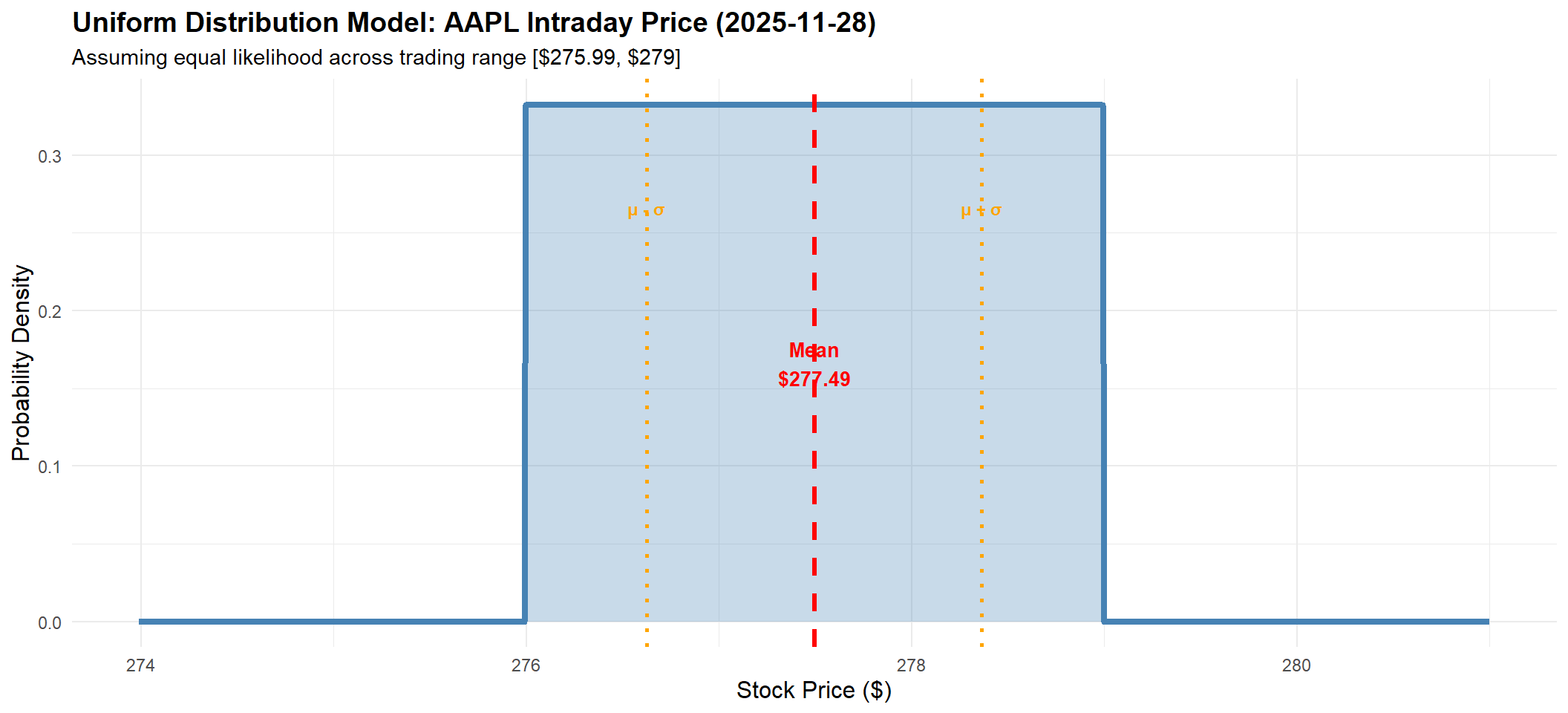
Context: An investor holds a tech stock (AAPL - Apple Inc.) for a short trading period. We analyze the intraday price range to model uncertainty using the uniform distribution.

Key Questions:

  • What is the expected (average) price during the trading window?

  • What is the price variability (standard deviation)?

  • What is the probability the price falls within a target range?

๐Ÿ“Š Data Source

We analyze Apple Inc. (AAPL) daily trading data from the last 30 trading days.

Source: Yahoo Finance API (via quantmod R package)

Period: Last 30 trading days from today

Data Quality: High-frequency market data (OHLC - Open, High, Low, Close)

Verification: Cross-checked with NASDAQ official records

๐Ÿ’ฐ Case Study: Data Analysis & Uniform Modeling

Code
# Load required libraries
library(quantmod)
library(dplyr)
library(lubridate)

# Fetch AAPL data (last 30 days)
getSymbols("AAPL", src = "yahoo", 
           from = Sys.Date() - 40, 
           to = Sys.Date(), auto.assign = TRUE)
[1] "AAPL"
Code
# Extract data
aapl_data <- as.data.frame(AAPL)
aapl_data$Date <- as.Date(rownames(aapl_data))

# Focus on most recent day
recent_day <- tail(aapl_data, 1)

# Extract High and Low (range)
low_price <- as.numeric(recent_day$AAPL.Low)
high_price <- as.numeric(recent_day$AAPL.High)

cat("Recent Trading Day Analysis\n")
Recent Trading Day Analysis
Code
cat("============================\n")
============================
Code
cat("Date:", format(recent_day$Date, "%Y-%m-%d"), "\n")
Date: 2025-11-28 
Code
cat("Low Price: $", round(low_price, 2), "\n")
Low Price: $ 275.99 
Code
cat("High Price: $", round(high_price, 2), "\n")
High Price: $ 279 
Code
# Model as Uniform(low, high)
# Calculate mean and variance
mean_price <- (low_price + high_price) / 2
var_price <- (high_price - low_price)^2 / 12
sd_price <- sqrt(var_price)

cat("\nUniform Distribution Model\n")

Uniform Distribution Model
Code
cat("===========================\n")
===========================
Code
cat("Y ~ Uniform(", round(low_price, 2), 
    ", ", round(high_price, 2), ")\n\n", sep = "")
Y ~ Uniform(275.99, 279)
Code
cat("Expected Price (ฮผ): $", 
    round(mean_price, 2), "\n")
Expected Price (ฮผ): $ 277.49 
Code
cat("Variance (ฯƒยฒ): ", 
    round(var_price, 2), "\n")
Variance (ฯƒยฒ):  0.76 
Code
cat("Std Deviation (ฯƒ): $", 
    round(sd_price, 2), "\n\n")
Std Deviation (ฯƒ): $ 0.87 
Code
# Probability within 1 std dev of mean
lower_bound <- mean_price - sd_price
upper_bound <- mean_price + sd_price
prob_within_1sd <- (upper_bound - lower_bound) / 
                   (high_price - low_price)

cat("P(ฮผ - ฯƒ โ‰ค Y โ‰ค ฮผ + ฯƒ) = ", 
    round(prob_within_1sd, 4), "\n")
P(ฮผ - ฯƒ โ‰ค Y โ‰ค ฮผ + ฯƒ) =  0.5774 

๐Ÿ’ฐ Case Study: Visualization

Code
library(ggplot2)

# Create data for uniform PDF
x_vals <- seq(low_price - 2, high_price + 2, length.out = 1000)
density_vals <- ifelse(x_vals >= low_price & x_vals <= high_price, 
                       1/(high_price - low_price), 0)
plot_data <- data.frame(x = x_vals, density = density_vals)

# Create plot
ggplot(plot_data, aes(x = x, y = density)) +
  geom_area(fill = "steelblue", alpha = 0.3) +
  geom_line(color = "steelblue", size = 1.5) +
  geom_vline(xintercept = mean_price, color = "red", linetype = "dashed", size = 1.2) +
  geom_vline(xintercept = c(lower_bound, upper_bound), 
             color = "orange", linetype = "dotted", size = 1) +
  annotate("text", x = mean_price, y = max(density_vals) * 0.5, 
           label = paste0("Mean\n$", round(mean_price, 2)), 
           color = "red", fontface = "bold", size = 3.5) +
  annotate("text", x = lower_bound, y = max(density_vals) * 0.8, 
           label = paste0("ฮผ - ฯƒ"), color = "orange", fontface = "bold", size = 3) +
  annotate("text", x = upper_bound, y = max(density_vals) * 0.8, 
           label = paste0("ฮผ + ฯƒ"), color = "orange", fontface = "bold", size = 3) +
  labs(title = paste0("Uniform Distribution Model: AAPL Intraday Price (", 
                      format(recent_day$Date, "%Y-%m-%d"), ")"),
       subtitle = paste0("Assuming equal likelihood across trading range [$", 
                        round(low_price, 2), ", $", round(high_price, 2), "]"),
       x = "Stock Price ($)", y = "Probability Density") +
  theme_minimal() +
  theme(plot.title = element_text(face = "bold", size = 14),
        plot.subtitle = element_text(size = 11),
        axis.title = element_text(size = 12))

๐Ÿ’ฐ Case Study: Financial Interpretation

Key Insights from AAPL Data:

  • Uniform Assumption: The model assumes equal likelihood for all prices within the dayโ€™s range โ€“ a simplification suitable for short-term uncertainty analysis

  • Expected Price: The mean \(\mu = \frac{\theta_1 + \theta_2}{2}\) represents the midpoint of the trading range, serving as a central estimate

  • Price Volatility: The standard deviation \(\sigma = \frac{\theta_2 - \theta_1}{2\sqrt{3}} \approx 0.289 \times (\text{Range})\) quantifies intraday price variability

  • Probability Calculations: For any target price range \([a, b]\) within the dayโ€™s range, probability is simply \(P(a \leq Y \leq b) = \frac{b - a}{\theta_2 - \theta_1}\)

Limitations:

  • Real intraday prices are NOT uniformly distributed (they follow complex patterns)

  • This model is most appropriate when we have minimal information beyond the range

  • More sophisticated models (e.g., log-normal, jump-diffusion) are used for rigorous financial modeling

๐Ÿ“ Quiz #1: Expected Value Definition

What is the correct formula for the expected value of a continuous random variable \(Y\) with density \(f(y)\)?

  • \(E(Y) = \int_{-\infty}^{\infty} yf(y) \, dy\)
  • \(E(Y) = \int_{-\infty}^{\infty} f(y) \, dy\)
  • \(E(Y) = \sum y f(y)\)
  • \(E(Y) = \int_{-\infty}^{\infty} y^2 f(y) \, dy\)

๐Ÿ“ Quiz #2: Uniform Distribution Parameters

For a uniform distribution on the interval \([3, 9]\), what is the value of the probability density function within the interval?

  • \(f(y) = \frac{1}{6}\)
  • \(f(y) = \frac{1}{3}\)
  • \(f(y) = \frac{1}{9}\)
  • \(f(y) = 6\)

๐Ÿ“ Quiz #3: Mean of Uniform Distribution

A random variable \(Y\) follows a uniform distribution on \([10, 30]\). What is \(E(Y)\)?

  • \(E(Y) = 20\)
  • \(E(Y) = 10\)
  • \(E(Y) = 15\)
  • \(E(Y) = 25\)

๐Ÿ“ Quiz #4: Variance Formula

Which formula correctly expresses the variance of a random variable \(Y\)?

  • \(V(Y) = E(Y^2) - [E(Y)]^2\)
  • \(V(Y) = E(Y)^2 - E(Y^2)\)
  • \(V(Y) = E(Y^2) + [E(Y)]^2\)
  • \(V(Y) = [E(Y)]^2\)

๐Ÿ“ Quiz #5: Uniform Distribution Probability

For \(Y \sim \text{Uniform}(0, 10)\), what is \(P(3 \leq Y \leq 7)\)?

  • \(P(3 \leq Y \leq 7) = 0.4\)
  • \(P(3 \leq Y \leq 7) = 0.3\)
  • \(P(3 \leq Y \leq 7) = 0.5\)
  • \(P(3 \leq Y \leq 7) = 0.7\)

๐Ÿ“ Summary

โœ… Key Takeaways

  • Expected values for continuous random variables are computed using integration: \(E(Y) = \int yf(y)dy\), with linearity properties enabling efficient calculation of means and variances

  • Expectation of functions \(E[g(Y)]\) can be computed directly from the original density without deriving the distribution of \(g(Y)\)

  • The uniform distribution \(Y \sim \text{Uniform}(\theta_1, \theta_2)\) has constant density \(\frac{1}{\theta_2 - \theta_1}\) over its interval, representing complete uncertainty

  • Mean and variance of uniform distribution are \(\mu = \frac{\theta_1 + \theta_2}{2}\) (midpoint) and \(\sigma^2 = \frac{(\theta_2 - \theta_1)^2}{12}\)

  • Poisson conditioning: When exactly one event occurs in a Poisson process over \((0, t)\), the occurrence time is uniformly distributed on \((0, t)\)

  • Financial applications include modeling price ranges, arrival times in service operations, and scenarios with equal likelihood across an interval

๐Ÿ“š Practice Problems

๐Ÿ“ Homework Problems

Problem 1 (Variance Derivation): Complete the derivation of \(V(Y) = \frac{(\theta_2 - \theta_1)^2}{12}\) for the uniform distribution. Show all algebraic steps clearly.

Problem 2 (Investment Analysis): A commodity price is uniformly distributed between \(\$80\) and \(\$120\). Find: (a) the expected price, (b) the probability the price exceeds \(\$100\), and (c) the standard deviation of the price.

Problem 3 (Expectation Computation): Let \(Y\) have density \(f(y) = 2y\) for \(0 \leq y \leq 1\). Find \(E(Y)\), \(E(Y^2)\), and \(V(Y)\).

Problem 4 (Poisson Application): During a 2-hour period, exactly 3 customers arrived at a bank following a Poisson process. What is the probability that all 3 arrivals occurred in the first hour? (Hint: Use properties of uniform distribution conditioning.)

Problem 5 (Function of Random Variable): For \(Y \sim \text{Uniform}(0, 1)\), find \(E(Y^3)\) and \(E(e^Y)\).

๐Ÿ‘‹ Thank You!

๐Ÿ“ฌ Contact Information:

Samir Orujov
Assistant Professor
School of Business
ADA University

๐Ÿ“ง Email: sorujov@ada.edu.az
๐Ÿข Office: D312
โฐ Office Hours: By appointment

๐Ÿ“… Next Class:

Topic: Normal Distribution and Properties

Reading: Chapter on Normal Distribution in textbook

Preparation: Review integration techniques and standard normal tables

โฐ Reminders:

โœ… Complete practice problems (due next class)

โœ… Review uniform distribution formulas

โœ… Work hard and stay curious!

โ“ Questions?

๐Ÿ’ฌ Open Discussion

Discussion Topics:

  • How do we know when the expected value integral converges?

  • What other real-world scenarios can be modeled with the uniform distribution?

  • How does the uniform distribution relate to other continuous distributions weโ€™ll study?

  • What are the limitations of assuming uniform distribution in financial modeling?

  • How can we extend these concepts to multivariate continuous random variables?