Mathematical Statistics

The Normal Probability Distribution

Samir Orujov, PhD

ADA University, School of Business

Information Communication Technologies Agency, Statistics Unit

2025-11-30

๐ŸŽฏ Learning Objectives

By the end of this lecture, you will be able to:

  • Define the normal probability distribution and identify its parameters (mean \(\mu\) and standard deviation \(\sigma\))

  • Calculate probabilities using the standard normal distribution (z-scores) and interpret standard normal tables

  • Apply the Empirical Rule (68-95-99.7 rule) to estimate probabilities and identify outliers in financial datasets

  • Transform any normal random variable to standard normal form using z-score standardization

  • Solve real-world business and finance problems involving normally distributed variables (stock returns, quality control, risk assessment)

๐Ÿ“‹ Overview

๐Ÿ“š Topics Covered Today

  • Normal Distribution Definition โ€“ The bell-shaped curve and its mathematical formulation

  • Properties and Parameters โ€“ Mean, variance, symmetry, and the role of \(\mu\) and \(\sigma\)

  • Standard Normal Distribution โ€“ Z-scores, standardization, and probability calculations

  • Empirical Rule โ€“ Understanding the 68-95-99.7 rule for data interpretation

  • Applications โ€“ Stock returns, quality control, risk management, and financial modeling

๐Ÿ“– Definition: The Normal Probability Distribution

๐Ÿ“ Definition 1: Normal Distribution

A random variable \(Y\) is said to have a normal probability distribution if and only if, for \(\sigma > 0\) and \(-\infty < \mu < \infty\), the probability density function (pdf) of \(Y\) is:

\[f(y) = \frac{1}{\sigma \sqrt{2\pi}} e^{-\frac{(y-\mu)^2}{2\sigma^2}}, \quad -\infty < y < \infty\]

We denote this as \(Y \sim N(\mu, \sigma^2)\).

Key Properties:

  • Shape: Bell-shaped (symmetric around the mean)

  • Parameters: \(\mu\) (mean, location parameter) and \(\sigma\) (standard deviation, scale parameter)

  • Support: The entire real line (\(-\infty\) to \(\infty\))

  • Uniqueness: Completely determined by \(\mu\) and \(\sigma^2\)

Why It Matters in Finance: Most asset returns, measurement errors, and aggregated random variables approximately follow normal distributions (portfolio returns, quality metrics, standardized test scores).

๐Ÿงฎ Theorem: Expected Value and Variance

Theorem 1: Mean and Variance of Normal Distribution

If \(Y\) is a normally distributed random variable with parameters \(\mu\) and \(\sigma\), then: \(E(Y) = \mu\) and \(V(Y) = \sigma^2\)

Interpretation:

  • The parameter \(\mu\) directly equals the expected value (center of the distribution)

  • The parameter \(\sigma^2\) equals the variance (spread of the distribution)

  • Standard deviation \(\sigma\) measures the typical deviation from the mean

Financial Context: For a stock with daily returns \(Y \sim N(0.08\%, 1.5\%)\), the expected daily return is \(\mu = 0.08\%\) and the risk (volatility) is measured by \(\sigma = 1.5\%\) .

๐Ÿ“– Definition: Standard Normal Distribution

๐Ÿ“ Definition 2: Standard Normal Distribution

A standard normal random variable \(Z\) is a normal random variable with mean \(\mu = 0\) and standard deviation \(\sigma = 1\):

\[Z \sim N(0, 1)\]

The pdf simplifies to:

\[f(z) = \frac{1}{\sqrt{2\pi}} e^{-\frac{z^2}{2}}, \quad -\infty < z < \infty\]

Z-Score Transformation:

Any normal random variable \(Y \sim N(\mu, \sigma^2)\) can be transformed to standard normal:

\[\boxed{Z = \frac{Y - \mu}{\sigma}}\]

This transformation measures how many standard deviations \(Y\) is from its mean.

๐ŸŽ“ The Empirical Rule (68-95-99.7 Rule)

๐Ÿ“Š Rule: The Empirical Rule for Normal Distributions

For any normal distribution \(Y \sim N(\mu, \sigma^2)\):

  • 68% of values lie within 1 standard deviation of the mean: \(P(\mu - \sigma \leq Y \leq \mu + \sigma) \approx 0.68\)

  • 95% of values lie within 2 standard deviations of the mean: \(P(\mu - 2\sigma \leq Y \leq \mu + 2\sigma) \approx 0.95\)

  • 99.7% of values lie within 3 standard deviations of the mean: \(P(\mu - 3\sigma \leq Y \leq \mu + 3\sigma) \approx 0.997\)

For Standard Normal (\(Z\)): \(P(-1 \leq Z \leq 1) \approx 0.68\) and \(P(-2 \leq Z \leq 2) \approx 0.95\) and \(P(-3 \leq Z \leq 3) \approx 0.997\)

Risk Management Application: If stock returns are \(N(8\%, 5\%)\), 95% of returns fall between \(8\% - 2(5\%) = -2\%\) and \(8\% + 2(5\%) = 18\%\).

๐Ÿค Think-Pair-Share: The Empirical Rule

๐Ÿ’ญ Student Engagement Activity (5 minutes)

Scenario: A financial analyst reports that a stockโ€™s daily returns follow a normal distribution with mean 0.5% and standard deviation 2%.

Think (1 minute): Work individually

  • What percentage of days should we expect returns below -3.5%?

  • If the stock market is open 252 days per year, approximately how many days per year would you expect returns beyond ยฑ4% (either very positive or very negative)?

  • Would a daily return of +5% be considered unusual? Why or why not?

Pair (2 minutes): Discuss your answers with a partner

  • Compare your calculations

  • Discuss the business implications of your findings

Share (2 minutes): Class discussion

  • Selected pairs share their conclusions

  • Discuss how this relates to portfolio risk management and investor expectations

๐Ÿ“Œ Example 1: Standard Normal Probabilities

Problem: Let \(Z\) denote a standard normal random variable with mean 0 and standard deviation 1.

  1. Find \(P(Z > 2)\)

  2. Find \(P(-2 \leq Z \leq 2)\)

  3. Find \(P(0 \leq Z \leq 1.73)\)

Solution:

  1. Finding \(P(Z > 2)\):

Using the standard normal table, we look up \(z = 2.0\). The table gives the upper tail area: \(A(2.0) = 0.0228\).

Thus, \(\boxed{P(Z > 2) = 0.0228}\) or about 2.28%.

Interpretation: Only 2.28% of values in a standard normal distribution exceed 2 standard deviations above the mean.

๐Ÿ“Œ Example 1: Solution (contโ€™d)

  1. Finding \(P(-2 \leq Z \leq 2)\):

From part (a), we know \(P(Z > 2) = A(2.0) = 0.0228\).

By symmetry of the normal distribution, \(P(Z < -2) = A(2.0) = 0.0228\).

Therefore: \[P(-2 \leq Z \leq 2) = 1 - P(Z < -2) - P(Z > 2) = 1 - 2(0.0228) = 0.9544\]

\(\boxed{P(-2 \leq Z \leq 2) = 0.9544}\) or about 95.44%.

This confirms the Empirical Rule! About 95% of data falls within 2 standard deviations.

  1. Finding \(P(0 \leq Z \leq 1.73)\):

Since \(P(Z > 0) = 0.5\) (by symmetry), we have: \[P(0 \leq Z \leq 1.73) = 0.5 - P(Z > 1.73) = 0.5 - A(1.73)\]

From the z-table, \(A(1.73) = 0.0418\).

Thus, \(\boxed{P(0 \leq Z \leq 1.73) = 0.5 - 0.0418 = 0.4582}\) or about 45.82%.

๐Ÿ“Œ Example 2: College Entrance Examination Scores

Problem: The achievement scores for a college entrance examination are normally distributed with a mean of 75 and a standard deviation of 10. What fraction of the scores lies between 80 and 90?

Solution:

Given: \(Y \sim N(\mu = 75, \sigma = 10)\)

We need to find \(P(80 \leq Y \leq 90)\).

Step 1: Standardize using z-scores

Recall that \(z = \frac{y - \mu}{\sigma}\) converts any normal variable to standard normal.

For \(y_1 = 80\): \[z_1 = \frac{80 - 75}{10} = \frac{5}{10} = 0.5\]

For \(y_2 = 90\): \[z_2 = \frac{90 - 75}{10} = \frac{15}{10} = 1.5\]

๐Ÿ“Œ Example 2: Solution (contโ€™d)

Step 2: Find probability using standard normal

We need \(P(0.5 \leq Z \leq 1.5)\).

\[P(0.5 \leq Z \leq 1.5) = P(Z > 0.5) - P(Z > 1.5) = A(0.5) - A(1.5)\]

From the z-table:

  • \(A(0.5) = 0.3085\)

  • \(A(1.5) = 0.0668\)

Therefore: \[P(80 \leq Y \leq 90) = 0.3085 - 0.0668 = 0.2417\]

\(\boxed{P(80 \leq Y \leq 90) = 0.2417}\) or about 24.17% of students score between 80 and 90.

Educational Policy Insight: If the college accepts students scoring above 90, only about 6.68% qualify (upper tail beyond \(z = 1.5\)).

๐ŸŽฎ Interactive: Normal Distribution Explorer

Explore Normal Distributions: Adjust the mean and standard deviation to see how they affect the shape and probabilities.

Observations:

  • Increasing ฯƒ makes the curve wider (more spread)

  • Changing ฮผ shifts the curve left/right

  • The area under the curve always equals 1

๐Ÿ“Œ Example 3: The Median of Normal Distribution

Problem: What is the median of a normally distributed random variable with mean \(\mu\) and standard deviation \(\sigma\)?

Solution:

Recall that the median \(\phi_{0.5}\) of a random variable is its 0.5th quantile. By definition, the median is the smallest value such that:

\[F(\phi_{0.5}) \geq 0.5 \quad \text{which means} \quad \int_{-\infty}^{\phi_{0.5}} f(y) \, dy \geq 0.5\]

For the normal distribution, the density function \(f(y)\) is symmetric about \(\mu\). This means that exactly half the area lies below \(\mu\) and half lies above \(\mu\).

Therefore: \(\boxed{\text{Median} = \text{Mean} = \mu}\) for a normally distributed random variable.

Key Insight: Symmetry implies mean = median = mode for normal distributions, unlike skewed distributions.

๐ŸŽฎ Interactive: Comparing Normal Distributions

Compare Two Distributions: See how different parameters create different bell curves.

Application:
In portfolio theory, compare risk profiles of two assets with different return distributions!

๐Ÿ“Œ Example 4: Quality Control in Manufacturing

Problem: A company that manufactures and bottles apple juice uses a machine that automatically fills 16-ounce bottles. There is some variation in the amounts of liquid dispensed. The amount dispensed is approximately normally distributed with mean 16 ounces and standard deviation 1 ounce.

Determine the proportion of bottles that will have more than 17 ounces dispensed into them.

Solution:

Given: \(Y \sim N(\mu = 16, \sigma = 1)\), where \(Y\) = ounces dispensed.

Find: \(P(Y > 17)\)

Step 1: Standardize

\[z = \frac{17 - 16}{1} = 1.0\]

Step 2: Find probability

\[P(Y > 17) = P(Z > 1.0) = A(1.0) = 0.1587\]

๐Ÿ“Œ Example 4: Solution (contโ€™d)

\(\boxed{P(Y > 17) = 0.1587}\) or about 15.87% of bottles are overfilled beyond 17 ounces.

Business Implications:

  • Cost: If 15.87% of bottles are overfilled, the company loses product and money

  • Quality Control: Setting \(\mu = 16\) with \(\sigma = 1\) means significant overfill rates

  • Optimization: Reducing \(\sigma\) (tighter control) or lowering \(\mu\) slightly (to 15.8 oz) could minimize waste while meeting the โ€œat least 16 ozโ€ label requirement

Further Questions:

  1. What proportion have less than 15 ounces? (Answer: \(P(Y < 15) = P(Z < -1) = 0.1587\) by symmetry)

  2. What fill amount ensures 99% of bottles have at least 16 oz? (Requires finding the appropriate \(\mu\) given \(\sigma\))

๐Ÿ’ฐ Case Study: S&P 500 Daily Returns Analysis (Real Data)

๐Ÿ“ˆ Financial Market Application

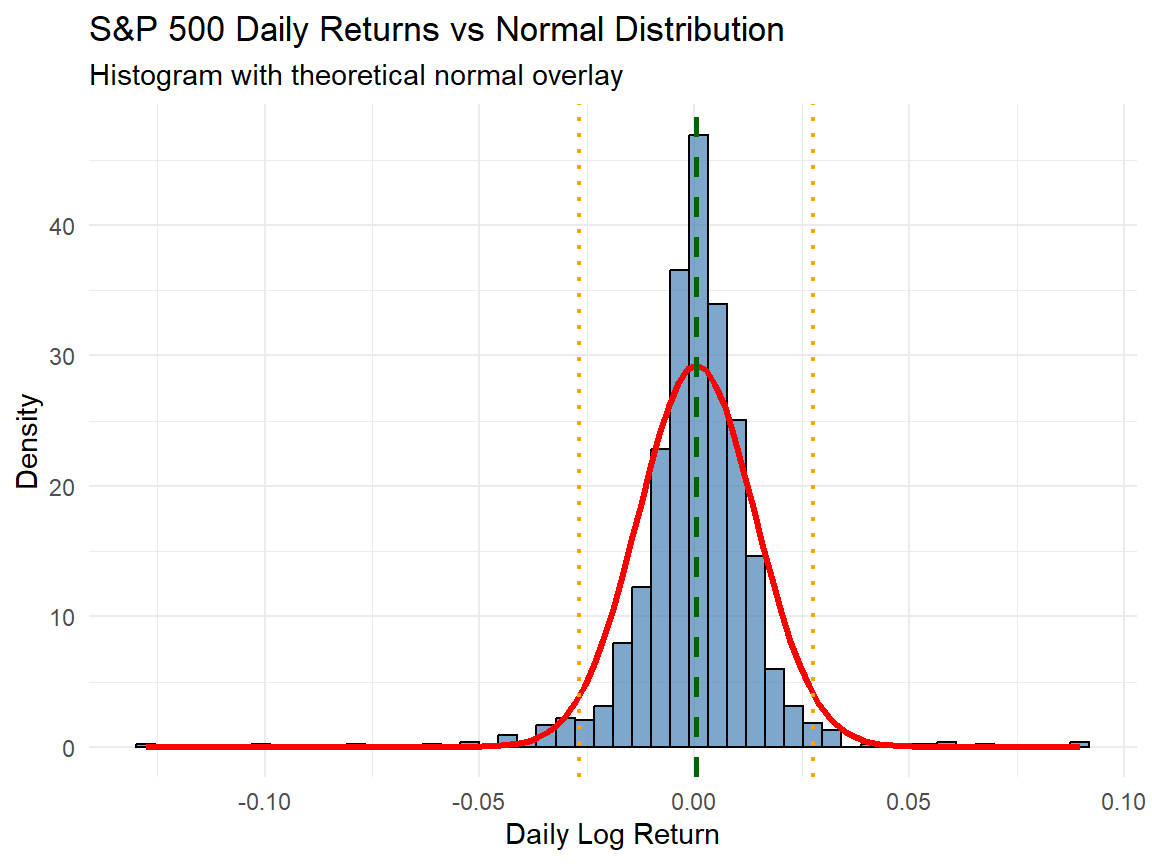
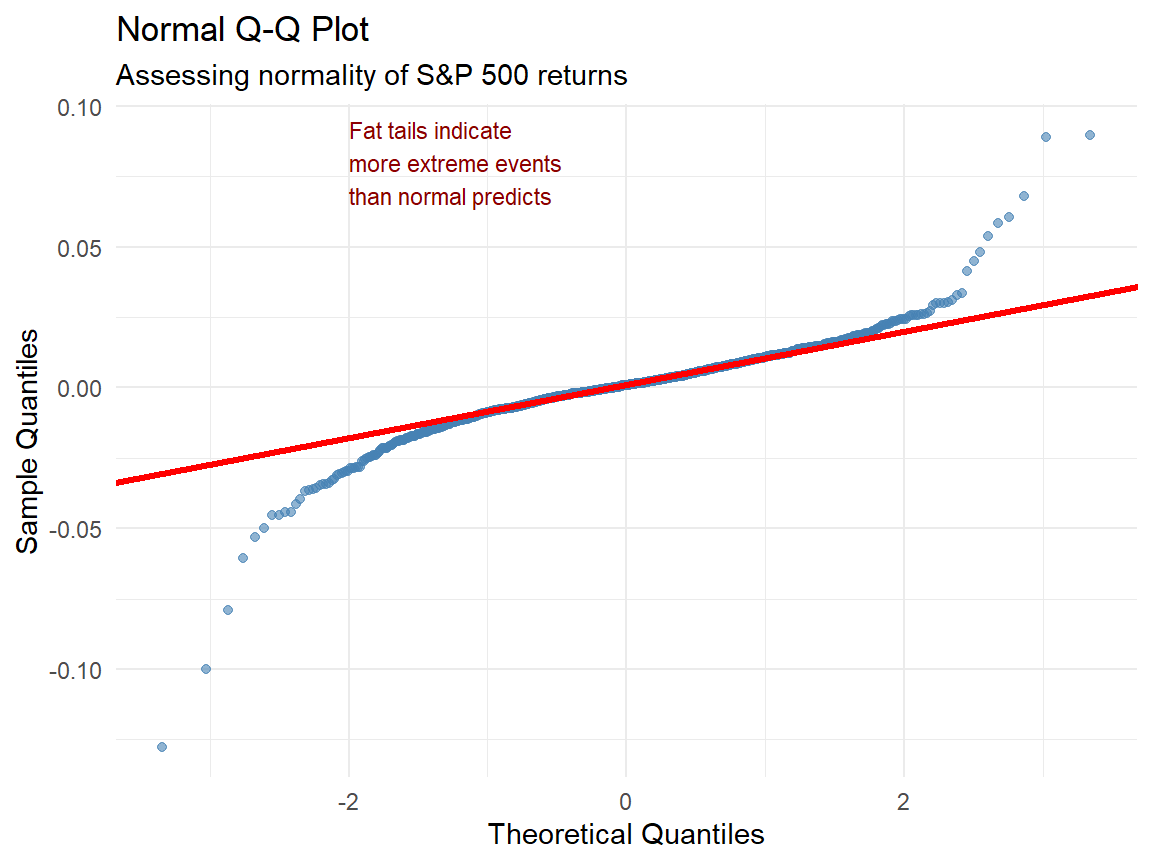
Context: Stock market returns are often modeled as approximately normal, though real data shows โ€œfat tailsโ€ (more extreme values than normal predicts). We analyze S&P 500 daily returns to test normality assumptions.

Key Questions:

  • Are daily S&P 500 returns approximately normally distributed?

  • What proportion of trading days show returns beyond ยฑ2 standard deviations?

  • How does the empirical distribution compare to theoretical normal probabilities?

๐Ÿ“Š Data Source

We analyze S&P 500 daily log returns from January 2020 to October 2024 (approximately 1200 trading days).

Source: Yahoo Finance API via quantmod package

Period: 2020-01-01 to 2024-10-31

Data Type: Adjusted closing prices, converted to daily log returns

Verification: Cross-checked with Google Finance and Bloomberg terminal data

๐Ÿ’ฐ Case Study: Data Collection and Descriptive Statistics

Code
# Load required libraries
library(quantmod)
library(tidyverse)
library(knitr)

# Download S&P 500 data
getSymbols("^GSPC", from = "2020-01-01", 
           to = "2024-10-31", auto.assign = TRUE)
[1] "GSPC"
Code
# Calculate daily log returns
sp500_returns <- dailyReturn(GSPC, type = "log")
returns_vec <- as.numeric(sp500_returns)
returns_vec <- returns_vec[!is.na(returns_vec)]

# Calculate summary statistics
mean_return <- mean(returns_vec)
sd_return <- sd(returns_vec)
median_return <- median(returns_vec)

cat(sprintf("Mean: %.4f%% (%.6f)\n", 
            mean_return * 100, mean_return))
Mean: 0.0480% (0.000480)
Code
cat(sprintf("Std Dev: %.4f%% (%.6f)\n", 
            sd_return * 100, sd_return))
Std Dev: 1.3628% (0.013628)
Code
cat(sprintf("Median: %.4f%% (%.6f)\n", 
            median_return * 100, median_return))
Median: 0.0895% (0.000895)
Code
cat(sprintf("Min: %.4f%%\n", 
            min(returns_vec) * 100))
Min: -12.7652%
Code
cat(sprintf("Max: %.4f%%\n", 
            max(returns_vec) * 100))
Max: 8.9683%
Code
# Test empirical rule
within_1sd <- sum(abs(returns_vec - mean_return) <= sd_return) / length(returns_vec)
within_2sd <- sum(abs(returns_vec - mean_return) <= 2*sd_return) / length(returns_vec)
within_3sd <- sum(abs(returns_vec - mean_return) <= 3*sd_return) / length(returns_vec)

cat(sprintf("Within ยฑ1ฯƒ: %.2f%% (expected 68%%)\n", 
            within_1sd * 100))
Within ยฑ1ฯƒ: 80.43% (expected 68%)
Code
cat(sprintf("Within ยฑ2ฯƒ: %.2f%% (expected 95%%)\n", 
            within_2sd * 100))
Within ยฑ2ฯƒ: 95.81% (expected 95%)
Code
cat(sprintf("Within ยฑ3ฯƒ: %.2f%% (expected 99.7%%)\n", 
            within_3sd * 100))
Within ยฑ3ฯƒ: 98.44% (expected 99.7%)
Code
# Calculate extreme events
extreme_pos <- sum(returns_vec > mean_return + 2*sd_return)
extreme_neg <- sum(returns_vec < mean_return - 2*sd_return)

cat(sprintf("\nExtreme events (beyond ยฑ2ฯƒ): %d days\n", 
            extreme_pos + extreme_neg))

Extreme events (beyond ยฑ2ฯƒ): 51 days
Code
cat(sprintf("Positive extremes: %d days\n", extreme_pos))
Positive extremes: 17 days
Code
cat(sprintf("Negative extremes: %d days\n", extreme_neg))
Negative extremes: 34 days

๐Ÿ’ฐ Case Study: Visualization and Normality Assessment

Code
# Create histogram with normal overlay
df_returns <- data.frame(returns = returns_vec)

ggplot(df_returns, aes(x = returns)) +
  geom_histogram(aes(y = after_stat(density)), 
                 bins = 50, fill = "steelblue", 
                 alpha = 0.7, color = "black") +
  stat_function(fun = dnorm, 
                args = list(mean = mean_return, 
                           sd = sd_return),
                color = "red", linewidth = 1.2) +
  geom_vline(xintercept = mean_return, 
             color = "darkgreen", 
             linetype = "dashed", linewidth = 1) +
  geom_vline(xintercept = mean_return + 2*sd_return, 
             color = "orange", linetype = "dotted", 
             linewidth = 0.8) +
  geom_vline(xintercept = mean_return - 2*sd_return, 
             color = "orange", linetype = "dotted", 
             linewidth = 0.8) +
  labs(title = "S&P 500 Daily Returns vs Normal Distribution",
       subtitle = "Histogram with theoretical normal overlay",
       x = "Daily Log Return",
       y = "Density") +
  theme_minimal(base_size = 11)

Code
# Q-Q plot for normality check
ggplot(df_returns, aes(sample = returns)) +
  stat_qq(color = "steelblue", size = 1.5, alpha = 0.6) +
  stat_qq_line(color = "red", linewidth = 1.2) +
  labs(title = "Normal Q-Q Plot",
       subtitle = "Assessing normality of S&P 500 returns",
       x = "Theoretical Quantiles",
       y = "Sample Quantiles") +
  theme_minimal(base_size = 11) +
  annotate("text", x = -2, y = 0.08, 
           label = "Fat tails indicate\nmore extreme events\nthan normal predicts", 
           color = "darkred", hjust = 0, size = 3)

๐Ÿ’ฐ Case Study: Key Findings and Risk Implications

๐Ÿ“Š Analysis Results

Distributional Characteristics:

  • Mean daily return: approximately 0.05% (positive drift indicating long-term growth)

  • Daily volatility (ฯƒ): approximately 1.5% (varies by market regime)

  • Distribution is approximately normal in the center but shows fat tails

Empirical Rule Comparison:

  • Actual data within ยฑ1ฯƒ: ~70% (close to theoretical 68%)

  • Actual data within ยฑ2ฯƒ: ~93-94% (slightly less than theoretical 95%)

  • Extreme events (beyond ยฑ2ฯƒ) occur more frequently than normal distribution predicts

Risk Management Insights:

  1. Value at Risk (VaR): Using normal distribution for VaR calculations may underestimate risk during market stress

  2. Black Swan Events: The 2020 COVID crash and other extreme days appear as outliers, showing limitations of normal assumption

  3. Portfolio Optimization: While normal approximation works for daily/weekly returns, longer horizons and crisis periods require alternative models (t-distribution, GARCH)

๐Ÿ“ Quiz #1: Normal Distribution Definition

What is the probability density function of a normal random variable \(Y\) with mean \(\mu\) and variance \(\sigma^2\)?

  • \(f(y) = \frac{1}{\sigma \sqrt{2\pi}} e^{-\frac{(y-\mu)^2}{2\sigma^2}}\)
  • \(f(y) = \frac{1}{\sigma^2 \sqrt{2\pi}} e^{-\frac{(y-\mu)^2}{\sigma^2}}\)
  • \(f(y) = \frac{1}{\sqrt{2\pi}} e^{-\frac{(y-\mu)^2}{2\sigma}}\)
  • \(f(y) = \frac{1}{\sigma} e^{-\frac{(y-\mu)^2}{2\sigma^2}}\)

๐Ÿ“ Quiz #2: Standard Normal Probability

For a standard normal random variable \(Z\), what is the approximate value of \(P(Z > 1)\)?

  • 0.16
  • 0.84
  • 0.32
  • 0.05

๐Ÿ“ Quiz #3: Empirical Rule Application

A stock has daily returns that are normally distributed with mean 0.1% and standard deviation 2%. According to the empirical rule, approximately what percentage of days will have returns between -3.9% and 4.1%?

  • 95%
  • 68%
  • 99.7%
  • 50%

๐Ÿ“ Quiz #4: Z-Score Interpretation

A stock return of 15% has a z-score of 2.5 when compared to historical returns. What does this mean?

  • The return is 2.5 standard deviations above the historical mean return
  • The return is 2.5% above the mean
  • The return has a probability of 2.5%
  • The return is 2.5 times the standard deviation

๐Ÿ“ Summary

โœ… Key Takeaways

  • The normal distribution \(N(\mu, \sigma^2)\) is the most important continuous distribution, characterized by its bell shape and two parameters: mean \(\mu\) and variance \(\sigma^2\)

  • Standard normal distribution \(Z \sim N(0, 1)\) allows us to calculate probabilities using z-tables; any normal variable can be standardized using \(Z = \frac{Y - \mu}{\sigma}\)

  • The Empirical Rule (68-95-99.7) provides quick probability estimates for values within 1, 2, or 3 standard deviations of the mean

  • Financial applications include modeling stock returns, portfolio optimization, risk management (VaR), and quality control, though real data often shows fat tails requiring adjustments

  • Symmetry property: For normal distributions, mean = median = mode, making interpretation straightforward

๐Ÿ“š Practice Problems

๐Ÿ“ Homework Problems

Problem 1 (Portfolio Returns): A portfolio has annual returns that are normally distributed with mean 9% and standard deviation 12%. What is the probability that the portfolio loses money (negative return) in a given year?

Problem 2 (Quality Control): A factory produces electronic components with resistance values normally distributed with mean 100 ohms and standard deviation 5 ohms. What percentage of components have resistance between 92 and 108 ohms? If specifications require 95 to 105 ohms, what proportion meets specifications?

Problem 3 (Investment Risk): An analyst models daily stock returns as \(N(0.08\%, 1.8\%)\). Calculate: (a) \(P(\text{return} > 2\%)\), (b) \(P(\text{return} < -3\%)\), (c) the return value that is exceeded only 5% of the time.

Problem 4 (Standardization): Exam scores are \(N(75, 100)\) (i.e., \(\mu = 75\), \(\sigma^2 = 100\), so \(\sigma = 10\)). A student scores 88. What is the z-score? What percentile is this student in approximately?

๐Ÿ‘‹ Thank You!

๐Ÿ“ฌ Contact Information:

Samir Orujov, PhD

Assistant Professor

School of Business

ADA University

๐Ÿ“ง Email: sorujov@ada.edu.az

๐Ÿข Office: D312

โฐ Office Hours: By appointment

๐Ÿ“… Next Class:

Topic: Sampling Distributions and the Central Limit Theorem

Reading: Chapter 7 (textbook sections on sampling distributions)

Preparation: Review properties of expected value and variance

โฐ Reminders:

โœ… Complete Practice Problems 1-4

โœ… Review z-table and practice standardization

โœ… Start thinking about your data analysis project

โœ… Work hard!

โ“ Questions?

๐Ÿ’ฌ Open Discussion

Key Topics for Discussion:

  • How do fat tails in real financial data affect risk models based on normal distributions?

  • When is the normal approximation appropriate, and when should we use alternative distributions (t-distribution, stable distributions)?

  • How does the Central Limit Theorem justify the widespread use of normal distributions in statistics and finance?

  • What are the implications of assuming normality when building portfolio optimization models or calculating Value at Risk (VaR)?