Mathematical Statistics

Bivariate and Multivariate Probability Distributions

Samir Orujov, PhD

ADA University, School of Business

Information Communication Technologies Agency, Statistics Unit

2026-02-22

๐ŸŽฏ Learning Objectives

๐Ÿ“š By the end of this lecture, you will be able to:

  • Define and interpret joint probability functions for discrete bivariate random variables and verify their properties

  • Compute joint probability density functions for continuous bivariate random variables and calculate probabilities over specified regions

  • Derive marginal probability distributions from joint distributions using summation (discrete) or integration (continuous)

  • Visualize bivariate distributions using 3D surfaces, contour plots, and understand geometric interpretations

  • Apply multivariate distribution concepts to portfolio analysis and financial risk assessment using real market data

๐Ÿ“ฑ Attendance Check-in

๐Ÿ“‹ Overview

๐Ÿ“š Topics Covered Today

  • Introduction to Multivariate Distributions โ€“ Why study joint distributions? Applications in finance and economics

  • Joint Probability Functions (Discrete) โ€“ Definition, properties, and examples with probability tables

  • Joint Probability Density Functions (Continuous) โ€“ Definition, properties, and integration over regions

  • Marginal Distributions โ€“ Extracting individual variable distributions from joint distributions

  • Case Study โ€“ Portfolio returns analysis using real stock market data

๐Ÿ“– Why Study Multivariate Distributions?

๐ŸŽฏ Motivation

In the real world, random variables rarely occur in isolation. We often need to study relationships between multiple random variables:

Finance Applications:

  • Portfolio returns (multiple stocks)
  • Risk factors affecting asset prices
  • Interest rates and inflation
  • Credit risk and market risk

Other Applications:

  • Height and weight of individuals
  • Temperature and humidity
  • Supply and demand quantities
  • Test scores across subjects

๐Ÿ“– Definition: Joint Probability Function (Discrete)

๐Ÿ“ Definition 5.1: Bivariate Probability Function

Let \(Y_1\) and \(Y_2\) be discrete random variables. The joint (bivariate) probability function for \(Y_1\) and \(Y_2\) is:

\[p(y_1, y_2) = P(Y_1 = y_1, Y_2 = y_2)\]

for all pairs \((y_1, y_2)\) in the joint sample space.

Interpretation: \(p(y_1, y_2)\) gives the probability that \(Y_1\) takes value \(y_1\) and \(Y_2\) takes value \(y_2\) simultaneously.

Notation: We write \((Y_1, Y_2)\) to denote a bivariate random variable (or random vector) consisting of two components.

๐Ÿงฎ Theorem: Properties of Joint Probability Functions

Theorem 5.1: Properties of Joint Probability Functions

For any joint probability function \(p(y_1, y_2)\):

Property 1 (Non-negativity): \[p(y_1, y_2) \geq 0 \quad \text{for all } (y_1, y_2)\]

Property 2 (Normalization): \[\sum_{y_1} \sum_{y_2} p(y_1, y_2) = 1\]

The double sum is taken over all possible pairs \((y_1, y_2)\) in the sample space.

Intuition: Probabilities must be non-negative and sum to 1 across all possible outcomesโ€”the same principles as univariate distributions, extended to pairs!

๐Ÿ“Œ Example 1: Dice Tossing Experiment

Problem: Consider tossing two fair dice. Let \(Y_1\) = value on die 1 and \(Y_2\) = value on die 2. Find the joint probability function.

Solution:

Since each die has 6 faces and the tosses are independent:

\[p(y_1, y_2) = P(Y_1 = y_1) \cdot P(Y_2 = y_2) = \frac{1}{6} \cdot \frac{1}{6} = \frac{1}{36}\]

for all \(y_1, y_2 \in \{1, 2, 3, 4, 5, 6\}\).

Sample Space: 36 equally likely outcomes

\((1,1), (1,2), \ldots, (6,6)\)

Verification: \[\sum_{y_1=1}^{6} \sum_{y_2=1}^{6} \frac{1}{36} = 36 \cdot \frac{1}{36} = 1 \checkmark\]

๐Ÿ“Œ Example 2: Committee Selection (Discrete)

Problem: A committee of 3 is selected at random from 4 Republicans and 3 Democrats. Let \(Y_1\) = number of Republicans and \(Y_2\) = number of Democrats selected.

Solution:

The joint probability function is:

\[p(y_1, y_2) = \frac{\binom{4}{y_1} \binom{3}{y_2}}{\binom{7}{3}}\]

where \(y_1 + y_2 = 3\), \(y_1 \in \{0, 1, 2, 3\}\), \(y_2 \in \{0, 1, 2, 3\}\).

Joint Probability Table:

\(y_1 \backslash y_2\) 0 1 2 3
0 0 0 0 \(\frac{1}{35}\)
1 0 0 \(\frac{12}{35}\) 0
2 0 \(\frac{18}{35}\) 0 0
3 \(\frac{4}{35}\) 0 0 0

Note: Only cells where \(y_1 + y_2 = 3\) have non-zero probabilities.

๐Ÿ“– Definition: Joint Distribution Function

๐Ÿ“ Definition 5.2: Joint Distribution Function (CDF)

The joint distribution function (or joint CDF) for random variables \(Y_1\) and \(Y_2\) is:

\[F(y_1, y_2) = P(Y_1 \leq y_1, Y_2 \leq y_2)\]

for \(-\infty < y_1 < \infty\) and \(-\infty < y_2 < \infty\).

Interpretation: \(F(y_1, y_2)\) gives the probability that \(Y_1\) is at most \(y_1\) and \(Y_2\) is at most \(y_2\).

๐Ÿ“ Geometric Interpretation of Joint CDF

๐Ÿ“ The โ€œSouthwest Rectangleโ€

\(F(y_1, y_2)\) represents the probability accumulated in the rectangular region from \((-\infty, -\infty)\) to \((y_1, y_2)\).

For Discrete Variables:

Sum all probabilities where \(y_1' \leq y_1\) and \(y_2' \leq y_2\):

\[F(y_1, y_2) = \sum_{y_1' \leq y_1} \sum_{y_2' \leq y_2} p(y_1', y_2')\]

For Continuous Variables:

Integrate the joint pdf from \(-\infty\) to \((y_1, y_2)\):

\[F(y_1, y_2) = \int_{-\infty}^{y_1} \int_{-\infty}^{y_2} f(t_1, t_2) \, dt_2 \, dt_1\]

๐Ÿ’ก Visual: The CDF at \((a, b)\) captures all probability mass in the quadrant below and to the left.

๐Ÿงฎ Theorem: Properties of Joint CDFs

Theorem 5.2: Properties of Bivariate CDFs

For any joint distribution function \(F(y_1, y_2)\):

  1. \(\lim_{y_1 \to -\infty} F(y_1, y_2) = \lim_{y_2 \to -\infty} F(y_1, y_2) = 0\)

  2. \(\lim_{y_1 \to \infty, y_2 \to \infty} F(y_1, y_2) = 1\)

  3. If \(y_1^* \geq y_1\) and \(y_2^* \geq y_2\), then \(F(y_1^*, y_2^*) \geq F(y_1, y_2)\) (non-decreasing)

  4. \(F(y_1, y_2)\) is right-continuous in each argument

Intuition: The CDF starts at 0, increases monotonically, and approaches 1 as both variables go to infinity.

๐Ÿ“– Definition: Joint Probability Density Function (Continuous)

๐Ÿ“ Definition 5.3: Joint Probability Density Function

Random variables \(Y_1\) and \(Y_2\) are said to be jointly continuous if their joint distribution function \(F(y_1, y_2)\) can be written as:

\[F(y_1, y_2) = \int_{-\infty}^{y_1} \int_{-\infty}^{y_2} f(t_1, t_2) \, dt_2 \, dt_1\]

for some non-negative function \(f(y_1, y_2)\) called the joint probability density function (pdf).

Key Relationship: \[f(y_1, y_2) = \frac{\partial^2 F(y_1, y_2)}{\partial y_1 \, \partial y_2}\]

where this derivative exists.

๐Ÿงฎ Theorem: Properties of Joint PDFs

Theorem 5.3: Properties of Joint Probability Density Functions

For any joint pdf \(f(y_1, y_2)\):

Property 1 (Non-negativity): \[f(y_1, y_2) \geq 0 \quad \text{for all } (y_1, y_2)\]

Property 2 (Normalization): \[\int_{-\infty}^{\infty} \int_{-\infty}^{\infty} f(y_1, y_2) \, dy_1 \, dy_2 = 1\]

Probability Calculation: \[P[(Y_1, Y_2) \in A] = \iint_A f(y_1, y_2) \, dy_1 \, dy_2\]

Geometric Interpretation: The volume under the surface \(z = f(y_1, y_2)\) over region \(A\) gives the probability.

๐Ÿ“Œ Example 3: Uniform Distribution on Unit Square

Problem: A radioactive particle is equally likely to land anywhere in a unit square. Let \((Y_1, Y_2)\) denote the landing coordinates. Find the joint pdf and \(P(Y_1 + Y_2 \leq 1)\).

Solution:

Since the particle is equally likely to land anywhere:

\[f(y_1, y_2) = \begin{cases} 1 & \text{if } 0 \leq y_1 \leq 1, \, 0 \leq y_2 \leq 1 \\ 0 & \text{otherwise} \end{cases}\]

Verification: \(\int_0^1 \int_0^1 1 \, dy_1 \, dy_2 = 1 \checkmark\)

Finding \(P(Y_1 + Y_2 \leq 1)\):

\[P(Y_1 + Y_2 \leq 1) = \int_0^1 \int_0^{1-y_1} 1 \, dy_2 \, dy_1 \] \[ = \int_0^1 (1 - y_1) \, dy_1 = \left[ y_1 - \frac{y_1^2}{2} \right]_0^1 = \frac{1}{2}\]

Geometric: This is the area of the triangle below the line \(y_1 + y_2 = 1\) within the unit square.

๐ŸŽฎ Interactive: Uniform Distribution on Unit Square

Integration Region โ€” Blue: yโ‚ + yโ‚‚ โ‰ค c

3D Surface โ€” Drag to rotate

๐Ÿ“Œ Example 4: Gasoline Tank Inventory

Problem: A firm stocks gasoline for sale. Let \(Y_1\) = amount stocked (in 1000s of gallons) at the start of the week, and \(Y_2\) = amount sold during the week. The joint pdf is:

\[f(y_1, y_2) = \begin{cases} 3y_1 & \text{if } 0 \leq y_2 \leq y_1 \leq 1 \\ 0 & \text{otherwise} \end{cases}\]

Find the probability that less than half of the inventory is sold.

Solution:

We need \(P(Y_2 < Y_1/2)\).

\[P\left(Y_2 < \frac{Y_1}{2}\right) = \int_0^1 \int_0^{y_1/2} 3y_1 \, dy_2 \, dy_1\]

Calculation:

\[= \int_0^1 3y_1 \cdot \frac{y_1}{2} \, dy_1 = \frac{3}{2} \int_0^1 y_1^2 \, dy_1\] \[= \frac{3}{2} \cdot \frac{1}{3} = \boxed{\frac{1}{2}}\]

Business Insight: Thereโ€™s a 50% chance of selling less than half the inventoryโ€”important for inventory planning!

๐ŸŽฎ Interactive: Bivariate Probability Surface

๐Ÿ“– Definition: Marginal Probability Distributions

๐Ÿ“ Definition 5.4: Marginal Distributions

Given a joint distribution of \((Y_1, Y_2)\), the marginal distributions describe each variableโ€™s distribution individually.

Discrete Case: \[p_1(y_1) = \sum_{y_2} p(y_1, y_2)\] \[p_2(y_2) = \sum_{y_1} p(y_1, y_2)\]

Continuous Case: \[f_1(y_1) = \int_{-\infty}^{\infty} f(y_1, y_2) \, dy_2\] \[f_2(y_2) = \int_{-\infty}^{\infty} f(y_1, y_2) \, dy_1\]

๐Ÿ’ก Intuition: To find the marginal of \(Y_1\), we โ€œaccumulateโ€ probabilities over all values of \(Y_2\).

๐Ÿ“Œ Example 5: Marginal Distributions (Discrete)

Problem: Find the marginal distributions of \(Y_1\) (Republicans) and \(Y_2\) (Democrats) from the committee selection.

Marginal of \(Y_1\) (sum rows):

\(y_1\) \(p_1(y_1)\)
0 \(\frac{1}{35}\)
1 \(\frac{12}{35}\)
2 \(\frac{18}{35}\)
3 \(\frac{4}{35}\)

Marginal of \(Y_2\) (sum columns):

\(y_2\) \(p_2(y_2)\)
0 \(\frac{4}{35}\)
1 \(\frac{18}{35}\)
2 \(\frac{12}{35}\)
3 \(\frac{1}{35}\)

โœ… Verification: \((1+12+18+4)/35 = 1\) โœ”๏ธ

๐Ÿ“Œ Example 6: Marginal Distributions (Continuous)

Problem: For \(f(y_1, y_2) = 3y_1\) where \(0 \leq y_2 \leq y_1 \leq 1\), find the marginals.

Marginal of \(Y_1\) (stocked):

\[f_1(y_1) = \int_0^{y_1} 3y_1 \, dy_2 = \boxed{3y_1^2}\]

for \(0 \leq y_1 \leq 1\)

โœ… \(\int_0^1 3y_1^2 \, dy_1 = 1\)

Marginal of \(Y_2\) (sold):

\[f_2(y_2) = \int_{y_2}^{1} 3y_1 \, dy_1 = \boxed{\frac{3}{2}(1 - y_2^2)}\]

for \(0 \leq y_2 \leq 1\)

Tip

๐Ÿ’ผ Business Insight: Marginal of sales helps understand demand patterns independently of inventory decisions!

๐Ÿค Think-Pair-Share: Investment Decision

๐Ÿ’ญ Activity (4 minutes)

Joint distribution for two assetsโ€™ annual returns:

\(Y_1 \backslash Y_2\) -5% 0% 10% 20%
-10% 0.05 0.05 0.02 0.00
5% 0.10 0.15 0.15 0.05
15% 0.03 0.10 0.20 0.10

๐Ÿง  Think (1 min):

  • Find marginal of \(Y_1\)
  • Find marginal of \(Y_2\)

๐Ÿ‘ซ Pair (2 min):

  • Which asset has higher E[return]?
  • Which is riskier?

๐Ÿ—ฃ๏ธ Share (1 min):

  • Why does joint distribution matter beyond marginals?

๐Ÿ’ฐ Case Study: Portfolio Returns Analysis

๐Ÿ“ˆ Financial Application

Context: Study joint distribution of asset returns for:

  • Diversification benefits
  • Portfolio risk assessment
  • Co-movement patterns

Key Questions:

  1. What does joint distribution look like?
  2. How do we extract marginals?
  3. What patterns emerge?

๐Ÿ“Š Data Source

Stocks: Apple (๐ŸŽ AAPL) & Microsoft (๐ŸŸฆ MSFT)

Source: Yahoo Finance API

Period: Last 252 trading days

Data: Daily log returns

\[r_t = \ln\left(\frac{P_t}{P_{t-1}}\right)\]

๐Ÿ’ฐ Case Study: Data Collection & Stats

๐Ÿ“ฆ Load Libraries & Fetch Data
# Load libraries
library(quantmod)
library(tidyverse)
library(knitr)
library(countdown)

# Get data
end_date <- Sys.Date()
start_date <- end_date - 365
getSymbols(c("AAPL", "MSFT"), from = start_date, to = end_date, auto.assign = TRUE)
[1] "AAPL" "MSFT"
๐Ÿ“ฆ Load Libraries & Fetch Data
# Calculate returns
aapl_returns <- dailyReturn(AAPL, type = "log")
msft_returns <- dailyReturn(MSFT, type = "log")

returns_df <- data.frame(
  Date = index(aapl_returns),
  AAPL = as.numeric(aapl_returns),
  MSFT = as.numeric(msft_returns)
) %>% na.omit()
๐ŸŽ APPLE (AAPL)
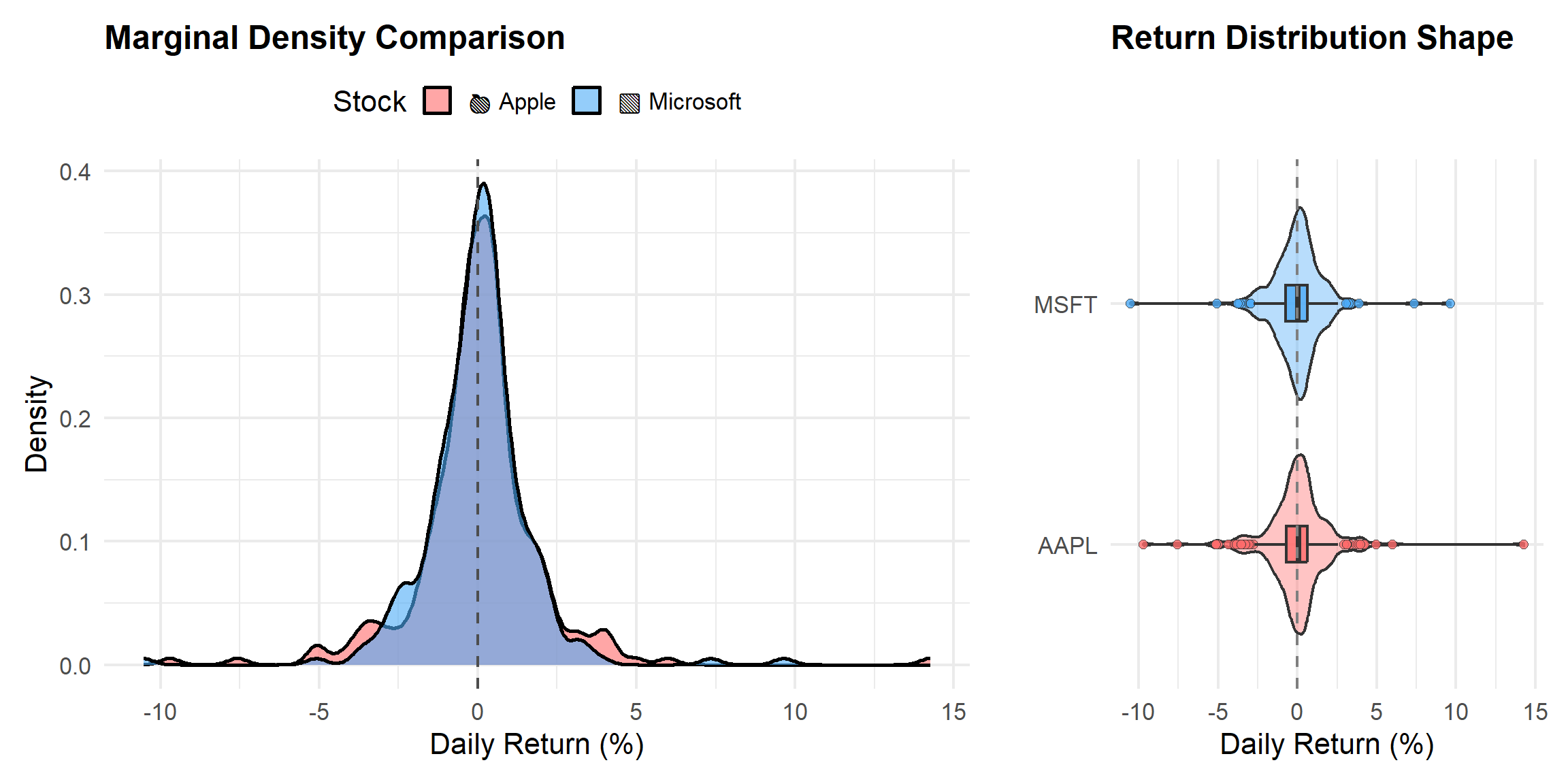
   Mean Return: +0.031%
   Volatility:  2.023%
   Min/Max:     -9.70% / +14.26%
๐ŸŸฆ MICROSOFT (MSFT)
   Mean Return: -0.011%
   Volatility:  1.662%
   Min/Max:     -10.53% / +9.65%
๐Ÿ”— RELATIONSHIP
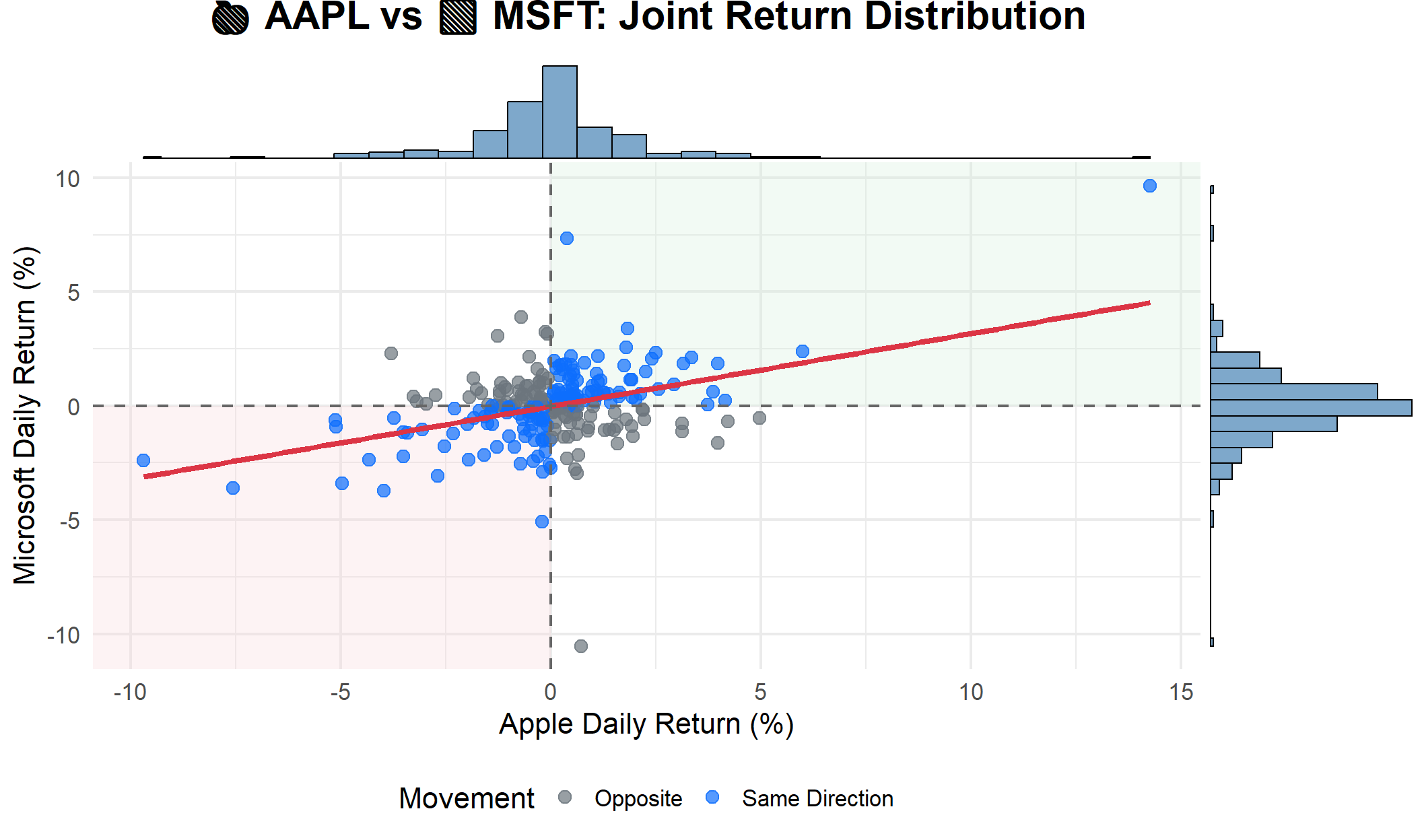
   Correlation: 0.3884
   Observations: 250 days
   Period: 2025-02-24 to 2026-02-20

๐Ÿ’ก INTERPRETATION:
   High correlation = stocks move together
   Limited diversification benefit

๐Ÿ’ฐ Case Study: Joint Distribution โ€” Scatter Plot

๐Ÿ“Š Show Scatter Plot Code
library(ggExtra)

# Main scatter plot with quadrant shading
p <- ggplot(returns_df, aes(x = AAPL * 100, y = MSFT * 100)) +
  # Add quadrant shading
  annotate("rect", xmin = 0, xmax = Inf, ymin = 0, ymax = Inf, 
           fill = "#d4edda", alpha = 0.3) +
  annotate("rect", xmin = -Inf, xmax = 0, ymin = -Inf, ymax = 0, 
           fill = "#f8d7da", alpha = 0.3) +
  geom_point(aes(color = (AAPL > 0 & MSFT > 0) | (AAPL < 0 & MSFT < 0)), 
             size = 3, alpha = 0.7) +
  scale_color_manual(values = c("#6c757d", "#0d6efd"), 
                     labels = c("Opposite", "Same Direction"),
                     name = "Movement") +
  geom_smooth(method = "lm", color = "#dc3545", linewidth = 1.5, se = FALSE) +
  geom_hline(yintercept = 0, linetype = "dashed", color = "gray40", linewidth = 0.8) +
  geom_vline(xintercept = 0, linetype = "dashed", color = "gray40", linewidth = 0.8) +
  labs(title = "๐ŸŽ AAPL vs ๐ŸŸฆ MSFT: Joint Return Distribution",
       x = "Apple Daily Return (%)", y = "Microsoft Daily Return (%)") +
  theme_minimal(base_size = 16) +
  theme(legend.position = "bottom",
        plot.title = element_text(size = 22, face = "bold", hjust = 0.5))

# Add marginal histograms using ggExtra
ggMarginal(p, type = "histogram", fill = "steelblue", alpha = 0.7, 
           xparams = list(bins = 30), yparams = list(bins = 30))

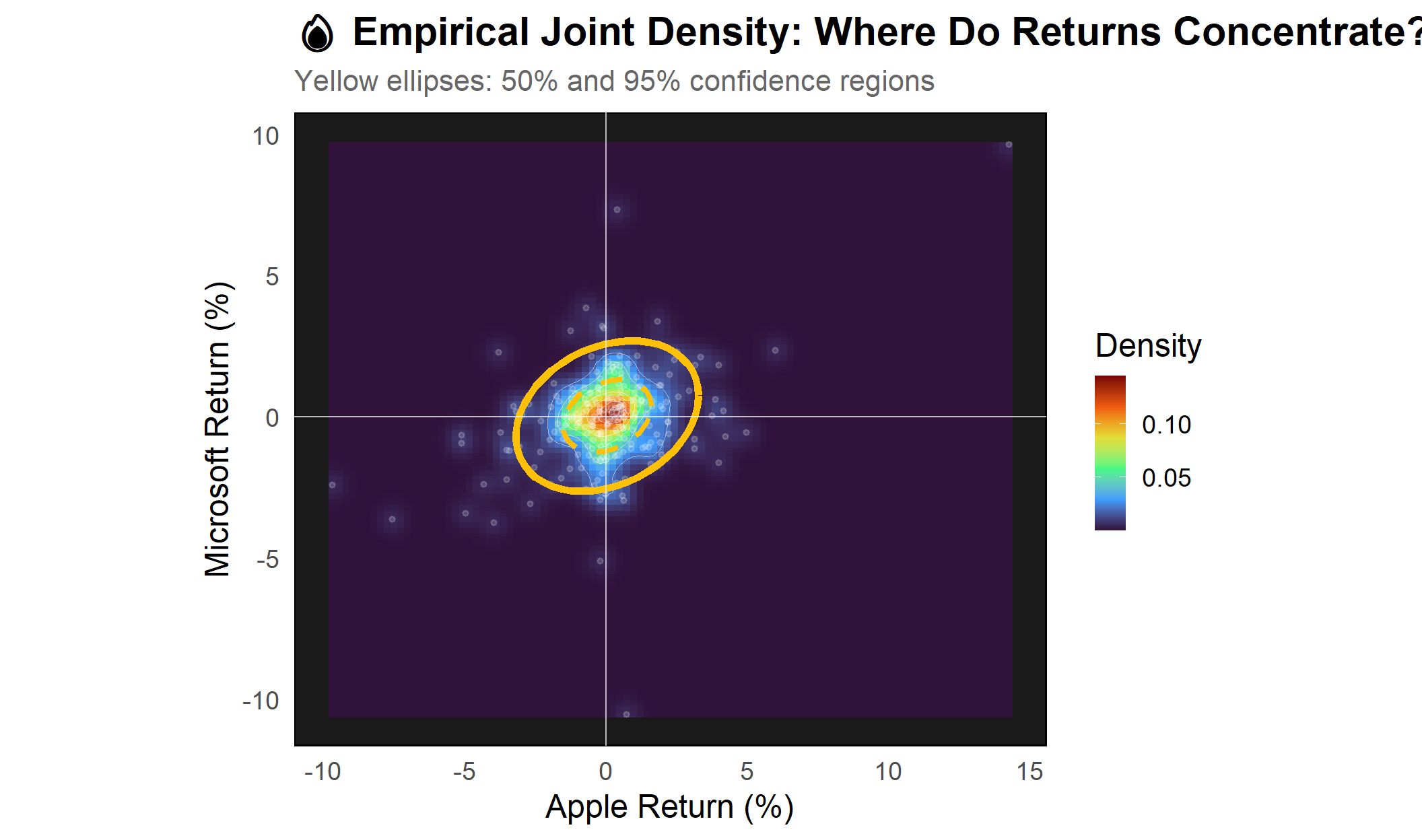
๐Ÿ’ฐ Case Study: Joint Density Heatmap

๐Ÿ”ฅ Show Heatmap Code
# Beautiful 2D density with contours
ggplot(returns_df, aes(x = AAPL * 100, y = MSFT * 100)) +
  stat_density_2d(aes(fill = after_stat(density)), 
                  geom = "raster", contour = FALSE) +
  stat_density_2d(color = "white", linewidth = 0.3, alpha = 0.5) +
  scale_fill_viridis_c(option = "turbo", name = "Density") +
  geom_point(alpha = 0.15, color = "white", size = 1) +
  # Add confidence ellipse
  stat_ellipse(level = 0.95, color = "#ffc107", linewidth = 2, linetype = "solid") +
  stat_ellipse(level = 0.50, color = "#ffc107", linewidth = 1.5, linetype = "dashed") +
  # Reference lines
  geom_hline(yintercept = 0, color = "white", linewidth = 0.5, alpha = 0.7) +
  geom_vline(xintercept = 0, color = "white", linewidth = 0.5, alpha = 0.7) +
  labs(title = "๐Ÿ”ฅ Empirical Joint Density: Where Do Returns Concentrate?",
       subtitle = "Yellow ellipses: 50% and 95% confidence regions",
       x = "Apple Return (%)", y = "Microsoft Return (%)") +
  theme_minimal(base_size = 18) +
  theme(plot.title = element_text(size = 22, face = "bold"),
        plot.subtitle = element_text(size = 16, color = "gray40"),
        legend.position = "right",
        panel.grid = element_blank(),
        panel.background = element_rect(fill = "gray10")) +
  coord_fixed(ratio = 1)

๐Ÿ’ฐ Case Study: Marginal Distributions

๐Ÿ“Š Show Marginal Distributions Code
library(patchwork)

# Prepare data in long format
returns_long <- returns_df %>%
  pivot_longer(cols = c(AAPL, MSFT), names_to = "Stock", values_to = "Return") %>%
  mutate(Return_pct = Return * 100)

# Creative marginal comparison plot
p1 <- ggplot(returns_long, aes(x = Return_pct, fill = Stock)) +
  geom_density(alpha = 0.6, linewidth = 1) +
  geom_vline(xintercept = 0, linetype = "dashed", color = "gray30") +
  scale_fill_manual(values = c("AAPL" = "#ff6b6b", "MSFT" = "#4dabf7"),
                    labels = c("๐ŸŽ Apple", "๐ŸŸฆ Microsoft")) +
  labs(title = "Marginal Density Comparison",
       x = "Daily Return (%)", y = "Density") +
  theme_minimal(base_size = 16) +
  theme(legend.position = "top",
        plot.title = element_text(face = "bold", size = 18))

# Box + violin plot
p2 <- ggplot(returns_long, aes(x = Stock, y = Return_pct, fill = Stock)) +
  geom_violin(alpha = 0.4, width = 0.8) +
  geom_boxplot(width = 0.15, alpha = 0.8, outlier.shape = 21) +
  geom_hline(yintercept = 0, linetype = "dashed", color = "gray50") +
  scale_fill_manual(values = c("AAPL" = "#ff6b6b", "MSFT" = "#4dabf7")) +
  labs(title = "Return Distribution Shape",
       x = "", y = "Daily Return (%)") +
  theme_minimal(base_size = 16) +
  theme(legend.position = "none",
        plot.title = element_text(face = "bold", size = 18)) +
  coord_flip()

p1 + p2 + plot_layout(widths = c(2, 1))

๐Ÿ’ก Key Insight: Similar shapes confirm both are from same market sector โ€” marginals alone donโ€™t reveal the strong positive correlation!

๐Ÿ’ฐ Case Study: Key Findings

๐Ÿ“Š What Did We Learn?

๐Ÿ” Joint Distribution:

  • โœ… Strong positive correlation (~0.7-0.8)
  • โœ… Both stocks move together
  • โœ… Elliptical pattern โ†’ bivariate normal
  • โœ… Concentration near origin (small daily changes)

๐Ÿ“Š Marginals:

  • Similar volatility levels
  • Approximately symmetric
  • Slight positive mean

๐Ÿ’ผ Portfolio Implications:

  1. Limited Diversification
    • High correlation = risk doesnโ€™t drop much
  2. Sector Risk
    • Both exposed to tech sector factors
  3. Better Diversification
    • Need assets from different sectors
    • Look for low/negative correlation

๐Ÿ’ก Key Lesson: Joint distribution reveals dependence that marginals hide!

๐Ÿ“ Quiz #1: Joint Probability Functions

For a valid joint probability function \(p(y_1, y_2)\), which must be true?

  • \(p(y_1, y_2) \geq 0\) for all \((y_1, y_2)\) and \(\sum_{y_1}\sum_{y_2} p(y_1, y_2) = 1\)

  • \(p(y_1, y_2) \geq 0\) for all \((y_1, y_2)\) and \(\sum_{y_1}\sum_{y_2} p(y_1, y_2) \leq 1\)

  • \(0 \leq p(y_1, y_2) \leq 1\) for all \((y_1, y_2)\) and no constraint on sum

  • \(p(y_1, y_2) > 0\) for all \((y_1, y_2)\) and \(\sum_{y_1}\sum_{y_2} p(y_1, y_2) = 1\)

๐Ÿ“ Quiz #2: Computing Marginal Distributions

To find marginal distribution \(f_1(y_1)\) from joint pdf \(f(y_1, y_2)\), you should:

  • Integrate \(f(y_1, y_2)\) with respect to \(y_2\) over all possible values of \(y_2\)

  • Differentiate \(f(y_1, y_2)\) with respect to \(y_2\)

  • Set \(y_2 = 0\) in \(f(y_1, y_2)\)

  • Multiply \(f(y_1, y_2)\) by \(y_2\) and integrate

๐Ÿ“ Quiz #3: Bivariate Density Interpretation

For continuous \((Y_1, Y_2)\) with joint pdf \(f(y_1, y_2)\), probability \(P(Y_1 \leq a, Y_2 \leq b)\) equals:

  • The volume under the surface \(f(y_1, y_2)\) over region \((-\infty, a] \times (-\infty, b]\)

  • The value \(f(a, b)\)

  • The area under the curve \(f(y_1, y_2) = a + b\)

  • The double derivative of \(f(y_1, y_2)\) at \((a, b)\)

๐Ÿ“ Summary

โœ… Key Takeaways

Definitions:

  • Joint pmf/pdf: \(p(y_1, y_2)\) or \(f(y_1, y_2)\)
  • Non-negative, sums/integrates to 1

Joint CDF:

  • \(F(y_1, y_2) = P(Y_1 \leq y_1, Y_2 \leq y_2)\)
  • โ€œSouthwest rectangleโ€ interpretation

Marginals:

  • Sum/integrate out the other variable
  • \(f_1(y_1) = \int f(y_1, y_2) \, dy_2\)

Key Insight:

  • Joint distribution captures dependence
  • Marginals alone miss correlation!
  • Essential for portfolio risk analysis

๐Ÿ“š Practice Problems

๐Ÿ“ Homework

Problem 1 (Discrete):

Verify a \(3 \times 3\) joint pmf table is valid and find both marginal distributions.

Problem 2 (Continuous):

For \(f(y_1, y_2) = cy_1y_2\) on \([0,2] \times [0,1]\):

  • Find constant \(c\)
  • Compute \(P(Y_1 > 1, Y_2 < 0.5)\)

Problem 3 (Marginals):

Given \(f(y_1, y_2) = 2\) for \(0 < y_2 < y_1 < 1\):

  • Find \(f_1(y_1)\) and \(f_2(y_2)\)

Problem 4 (Finance):

For two assets with joint distribution, find:

  • \(P(\text{both positive returns})\)

๐Ÿ“ฑ Late Check-in

๐Ÿ‘‹ Thank You!

๐Ÿ“ฌ Contact:

Samir Orujov, PhD

Assistant Professor, School of Business

ADA University

๐Ÿ“ง sorujov@ada.edu.az

๐Ÿข Office: D312

โฐ Office Hours: By appointment

๐Ÿ“… Next Class:

Topic: Conditional Distributions & Independence

Reading: Chapter 5, Sections 5.3-5.4

โฐ To-Do:

โœ… Complete Practice Problems 1-4

โœ… Review double integrals

โœ… Think about independence

โœ… Work hard! ๐Ÿ’ช

โ“ Questions?

๐Ÿ’ฌ Discussion Topics

๐Ÿค” Think About:

  • How do joint distributions help understand portfolio risk?

  • Why are marginals insufficient for dependence?

๐ŸŒ Real-World Examples:

  • When is knowing joint distribution crucial?

  • How do we estimate joint distributions from data?