Mathematical Statistics
Expected Values, Covariance, and Correlation
Samir Orujov, PhD
ADA University, School of Business
Information Communication Technologies Agency, Statistics Unit
2026-02-22
🎯 Learning Objectives
By the end of this lecture, you will be able to:
Compute expected values of functions of bivariate random variables using Definition 5.9
Apply linearity properties (Theorems 5.6-5.8) to simplify expected value calculations
Calculate covariance using both the definition and computational formula (Theorem 5.10)
Compute and interpret the correlation coefficient as a standardized measure of linear association
Apply the portfolio variance formula to analyze risk in multi-asset portfolios using real financial data
📱 Attendance Check-in
📋 Overview
📚 Topics Covered Today
Expected Value of Functions – Definition 5.9 and computing \(E[g(Y_1, Y_2)]\)
Theorems on Expected Values – Linearity and fundamental result \(E[Y_1 + Y_2] = E[Y_1] + E[Y_2]\)
Covariance – Definition, interpretation, computational formula
Correlation Coefficient – Standardized covariance and properties
Case Study – Portfolio optimization with real data
📖 Motivation: Why Covariance and Correlation?
🎯 Measuring Relationships Between Variables
Understanding how two variables move together is fundamental in many applications:
Finance Applications:
- Do stock and bond returns move together or oppositely?
- How much does adding an asset reduce portfolio risk?
- What’s the systematic risk of an asset (beta)?
Other Applications:
- Does studying more hours improve exam scores?
- Are height and weight related?
- How does advertising spending relate to sales?
Key Question: How do we quantify the strength and direction of the linear relationship between two random variables?
📖 Definition: Expected Value of a Function
📝 Definition 5.9: Expected Value of \(g(Y_1, Y_2)\)
Let \(g(Y_1, Y_2)\) be a function of random variables \(Y_1\) and \(Y_2\).
Discrete Case: \[E[g(Y_1, Y_2)] = \sum_{y_1} \sum_{y_2} g(y_1, y_2) \cdot p(y_1, y_2)\]
Continuous Case: \[E[g(Y_1, Y_2)] = \int_{-\infty}^{\infty} \int_{-\infty}^{\infty} g(y_1, y_2) \cdot f(y_1, y_2) \, dy_1 \, dy_2\]
Key Insight: We can find the expected value of any function of \((Y_1, Y_2)\) by weighting function values by probabilities (discrete) or densities (continuous).
📌 Example 1: Computing \(E[Y_1 \cdot Y_2]\)
Problem: Let \(f(y_1, y_2) = 2y_1\) for \(0 < y_1 < 1\) and \(0 < y_2 < 1\). Find \(E[Y_1 \cdot Y_2]\).
Solution: Using Definition 5.9 with \(g(y_1, y_2) = y_1 \cdot y_2\):
\[E[Y_1 Y_2] = \int_0^1 \int_0^1 y_1 y_2 \cdot 2y_1 \, dy_1 \, dy_2\]
\[= \int_0^1 \int_0^1 2y_1^2 y_2 \, dy_1 \, dy_2 = \int_0^1 2y_2 \left[ \frac{y_1^3}{3} \right]_0^1 dy_2\]
\[= \int_0^1 \frac{2y_2}{3} \, dy_2 = \frac{2}{3} \left[ \frac{y_2^2}{2} \right]_0^1 = \frac{2}{3} \cdot \frac{1}{2} = \boxed{\frac{1}{3}}\]
Financial Context: If \(Y_1\) represents one asset’s return and \(Y_2\) another’s, \(E[Y_1 Y_2]\) is crucial for portfolio variance calculations.
📌 Example 2: Computing \(E[Y_1]\) from Joint Density
Problem: Using the same joint density \(f(y_1, y_2) = 2y_1\) on \([0,1] \times [0,1]\), find \(E[Y_1]\).
Method 1: Using marginal density
From Lecture 1: \(f_1(y_1) = \int_0^1 2y_1 \, dy_2 = 2y_1\)
\[E[Y_1] = \int_0^1 y_1 \cdot 2y_1 \, dy_1 = 2 \int_0^1 y_1^2 \, dy_1 = 2 \cdot \frac{1}{3} = \boxed{\frac{2}{3}}\]
Method 2: Using joint density directly
\[E[Y_1] = \int_0^1 \int_0^1 y_1 \cdot 2y_1 \, dy_2 \, dy_1 = \int_0^1 2y_1^2 \left[ y_2 \right]_0^1 dy_1 = \frac{2}{3}\]
Both methods give the same answer!
🧮 Theorems on Expected Values
Theorems 5.6-5.8: Linearity of Expected Value
Theorem 5.6: \(E[c] = c\) for any constant \(c\)
Theorem 5.7: \(E[c \cdot g(Y_1, Y_2)] = c \cdot E[g(Y_1, Y_2)]\)
Theorem 5.8: \(E[g_1(Y_1, Y_2) + g_2(Y_1, Y_2)] = E[g_1(Y_1, Y_2)] + E[g_2(Y_1, Y_2)]\)
🌟 Corollary: Fundamental Result
\[\boxed{E[Y_1 + Y_2] = E[Y_1] + E[Y_2]}\]
This holds always, regardless of whether \(Y_1\) and \(Y_2\) are independent!
More generally: \(E[aY_1 + bY_2 + c] = aE[Y_1] + bE[Y_2] + c\)
📌 Example 3: Expected Portfolio Return
Problem: An investor holds a portfolio with weight \(w_1 = 0.6\) in Stock A (expected return 8%) and \(w_2 = 0.4\) in Stock B (expected return 12%). Find the expected portfolio return.
Let \(Y_1\) = return on Stock A, \(Y_2\) = return on Stock B.
Portfolio return: \(R_p = w_1 Y_1 + w_2 Y_2 = 0.6 Y_1 + 0.4 Y_2\)
By linearity of expected value:
\[E[R_p] = E[0.6 Y_1 + 0.4 Y_2] = 0.6 E[Y_1] + 0.4 E[Y_2]\]
\[= 0.6(0.08) + 0.4(0.12) = 0.048 + 0.048 = \boxed{0.096 = 9.6\%}\]
Key Point: Expected portfolio return is simply the weighted average of individual expected returns—no covariance needed!
🧮 Theorem 5.9: Independence and Expected Values
Theorem 5.9: Product of Independent Variables
If \(Y_1\) and \(Y_2\) are independent, then for any functions \(g\) and \(h\):
\[E[g(Y_1) \cdot h(Y_2)] = E[g(Y_1)] \cdot E[h(Y_2)]\]
Special Case: \[E[Y_1 \cdot Y_2] = E[Y_1] \cdot E[Y_2] \quad \text{(if independent)}\]
Warning
Warning: The converse is NOT true! \(E[Y_1 Y_2] = E[Y_1] E[Y_2]\) does not imply independence.
Tip
Verification (Example 1): We found \(E[Y_1 Y_2] = 1/3\) and \(E[Y_1] = 2/3\).
For independent case: We’d also need \(E[Y_2] = 1/2\) (uniform on \([0,1]\)).
Check: \(E[Y_1] \cdot E[Y_2] = (2/3)(1/2) = 1/3 = E[Y_1 Y_2]\) ✓
📖 Definition: Covariance
📝 Definition 5.10: Covariance
The covariance of two random variables \(Y_1\) and \(Y_2\) is:
\[\text{Cov}(Y_1, Y_2) = E[(Y_1 - \mu_1)(Y_2 - \mu_2)]\]
where \(\mu_1 = E[Y_1]\) and \(\mu_2 = E[Y_2]\).
Interpretation:
- Positive covariance: Variables tend to deviate from their means in the same direction
- Negative covariance: Variables tend to deviate in opposite directions
- Zero covariance: No linear relationship (but variables may still be dependent!)
Notation: \(\text{Cov}(Y_1, Y_2) = \sigma_{12}\) or \(\sigma_{Y_1 Y_2}\)
🧮 Theorem 5.10: Computational Formula for Covariance
Theorem 5.10: Shortcut Formula
\[\text{Cov}(Y_1, Y_2) = E[Y_1 Y_2] - \mu_1 \mu_2 = E[Y_1 Y_2] - E[Y_1] \cdot E[Y_2]\]
Proof: \[\text{Cov}(Y_1, Y_2) = E[(Y_1 - \mu_1)(Y_2 - \mu_2)]\] \[= E[Y_1 Y_2 - \mu_2 Y_1 - \mu_1 Y_2 + \mu_1 \mu_2]\] \[= E[Y_1 Y_2] - \mu_2 E[Y_1] - \mu_1 E[Y_2] + \mu_1 \mu_2\] \[= E[Y_1 Y_2] - \mu_1 \mu_2 - \mu_1 \mu_2 + \mu_1 \mu_2 = E[Y_1 Y_2] - \mu_1 \mu_2\]
Key Insight: If \(Y_1\) and \(Y_2\) are independent, then \(E[Y_1 Y_2] = E[Y_1] E[Y_2]\), so \(\text{Cov}(Y_1, Y_2) = 0\).
📌 Example 4: Computing Covariance
Problem: For the joint density from Example 1, \(f(y_1, y_2) = 2y_1\) on \([0,1] \times [0,1]\), find \(\text{Cov}(Y_1, Y_2)\).
Solution:
From previous examples:
- \(E[Y_1] = 2/3\)
- \(E[Y_2] = 1/2\) (uniform on \([0,1]\))
- \(E[Y_1 Y_2] = 1/3\)
Using the computational formula:
\[\text{Cov}(Y_1, Y_2) = E[Y_1 Y_2] - E[Y_1] \cdot E[Y_2]\] \[= \frac{1}{3} - \frac{2}{3} \cdot \frac{1}{2} = \frac{1}{3} - \frac{1}{3} = \boxed{0}\]
Interpretation: Zero covariance confirms independence (from Theorem 5.5). Stock returns have no linear relationship.
📖 Definition: Correlation Coefficient
📝 Definition 5.11: Correlation Coefficient
The correlation coefficient between \(Y_1\) and \(Y_2\) is:
\[\rho = \rho_{Y_1, Y_2} = \frac{\text{Cov}(Y_1, Y_2)}{\sigma_1 \sigma_2}\]
where \(\sigma_1 = \sqrt{V(Y_1)}\) and \(\sigma_2 = \sqrt{V(Y_2)}\) are the standard deviations.
🌟 Properties of Correlation
- Bounded: \(-1 \leq \rho \leq 1\) always
- Dimensionless: No units, unlike covariance
- Standardized: Same interpretation across different scales
- Perfect linear relationship: \(|\rho| = 1\) if and only if \(Y_2 = a + bY_1\) for constants \(a, b\)
📌 Correlation Interpretation Guide
Correlation Values:
- \(\rho = +1\): Perfect positive linear
- \(\rho > 0.7\): Strong positive
- \(0.3 < \rho < 0.7\): Moderate positive
- \(-0.3 < \rho < 0.3\): Weak/no correlation
- \(\rho < -0.7\): Strong negative
- \(\rho = -1\): Perfect negative linear
Financial Examples:
- Stocks in same sector: \(\rho \approx 0.6-0.8\)
- Stocks and bonds: \(\rho \approx -0.2\) to \(+0.2\)
- Gold and USD: \(\rho \approx -0.3\) to \(-0.5\)
- S&P 500 vs individual stocks: \(\rho \approx 0.4-0.9\)
🧮 Theorem 5.11: Variance of Linear Combinations
Theorem 5.11: Portfolio Variance Formula
For any constants \(a\) and \(b\):
\[V(aY_1 + bY_2) = a^2 V(Y_1) + b^2 V(Y_2) + 2ab \text{ Cov}(Y_1, Y_2)\]
In terms of correlation:
\[V(aY_1 + bY_2) = a^2 \sigma_1^2 + b^2 \sigma_2^2 + 2ab\rho\sigma_1\sigma_2\]
Special Cases:
- If \(Y_1\) and \(Y_2\) are independent: \(\rho = 0\), so \(V(aY_1 + bY_2) = a^2 V(Y_1) + b^2 V(Y_2)\)
- For a portfolio with weights \(w_1\) and \(w_2\): \[\sigma_p^2 = w_1^2\sigma_1^2 + w_2^2\sigma_2^2 + 2w_1w_2\rho\sigma_1\sigma_2\]
📌 Example 5: Portfolio Standard Deviation
Problem: Portfolio with \(w_1 = 0.6\) in Stock A (\(\sigma_1 = 20\%\)) and \(w_2 = 0.4\) in Stock B (\(\sigma_2 = 15\%\)), with correlation \(\rho = 0.5\). Find portfolio standard deviation.
Solution: Using the portfolio variance formula:
\[\sigma_p^2 = w_1^2\sigma_1^2 + w_2^2\sigma_2^2 + 2w_1w_2\rho\sigma_1\sigma_2\]
\[= (0.6)^2(0.20)^2 + (0.4)^2(0.15)^2 + 2(0.6)(0.4)(0.5)(0.20)(0.15)\]
\[= 0.0144 + 0.0036 + 0.0072 = 0.0252\]
\[\sigma_p = \sqrt{0.0252} = 0.1587 = \boxed{15.87\%}\]
Key Insight: Portfolio risk (15.87%) < weighted average of individual risks (18%) due to diversification!
🤝 Think-Pair-Share Activity
💭 Diversification Paradox
Scenario: You have two investment options:
Option A:
- 100% in Stock X (\(\mu = 10\%\), \(\sigma = 25\%\))
Option B:
- 50% Stock X + 50% Stock Y (\(\mu_Y = 8\%\), \(\sigma_Y = 20\%\), \(\rho = -0.3\))
Questions:
- Calculate expected return for both options
- Calculate standard deviation for both options
- Which option would you choose and why?
Activity: (3 minutes)
- 1 min: Think individually and calculate
- 1 min: Pair up and discuss your answers
- 1 min: Share key insights with class
🤝 Think-Pair-Share: Solutions
Expected Returns:
Option A:
\[E[R_A] = 10\%\]
Option B: \[E[R_B] = 0.5(10\%) + 0.5(8\%) = 9\%\]
Standard Deviations:
Option A:
\[\sigma_A = 25\%\]
Option B: \[\sigma_B^2 = (0.5)^2(0.25)^2 + (0.5)^2(0.20)^2\] \[+ 2(0.5)(0.5)(-0.3)(0.25)(0.20)\] \[= 0.015625 + 0.01 - 0.0075 = 0.018125\] \[\sigma_B = 13.46\%\]
Key Insight: Option B has lower return (9% vs 10%) but much lower risk (13.46% vs 25%)! The negative correlation provides powerful diversification. Most investors would prefer B for better risk-adjusted returns.
🎯 Minimum Variance Portfolio: The Optimization Problem
📝 Mathematical Formulation
Given:
- Two assets with standard deviations \(\sigma_1\) and \(\sigma_2\) (volatilities)
- Correlation coefficient \(\rho\) between the assets
- Portfolio weights: \(w_1\) and \(w_2\) where \(w_1 + w_2 = 1\)
Optimization Problem:
\[\min_{w_1, w_2} \quad \sigma_p^2 = w_1^2\sigma_1^2 + w_2^2\sigma_2^2 + 2w_1w_2\rho\sigma_1\sigma_2\]
\[\text{subject to:} \quad w_1 + w_2 = 1, \quad w_1, w_2 \geq 0 \text{ (no short selling)}\]
Solution (using calculus):
Substitute \(w_2 = 1 - w_1\), take derivative with respect to \(w_1\), and set to zero:
\[w_1^* = \frac{\sigma_2^2 - \rho\sigma_1\sigma_2}{\sigma_1^2 + \sigma_2^2 - 2\rho\sigma_1\sigma_2}, \quad w_2^* = 1 - w_1^*\]
Key Insight: Optimal weights depend on both variances and correlation!
📊 Interactive: Minimum Variance Portfolio vs Correlation
Code
viewof rho_slider = {
  const input = Inputs.range([-1, 1], {
    value: 0.3,
    step: 0.1,
    label: "Correlation (ρ):",
    format: d => d.toFixed(2)
  });

  input.addEventListener('pointerdown', e => e.stopPropagation());
  input.addEventListener('touchstart', e => e.stopPropagation());
  input.addEventListener('mousedown', e => e.stopPropagation());
  input.addEventListener('click', e => e.stopPropagation());
  input.addEventListener('wheel', e => e.stopPropagation());
  input.addEventListener('pointermove', e => e.stopPropagation());
  input.addEventListener('touchmove', e => e.stopPropagation());

  return input;
}
Code
sigma1 = 0.20  // 20% volatility for Asset 1
sigma2 = 0.15  // 15% volatility for Asset 2

// Calculate optimal minimum variance portfolio weight
// w1* = (σ₂² - ρσ₁σ₂) / (σ₁² + σ₂² - 2ρσ₁σ₂)
w1_optimal = (Math.pow(sigma2, 2) - rho_slider * sigma1 * sigma2) /
             (Math.pow(sigma1, 2) + Math.pow(sigma2, 2) - 2 * rho_slider * sigma1 * sigma2)

// Constrain to [0, 1] (no short selling)
w1_star = Math.max(0, Math.min(1, w1_optimal))
w2_star = 1 - w1_star

// Minimum variance portfolio statistics
min_var = Math.pow(w1_star * sigma1, 2) +
          Math.pow(w2_star * sigma2, 2) +
          2 * w1_star * w2_star * rho_slider * sigma1 * sigma2

min_std = Math.sqrt(min_var)

// Generate efficient frontier data
weights = d3.range(0, 1.01, 0.01)
frontier_data = weights.map(w1 => {
  const w2 = 1 - w1;
  const var_p = Math.pow(w1 * sigma1, 2) +
                Math.pow(w2 * sigma2, 2) +
                2 * w1 * w2 * rho_slider * sigma1 * sigma2;
  return {
    w1: w1,
    std: Math.sqrt(var_p)
  };
})
Code
Plot.plot({
  width: 820,
  height: 460,
  marginLeft: 60,
  marginBottom: 40,
  x: {
    label: "Weight in Asset 1",
    domain: [0, 1],
    grid: true
  },
  y: {
    label: "Portfolio Std Dev",
    tickFormat: d => `${(d * 100).toFixed(1)}%`,
    grid: true
  },
  marks: [
    Plot.line(frontier_data, {
      x: "w1",
      y: "std",
      stroke: "#2ecc71",
      strokeWidth: 3
    }),
    // Minimum variance portfolio point
    Plot.dot([{
      x: w1_star,
      y: min_std
    }], {
      x: "x",
      y: "y",
      r: 8,
      fill: "#e74c3c",
      stroke: "#c0392b",
      strokeWidth: 2
    }),
    // Individual assets
    Plot.dot([
      {x: 0, y: sigma2, label: "Asset 2"},
      {x: 1, y: sigma1, label: "Asset 1"}
    ], {
      x: "x",
      y: "y",
      r: 5,
      fill: "#3498db"
    }),
    Plot.text([
      {x: 0.05, y: sigma2, label: "Asset 2", dx: 15},
      {x: 0.95, y: sigma1, label: "Asset 1", dx: 15}
    ], {
      x: "x",
      y: "y",
      text: "label",
      dx: "dx",
      fontSize: 12,
      fontWeight: "bold"
    }),
    // Label for minimum variance portfolio
    Plot.text([{
      x: w1_star,
      y: min_std+0.005,
      label: "Min Variance",
      dy: -20
    }], {
      x: "x",
      y: "y",
      text: "label",
      dy: "dy",
      fontSize: 11,
      fontWeight: "bold",
      fill: "#e74c3c"
    })
  ]
})
Code
html`<div style="text-align: center; font-size: 1.1em; margin-top: 10px;">
<strong>Minimum Variance Portfolio:</strong> w₁* = ${(w1_star * 100).toFixed(1)}%,
w₂* = ${(w2_star * 100).toFixed(1)}% |
σₚ = ${(min_std * 100).toFixed(2)}% |
ρ = ${rho_slider.toFixed(2)}<br>
<em style="font-size: 0.9em;">Optimal weights change with correlation! Lower ρ → greater diversification benefit</em>
</div>`
💰 Case Study: Real Portfolio Data
Using real data from 2010-2024:
- SPY (S&P 500 ETF): Large-cap US stocks
- TLT (20+ Year Treasury Bond ETF): Long-term government bonds
- GLD (Gold ETF): Precious metals
Code
library(tidyquant)
library(tidyverse)
library(knitr)

# Download monthly returns
symbols <- c("SPY", "TLT", "GLD")
prices <- tq_get(symbols,
                 from = "2010-01-01",
                 to = "2024-12-31",
                 get = "stock.prices")

# Calculate monthly returns
returns <- prices %>%
  group_by(symbol) %>%
  tq_transmute(select = adjusted,
               mutate_fun = periodReturn,
               period = "monthly",
               col_rename = "return")

# Convert to matrix format
returns_matrix <- returns %>%
  pivot_wider(names_from = symbol, values_from = return) %>%
  select(-date) %>%
  as.matrix()

# Compute statistics
cov_matrix <- cov(returns_matrix) * 12  # Annualize
cor_matrix <- cor(returns_matrix)

# Summary statistics
summary_stats <- data.frame(
  Asset = symbols,
  Mean = colMeans(returns_matrix) * 12 * 100,  # Annualized %
  StdDev = apply(returns_matrix, 2, sd) * sqrt(12) * 100,  # Annualized %
  Sharpe = (colMeans(returns_matrix) * 12) / (apply(returns_matrix, 2, sd) * sqrt(12))
)

kable(summary_stats, digits = 2,
caption = "Asset Statistics (2010-2024, Annualized)")| Asset | Mean | StdDev | Sharpe | |
|---|---|---|---|---|
| SPY | SPY | 13.95 | 14.59 | 0.96 |
| TLT | TLT | 3.57 | 13.89 | 0.26 |
| GLD | GLD | 6.45 | 15.62 | 0.41 |
💰 Case Study: Correlation Matrix
📊 Key Observations
- SPY-TLT: Low/slightly negative correlation → good diversification
- SPY-GLD: Low positive correlation → some diversification benefit
- TLT-GLD: Moderate positive correlation → less diversification between these two
Investment Implication: Combining stocks (SPY) with bonds (TLT) provides excellent risk reduction due to low correlation.
💰 Case Study: Portfolio Analysis
Code
# Define different portfolio allocations
portfolios <- list(
  "Equal Weight" = c(1/3, 1/3, 1/3),
  "60/40 (SPY/TLT)" = c(0.6, 0.4, 0.0),
  "Conservative" = c(0.3, 0.5, 0.2),
  "Aggressive" = c(0.7, 0.1, 0.2)
)

# Expected returns (annualized)
mu <- colMeans(returns_matrix) * 12

# Portfolio metrics
results <- data.frame(
  Portfolio = character(),
  ExpReturn = numeric(),
  StdDev = numeric(),
  Sharpe = numeric()
)

for(name in names(portfolios)) {
  w <- portfolios[[name]]
  port_return <- sum(w * mu)
  port_var <- t(w) %*% cov_matrix %*% w
  port_std <- sqrt(port_var)
  sharpe <- port_return / port_std

  results <- rbind(results, data.frame(
    Portfolio = name,
    ExpReturn = port_return * 100,
    StdDev = port_std * 100,
    Sharpe = sharpe
  ))
}

kable(results, digits = 2, row.names = FALSE)| Portfolio | ExpReturn | StdDev | Sharpe |
|---|---|---|---|
| Equal Weight | 7.99 | 9.25 | 0.86 |
| 60/40 (SPY/TLT) | 9.79 | 9.89 | 0.99 |
| Conservative | 7.26 | 9.24 | 0.79 |
| Aggressive | 11.41 | 11.05 | 1.03 |
Code
library(ggplot2)

# Plot portfolios on risk-return space
ggplot(results, aes(x = StdDev, y = ExpReturn)) +
  geom_point(size = 4, color = "steelblue") +
  geom_text(aes(label = Portfolio),
            vjust = -1, hjust = 0.5, size = 3) +
  geom_point(data = data.frame(
    StdDev = summary_stats$StdDev,
    ExpReturn = summary_stats$Mean
  ), color = "red", size = 3) +
  geom_text(data = data.frame(
    StdDev = summary_stats$StdDev,
    ExpReturn = summary_stats$Mean,
    label = c("SPY", "TLT", "GLD")
  ), aes(label = label), vjust = 1.5,
  color = "red", size = 3) +
  labs(title = "Portfolio Risk-Return Analysis",
       subtitle = "Comparing allocation strategies",
       x = "Annualized Volatility (%)",
       y = "Expected Return (%)") +
  theme_minimal(base_size = 12) +
  xlim(0, max(summary_stats$StdDev) * 1.2)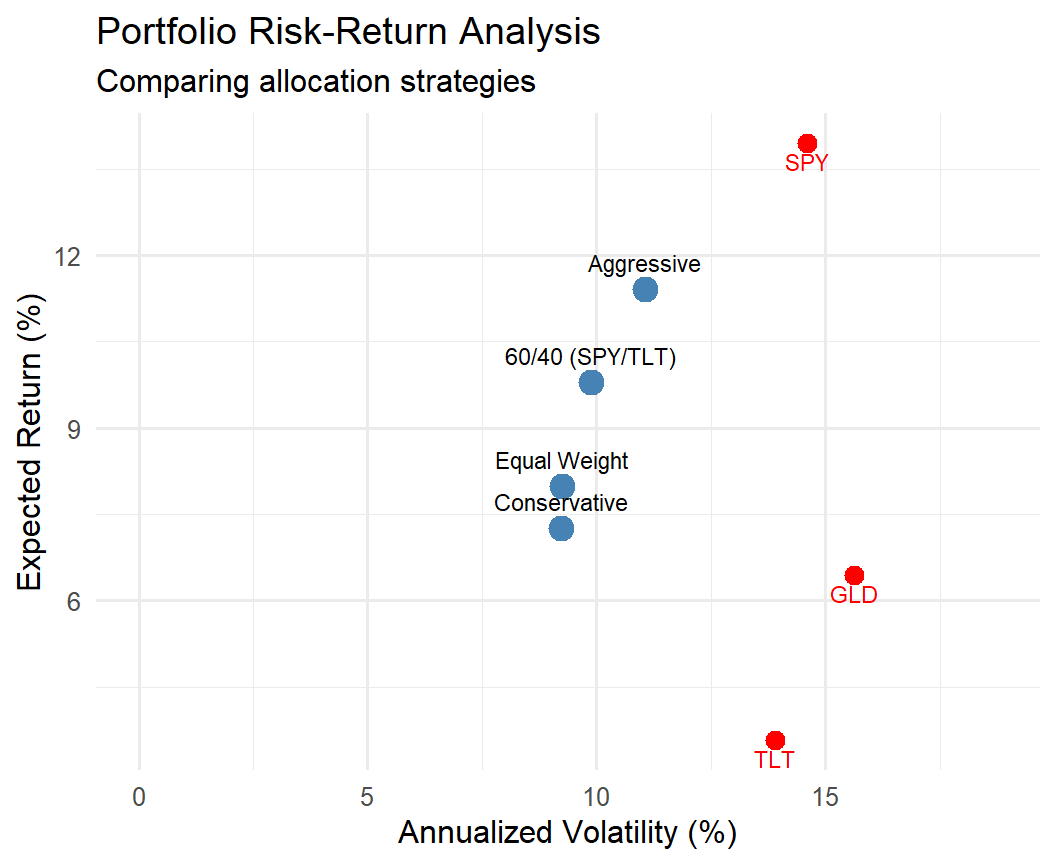
💰 Case Study: Key Findings
📊 Analysis Results
Correlation Insights:
SPY-TLT: Low/negative → good diversification
SPY-GLD: Low positive → some benefit
TLT-GLD: Moderate positive
Low correlations reduce risk
Portfolio Variance:
Equal-weight portfolio has lower risk:
\[\sigma_p^2 = \sum_i w_i^2 \sigma_i^2 \] \[+2\sum_{i<j} w_i w_j \rho_{ij} \sigma_i \sigma_j\]
Low/negative ρ reduces variance!
Investment Implications:
Diversification works
Correlation matters most
Trade-off: lower risk = lower return
📝 Quiz #1: Computing Expected Value
If \(E[Y_1] = 5\), \(E[Y_2] = 10\), what is \(E[3Y_1 + 2Y_2 - 7]\)?
- 28
- 35
- 22
- 15
📝 Quiz #2: Covariance Computation
If \(E[Y_1] = 2\), \(E[Y_2] = 3\), and \(E[Y_1 Y_2] = 7\), what is \(\text{Cov}(Y_1, Y_2)\)?
- 1
- 6
- 7
- -1
📝 Quiz #3: Independence and Covariance
Which statement about covariance is TRUE?
- If two variables are independent, their covariance must be zero
- If covariance is zero, the variables must be independent
- Covariance can be greater than 1
- Covariance equals correlation divided by the product of standard deviations
📝 Quiz #4: Portfolio Variance
For a portfolio with \(w_1 = w_2 = 0.5\), \(\sigma_1 = \sigma_2 = 20\%\), and \(\rho = 0\), what is the portfolio standard deviation?
- 14.14%
- 20%
- 10%
- 28.28%
📝 Summary
✅ Key Takeaways
Expected value of functions \(E[g(Y_1, Y_2)]\) is computed by weighting function values by joint probabilities/densities
Linearity: \(E[aY_1 + bY_2] = aE[Y_1] + bE[Y_2]\) always holds; \(E[Y_1 Y_2] = E[Y_1]E[Y_2]\) only if independent
Covariance \(\text{Cov}(Y_1, Y_2) = E[Y_1 Y_2] - E[Y_1]E[Y_2]\) measures linear association
Correlation \(\rho = \text{Cov}(Y_1, Y_2)/(\sigma_1 \sigma_2)\) is standardized with \(-1 \leq \rho \leq 1\)
Critical insight: \(\text{Cov} = 0\) does NOT imply independence!
Portfolio variance: \(V(w_1 Y_1 + w_2 Y_2) = w_1^2 V(Y_1) + w_2^2 V(Y_2) + 2w_1 w_2 \text{Cov}(Y_1, Y_2)\)
📚 Practice Problems
📝 Homework Problems
Problem 1: For \(f(y_1, y_2) = 8y_1y_2\) on \(0 < y_1 < 1\), \(0 < y_2 < 1\), find \(E[Y_1 + Y_2]\) and \(E[Y_1 Y_2]\).
Problem 2: For \(f(y_1, y_2) = 2\) on \(0 < y_1 < 1\), \(0 < y_2 < y_1\), compute \(\text{Cov}(Y_1, Y_2)\).
Problem 3: Two stocks: \(\sigma_1 = 30\%\), \(\sigma_2 = 20\%\), \(\text{Cov} = 0.024\). Find correlation.
Problem 4: Portfolio: \(w_1 = 0.4\), \(w_2 = 0.6\), \(\mu_1 = 12\%\), \(\mu_2 = 8\%\), \(\sigma_1 = 25\%\), \(\sigma_2 = 15\%\), \(\rho = 0.3\). Find expected return and standard deviation.
Problem 5: Verify for \(Y_1 \sim \text{Uniform}(-1, 1)\) and \(Y_2 = Y_1^2\): \(\text{Cov}(Y_1, Y_2) = 0\) but variables are dependent.
📱 Late Check-in
👋 Thank You!
📬 Contact Information:
Samir Orujov, PhD
Assistant Professor
School of Business
ADA University
📧 Email: sorujov@ada.edu.az
🏢 Office: D312
⏰ Office Hours: By appointment
📅 Next Class:
Topic: Functions of Random Variables (Chapter 6)
Reading: Chapter 6, Sections 6.1-6.3
Preparation: Review change of variables in calculus
⏰ Reminders:
✅ Complete Practice Problems 1-5
✅ Master the portfolio variance formula
✅ Remember: Cov = 0 ≠ independence!
✅ Work hard!
❓ Questions?
💬 Open Discussion
Key Topics for Discussion:
Why is covariance so important in finance and portfolio theory?
Can you think of examples where two variables have zero covariance but are clearly dependent?
How would you estimate covariance from sample data? What are the challenges?
What happens to diversification benefits during financial crises when correlations spike?

Mathematical Statistics - Covariance and Correlation