Mathematical Statistics

Sampling Distributions Related to the Normal Distribution

Samir Orujov, PhD

ADA University, School of Business

Information Communication Technologies Agency, Statistics Unit

2026-03-07

๐ŸŽฏ Learning Objectives

By the end of this lecture, you will be able to:

  • Define a statistic and its sampling distribution and explain why they matter for inference about economic and financial populations

  • Apply Theorem 7.1 to derive the sampling distribution of the sample mean \(\bar{Y}\) from a normal population

  • Compute probabilities involving \(\chi^2\), \(t\), and \(F\) distributions using their definitions and relationship to normal samples

  • Interpret how the \(\chi^2\) distribution governs sample variance \(S^2\) and connect it to risk measurement in portfolios

  • Compare the \(t\) and \(F\) distributions to the standard normal and explain their role in small-sample inference for economic data

๐Ÿ“ฑ Attendance Check-in

๐Ÿ“‹ Overview

๐Ÿ“š Topics Covered Today

  • Statistics & Sampling Distributions โ€“ From data to inference

  • Distribution of \(\bar{Y}\) โ€“ Theorem 7.1 and the normal population

  • The \(\chi^2\) Distribution โ€“ Sum of squared normals and sample variance

  • Studentโ€™s \(t\) Distribution โ€“ When \(\sigma\) is unknown

  • The \(F\) Distribution โ€“ Comparing two variances

  • Case Study โ€“ Analyzing stock return volatility with Python

๐Ÿ“– Why Sampling Distributions?

๐ŸŽฏ Motivation

Every day, analysts and economists make decisions based on samples, not entire populations. Understanding how sample statistics behave is the foundation of statistical inference.

Finance & Business Applications:

  • Estimating average portfolio returns from historical data
  • Testing whether a fundโ€™s Sharpe ratio exceeds a benchmark
  • Comparing volatility of two asset classes
  • Quality control in manufacturing output

Economics & Policy Applications:

  • Estimating mean household income from survey samples
  • Testing effectiveness of a policy intervention (e.g., tax reform)
  • Comparing GDP growth rates across regions
  • Measuring inflation variability across time periods

Key Question: If we draw a sample and compute \(\bar{Y}\), \(S^2\), or a ratio of variances, what probability distribution do these statistics follow?

๐Ÿ“– Definition: Statistic

๐Ÿ“ Definition 7.1: Statistic

A statistic is a function of the observable random variables in a sample and known constants.

\[T = g(Y_1, Y_2, \ldots, Y_n)\]

Interpretation: A statistic transforms raw sample data into a single number used for inference.

Common Statistics You Already Know:

Statistic Formula Use
Sample Mean \(\bar{Y} = \frac{1}{n}\sum_{i=1}^n Y_i\) Estimate \(\mu\)
Sample Variance \(S^2 = \frac{1}{n-1}\sum_{i=1}^n (Y_i - \bar{Y})^2\) Estimate \(\sigma^2\)
Sample Range \(R = Y_{(n)} - Y_{(1)}\) Measure spread

๐Ÿ“– Sampling Distributions: The Big Picture

Key Insight: Because \(Y_1, Y_2, \ldots, Y_n\) are random variables, any statistic \(T = g(Y_1, \ldots, Y_n)\) is also a random variable with its own probability distribution.

The Sampling Distribution

The sampling distribution of a statistic is the probability distribution of that statistic computed over all possible samples of size \(n\) from the population.

It is the theoretical model for the relative frequency histogram we would observe through repeated sampling.

Economic Analogy: Imagine surveying 50 households about monthly spending. Each time you draw a new sample, you get a different \(\bar{Y}\). The distribution of all possible \(\bar{Y}\) values is the sampling distribution.

๐Ÿ“Œ Example: Rolling Dice โ€” A Warm-Up

Problem: A balanced die is tossed \(n = 3\) times. Let \(Y_1, Y_2, Y_3\) be the results. What are \(E(\bar{Y})\) and \(\sigma_{\bar{Y}}\)?

Solution: For a balanced die, \(\mu = E(Y_i) = 3.5\) and \(\sigma^2 = V(Y_i) = 2.9167\).

Since the \(Y_i\) are independent:

\[E(\bar{Y}) = \mu = 3.5\]

\[V(\bar{Y}) = \frac{\sigma^2}{n} = \frac{2.9167}{3} = 0.9722 \implies \sigma_{\bar{Y}} = 0.986\]

๐Ÿ’ก Key Takeaway

\(\bar{Y}\) has less variability than individual observations โ€” by a factor of \(1/\sqrt{n}\). This is why averaging works in economics: polling more people, collecting more price data, or observing more trading days all reduce estimation error.

๐Ÿงฎ Theorem 7.1: Distribution of \(\bar{Y}\)

Theorem 7.1: Sampling Distribution of the Mean (Normal Population)

Let \(Y_1, Y_2, \ldots, Y_n\) be a random sample from a normal distribution with mean \(\mu\) and variance \(\sigma^2\). Then:

\[\bar{Y} = \frac{1}{n}\sum_{i=1}^n Y_i\]

is normally distributed with:

\[\mu_{\bar{Y}} = \mu \qquad \text{and} \qquad \sigma^2_{\bar{Y}} = \frac{\sigma^2}{n}\]

Immediate Consequence: The standardized version

\[Z = \frac{\bar{Y} - \mu}{\sigma / \sqrt{n}}\]

has a standard normal distribution. This is the workhorse for inference when \(\sigma\) is known.

๐Ÿ“Œ Example: GDP Growth Estimation

Problem: Quarterly GDP growth rates in a stable economy are normally distributed with \(\sigma = 0.8\%\). A sample of \(n = 16\) quarters yields \(\bar{Y}\). Find \(P(|\bar{Y} - \mu| \leq 0.3)\).

Solution: By Theorem 7.1, \(\bar{Y} \sim N(\mu,\; \sigma^2/n)\), so:

\[Z = \frac{\bar{Y} - \mu}{\sigma/\sqrt{n}} = \frac{\bar{Y} - \mu}{0.8/\sqrt{16}} = \frac{\bar{Y} - \mu}{0.2}\]

\[P(|\bar{Y} - \mu| \leq 0.3) = P\!\left(\frac{-0.3}{0.2} \leq Z \leq \frac{0.3}{0.2}\right) = P(-1.5 \leq Z \leq 1.5)\]

\[= 1 - 2 \times P(Z > 1.5) = 1 - 2(0.0668) = \boxed{0.8664}\]

Interpretation: There is about an 87% chance that the sample mean growth rate will be within 0.3 percentage points of the true mean โ€” a useful precision for macroeconomic forecasting.

๐Ÿ“Œ Example: Sample Size for Precision

Problem: How many quarterly observations do we need so that \(\bar{Y}\) is within 0.3% of \(\mu\) with probability 0.95?

Solution: We need \(P(|\bar{Y} - \mu| \leq 0.3) = 0.95\), which requires:

\[P\!\left(-\frac{0.3}{\sigma/\sqrt{n}} \leq Z \leq \frac{0.3}{\sigma/\sqrt{n}}\right) = 0.95\]

This means \(\frac{0.3}{\sigma/\sqrt{n}} = z_{0.025} = 1.96\), so:

\[\sqrt{n} = \frac{1.96 \times 0.8}{0.3} = 5.227 \implies n = 27.32\]

\[\boxed{n = 28 \text{ quarters (7 years of data)}}\]

Policy Insight: Regulators and central banks need multi-year data windows to achieve reliable growth estimates โ€” this quantifies exactly how long.

๐Ÿงฎ The \(\chi^2\) Distribution

Theorem 7.2: Chi-Square from Normal Samples

Let \(Y_1, \ldots, Y_n\) be a random sample from \(N(\mu, \sigma^2)\). Then \(Z_i = (Y_i - \mu)/\sigma\) are independent standard normals, and:

\[\sum_{i=1}^n Z_i^2 = \sum_{i=1}^n \left(\frac{Y_i - \mu}{\sigma}\right)^2 \sim \chi^2(n)\]

Properties of \(\chi^2(\nu)\):

  • \(E(\chi^2) = \nu\)
  • \(V(\chi^2) = 2\nu\)
  • Right-skewed, but becomes more symmetric as \(\nu\) increases

Finance Connection:

The sum of squared deviations measures total risk. The \(\chi^2\) distribution tells us how sample variance behaves โ€” critical for VaR (Value at Risk) and portfolio risk estimation.

๐Ÿงฎ Theorem 7.3: Distribution of \(S^2\)

Theorem 7.3: Sample Variance Distribution

Let \(Y_1, \ldots, Y_n\) be a random sample from \(N(\mu, \sigma^2)\). Then:

\[\frac{(n-1)S^2}{\sigma^2} = \frac{1}{\sigma^2}\sum_{i=1}^n (Y_i - \bar{Y})^2 \sim \chi^2(n-1)\]

Moreover: \(\bar{Y}\) and \(S^2\) are independent random variables.

Why Does This Matter?

  • We lose 1 degree of freedom because we estimate \(\mu\) with \(\bar{Y}\)
  • This result is the foundation for confidence intervals for \(\sigma^2\)
  • The independence of \(\bar{Y}\) and \(S^2\) is surprising and crucial โ€” it enables the \(t\)-test

Consequence: \(E(S^2) = \sigma^2\) โ€” the sample variance is an unbiased estimator of population variance.

๐Ÿ“Œ Example: Bond Yield Variability

Problem: Daily changes in a government bond yield are \(N(\mu, \sigma^2)\). From \(n = 21\) trading days, we observe \(S^2\). Find \(b\) such that \(P(S^2 \leq b) = 0.95\).

Solution: By Theorem 7.3, \((n-1)S^2/\sigma^2 \sim \chi^2(20)\).

We need:

\[P\!\left(\frac{20S^2}{\sigma^2} \leq \chi^2_{0.05}(20)\right) = 0.95\]

From chi-square tables: \(\chi^2_{0.05}(20) = 31.41\)

\[\frac{20b}{\sigma^2} = 31.41 \implies b = \frac{31.41 \cdot \sigma^2}{20} = 1.571\sigma^2\]

Risk Interpretation: There is a 95% chance that the sample variance of bond yield changes wonโ€™t exceed 1.571 times the true variance โ€” useful for setting conservative risk bounds.

๐Ÿ“– Definition: Studentโ€™s \(t\) Distribution

๐Ÿ“ Definition 7.2: Studentโ€™s \(t\) Distribution

Let \(Z \sim N(0,1)\) and \(W \sim \chi^2(\nu)\) be independent. Then:

\[T = \frac{Z}{\sqrt{W/\nu}}\]

has a \(t\) distribution with \(\nu\) degrees of freedom.

๐Ÿ“œ Historical Note

William Sealy Gosset published this under the pseudonym โ€œStudentโ€ in 1908 while working at Guinness Brewery โ€” small samples of barley quality led to one of statisticsโ€™ most important distributions.

Key Application: For a normal sample:

\[T = \frac{\bar{Y} - \mu}{S/\sqrt{n}} = \sqrt{n}\left(\frac{\bar{Y} - \mu}{S}\right) \sim t(n-1)\]

This replaces \[Z = \frac{(\bar{Y}-\mu)}{\sigma/\sqrt{n}}\] when \(\sigma\) is unknown โ€” which is almost always the case in economics!

๐Ÿ“– \(t\) vs. Normal: Heavier Tails

Properties of \(t(\nu)\):

  • Symmetric about 0, bell-shaped
  • \(E(T) = 0\) for \(\nu > 1\)
  • \(V(T) = \frac{\nu}{\nu - 2}\) for \(\nu > 2\) โ€” always > 1
  • Heavier tails than standard normal
  • As \(\nu \to \infty\), \(t(\nu) \to N(0,1)\)

Important

Economic Implication: With small samples (common in macro and finance), using the normal distribution when \(\sigma\) is unknown underestimates the uncertainty. The \(t\) distribution corrects for this.

Why heavier tails?

The extra variability comes from estimating \(\sigma\) with \(S\). In small samples, \(S\) can be quite different from \(\sigma\), inflating or deflating the ratio.

\(\nu\) (df) \(V(T)\) How close to normal?
5 1.667 Much wider tails
10 1.250 Noticeably wider
30 1.071 Nearly normal
100 1.020 Very close
\(\infty\) 1.000 Exactly normal

๐ŸŽฎ Interactive: N(0,1) vs. t โ€” Tail Convergence

Key insight: As \(\nu \to \infty\), \(t(\nu) \to N(0,1)\). The heavier tails reflect uncertainty in estimating \(\sigma\) from data โ€” watch them shrink as \(\nu\) grows.

๐Ÿ“Œ Example: Estimating Average Firm Size

Problem: Annual revenues of firms in a sector are \(N(\mu, \sigma^2)\). A sample of \(n = 6\) firms gives \(\bar{Y}\) and \(S\). Find \(P\!\left(|\bar{Y} - \mu| \leq 2\frac{S}{\sqrt{n}}\right)\).

Solution:

\[P\!\left(-2 \leq \frac{\bar{Y} - \mu}{S/\sqrt{n}} \leq 2\right) = P(-2 \leq T \leq 2)\]

where \(T \sim t(5)\).

From \(t\)-tables: \(t_{0.05}(5) = 2.015\), so \(P(T > 2.015) = 0.05\).

Since \(2 < 2.015\): \(P(-2 \leq T \leq 2) \approx 0.90\) (slightly less)

Compare with known \(\sigma\): If \(\sigma\) were known, \(P(-2 \leq Z \leq 2) = 0.9544\). The \(t\) distribution gives a wider interval reflecting our additional uncertainty about \(\sigma\).

๐Ÿ“– Definition: The \(F\) Distribution

๐Ÿ“ Definition 7.3: \(F\) Distribution

Let \(W_1 \sim \chi^2(\nu_1)\) and \(W_2 \sim \chi^2(\nu_2)\) be independent. Then:

\[F = \frac{W_1/\nu_1}{W_2/\nu_2}\]

has an \(F\) distribution with \(\nu_1\) numerator df and \(\nu_2\) denominator df.

๐ŸŽฏ Key Application

Comparing two population variances from independent normal samples:

\[F = \frac{S_1^2/\sigma_1^2}{S_2^2/\sigma_2^2} \sim F(n_1 - 1, \; n_2 - 1)\]

If \(\sigma_1^2 = \sigma_2^2\), this simplifies to \(F = S_1^2/S_2^2\).

๐Ÿ’ผ Economics Use Cases

Testing whether stock A is more volatile than stock B, comparing income inequality across regions, ANOVA F-tests for policy impacts across groups.

๐Ÿ“Œ Example: Comparing Market Volatilities

Problem: Independent samples of \(n_1 = 6\) returns from Market A and \(n_2 = 10\) from Market B (both normal with equal \(\sigma^2\)). Find \(P(S_1^2/S_2^2 > 4.07)\).

Solution: When \(\sigma_1^2 = \sigma_2^2\):

\[F = \frac{S_1^2}{S_2^2} \sim F(n_1 - 1, n_2 - 1) = F(5, 9)\]

From \(F\)-tables: \(F_{0.05}(5, 9) = 3.48\) and \(F_{0.025}(5, 9) = 4.48\).

Since \(3.48 < 4.07 < 4.48\):

\[\boxed{0.025 < P(F > 4.07) < 0.05}\]

Interpretation: If the two markets truly have equal volatility, observing \(S_1^2/S_2^2 > 4.07\) would be unusual (probability between 2.5% and 5%) โ€” possible evidence that Market A is actually more volatile.

๐ŸŽฎ Interactive: Sampling Distributions Explorer

Key insight: See how the \(\chi^2\), \(t\), and \(F\) distributions change shape with degrees of freedom

๐Ÿค Think-Pair-Share: The โ€œGosset Challengeโ€

๐Ÿ’ฌ Activity (4 minutes)

Scenario: Central bank analyst. Quarterly inflation data, \(n = 8\) periods (normal). Colleague says: โ€œJust use \(z_{0.025} = 1.96\) โ€” the \(t\) distribution is overkill.โ€

๐Ÿง  Think (1 min):

  • Why is the colleague wrong?
  • What assumption does \(z\) require that weโ€™re violating?

๐Ÿ‘ซ Pair (2 min):

  • Look up \(t_{0.025}(7)\) and compare to 1.96
  • How much wider (%) is the correct interval?
  • At what \(n\) does the gap shrink below 1%?

๐Ÿ—ฃ๏ธ Share (1 min):

  • Why does this matter more when data is scarce?
  • Name one real economic scenario where \(n = 8\) is realistic
4:00

โœ… Solution: The Gosset Challenge

Scenario: \(n = 8\) quarterly inflation periods, \(\sigma\) unknown โ†’ \(T \sim t(7)\)

โ‘  Why the colleague is wrong

Using \(z_{0.025} = 1.96\) assumes \(\sigma\) is known. With \(n = 8\), we estimate \(\sigma\) by \(S\) โ€” this extra uncertainty inflates the true critical value. Using \(z\) here underestimates risk.

โ‘ก & โ‘ข Critical values and interval width

\[z_{0.025} = 1.960 \qquad t_{0.025}(7) = 2.365\]

Width ratio: \(\dfrac{2.365}{1.960} = 1.207\) โ†’ the correct interval is 20.7% wider

โ‘ฃ When does the gap close?

\(n\) df \(t_{0.025}\) Extra width vs \(z\)
8 7 2.365 20.7%
30 29 2.045 4.3%
120 119 1.980 1.0%
200 199 1.972 0.6%

Rule of thumb: \(n \approx 120\) to get below 1% extra width.

๐Ÿ’ฐ Case Study: Stock Return Distributions

๐Ÿ“Š Show Code
import numpy as np
import pandas as pd
import yfinance as yf
import matplotlib.pyplot as plt
from scipy import stats

symbols = ["^GSPC", "^GDAXI", "^N225"]
names = {"^GSPC": "S&P 500",
         "^GDAXI": "DAX (Germany)",
         "^N225": "Nikkei 225"}

all_returns = {}
for sym in symbols:
    data = yf.download(sym, start="2020-01-01",
                       end="2025-01-01")
    returns = data["Close"].pct_change().dropna()
    all_returns[names[sym]] = returns

summary = pd.DataFrame({
    name: {"Mean (%)": ret.mean()*100,
           "Std Dev (%)": ret.std()*100,
           "n (days)": len(ret),
           "SE of Mean (%)": ret.std()/np.sqrt(len(ret))*100}
    for name, ret in all_returns.items()}).T
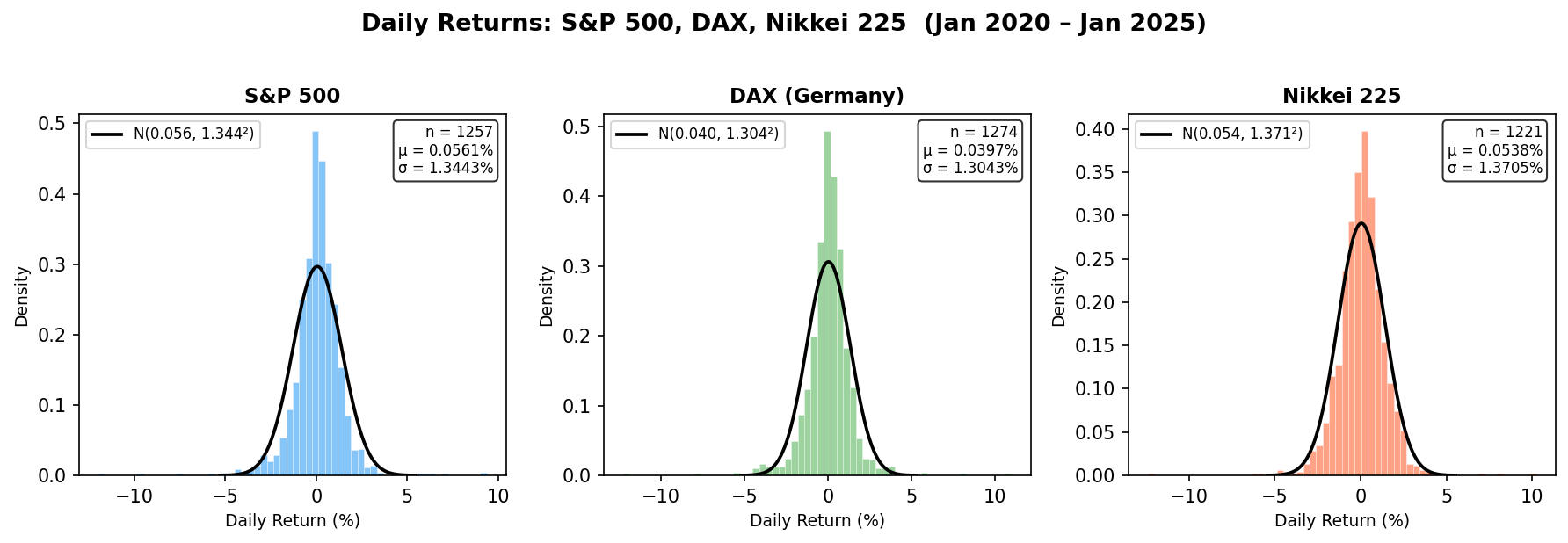
print(summary.round(4))
Index Mean (%) Std Dev (%) n (days) SE of Mean (%)
S&P 500 0.0561 1.3443 1,257 0.0379
DAX (Germany) 0.0397 1.3043 1,274 0.0365
Nikkei 225 0.0538 1.3705 1,221 0.0392

๐Ÿ’ฐ Case Study: Applying \(\chi^2\) and \(t\) to Real Data

๐Ÿ“Š Show Code
from scipy.stats import chi2, t

np.random.seed(42)
sample = np.random.choice(sp500, size=25)
n, ybar = len(sample), sample.mean()
s2, s = sample.var(ddof=1), np.sqrt(s2)

# Chi-square test: Hโ‚€: ฯƒ = 1% daily (risk benchmark)
sigma0 = 1.0
chi2_stat = (n - 1) * s2 / sigma0**2   # test statistic
chi2_crit = chi2.ppf(0.95, df=n-1)     # right-tail critical value at ฮฑ=0.05
chi2_pval = 1 - chi2.cdf(chi2_stat, df=n-1)

# t-test: Hโ‚€: ฮผ = 0 (zero expected daily return)
t_stat = ybar / (s / np.sqrt(n))
p_val = 2 * (1 - t.cdf(abs(t_stat), df=n-1))

# 95% CI for ฮผ
t_crit = t.ppf(0.975, df=n-1)
ci = (ybar - t_crit * s / np.sqrt(n),
      ybar + t_crit * s / np.sqrt(n))

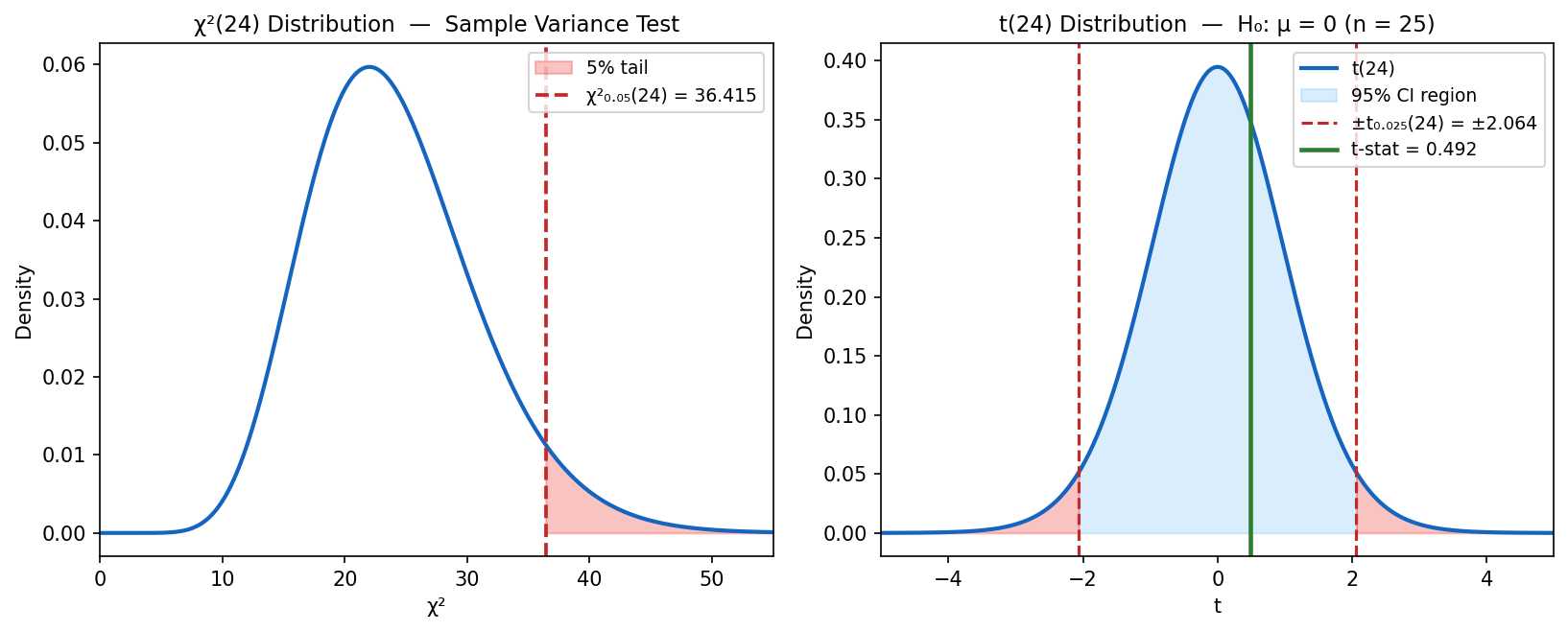
Sample: S&P 500, \(n = 25\), \(\bar{y} = -0.4664\%\), \(S = 1.4687\%\), \(S^2 = 2.157\%^2\)

\(\chi^2\) test โ€” volatility \(t\) test โ€” mean return 95% CI for \(\mu\)
\(H_0\) \(\sigma = 1\%\) daily \(\mu = 0\) โ€”
Statistic \(\chi^2 = \frac{24 \times 2.157}{1^2} = 51.77\) \(t = -1.588\) \((-1.073\%,\ 0.140\%)\)
Critical / \(p\) \(\chi^2_{0.05}(24) = 36.42\) \(p = 0.125\) 0 is inside the interval
Decision Reject \(H_0\) โœ“ Fail to reject Mean not sig. \(\neq 0\)
Conclusion Volatility exceeds 1% benchmark Returns consistent with EMH Insufficient evidence

๐Ÿ’ฐ Case Study: Results Visualized

๐Ÿ’ฐ Case Study: Key Findings

๐Ÿ“Š Analysis Results

Distributional Findings:

  • Stock returns are approximately normal but with heavier tails (leptokurtic)

  • The normal assumption is reasonable for sample means (CLT, next lecture!)

  • Different markets show different volatility levels

\(\chi^2\) Test Result:

  • \(H_0\): \(\sigma = 1\%\) daily โ€” Rejected
  • \(\chi^2 = 51.77 > \chi^2_{0.05}(24) = 36.42\)
  • S&P 500 volatility significantly exceeds the 1% benchmark (\(p < 0.001\))
  • Theory: \(\frac{(n-1)S^2}{\sigma_0^2} \sim \chi^2(n-1)\)

\(t\) Test & CI Result:

  • \(H_0\): \(\mu = 0\) โ€” Not rejected (\(t = -1.588\), \(p = 0.125\))
  • 95% CI: \((-1.073\%,\ 0.140\%)\) contains zero
  • Consistent with the efficient market hypothesis โ€” no exploitable return signal in this sample
  • Theory: \(\frac{\bar{Y} - \mu}{S/\sqrt{n}} \sim t(n-1)\)

๐Ÿ“ Quiz #1: Identifying Distributions

If \(Y_1, \ldots, Y_{16}\) are a random sample from \(N(\mu, \sigma^2)\), which distribution does \(\frac{15S^2}{\sigma^2}\) follow?

  • \(\chi^2\) with 15 degrees of freedom
  • \(\chi^2\) with 16 degrees of freedom
  • \(t\) with 15 degrees of freedom
  • \(N(0, 1)\)

๐Ÿ“ Quiz #2: Properties of \(t\)

Why does the \(t\) distribution have heavier tails than the standard normal?

  • Because estimating ฯƒ with S introduces additional randomness in the denominator
  • Because the \(t\) distribution has a larger mean
  • Because the sample size is always small
  • Because the ฯ‡ยฒ distribution is left-skewed

๐Ÿ“ Quiz #3: Practical Application

An economist collects \(n_1 = 11\) monthly inflation rates from Country A and \(n_2 = 16\) from Country B (both normal). To test \(H_0: \sigma_A^2 = \sigma_B^2\), the statistic \(F = S_A^2/S_B^2\) follows which distribution under \(H_0\)?

  • \(F(10, 15)\)
  • \(F(11, 16)\)
  • \(F(15, 10)\)
  • \(\chi^2(25)\)

๐Ÿ“ Quiz #4: Sample Size Reasoning

A financial analyst needs \(P(|\bar{Y} - \mu| \leq 0.5) = 0.99\) for normally distributed returns with \(\sigma = 2\%\). Using \(z_{0.005} = 2.576\), what is the minimum sample size?

  • \(n = 107\)
  • \(n = 64\)
  • \(n = 27\)
  • \(n = 200\)

๐Ÿ“ Summary

โœ… Key Takeaways

  • Statistics are random variables โ€” their probability distributions (sampling distributions) are the basis of all statistical inference in economics and finance

  • Theorem 7.1: \(\bar{Y} \sim N(\mu, \sigma^2/n)\) when sampling from a normal population โ€” precision improves with \(\sqrt{n}\)

  • \(\chi^2\) distribution governs the sample variance: \((n-1)S^2/\sigma^2 \sim \chi^2(n-1)\), and \(\bar{Y} \perp S^2\) (independence)

  • Studentโ€™s \(t\) replaces the normal when \(\sigma\) is unknown: \(\sqrt{n}(\bar{Y}-\mu)/S \sim t(n-1)\) โ€” heavier tails = more conservative inference

  • \(F\) distribution compares two variances: \(F = (S_1^2/\sigma_1^2)/(S_2^2/\sigma_2^2) \sim F(n_1-1, n_2-1)\) โ€” essential for ANOVA and regression

๐Ÿ“š Practice Problems

๐Ÿ“ Homework Problems

Problem 1 (Computation): If \(Z_1, \ldots, Z_8\) are i.i.d. standard normal, find \(b\) such that \(P\!\left(\sum Z_i^2 \leq b\right) = 0.95\).

Problem 2 (\(t\)-distribution): A sample of \(n = 10\) quarterly GDP growth rates (normal) gives \(\bar{Y} = 2.1\%\) and \(S = 0.8\%\). Construct a 95% confidence interval for \(\mu\) using the \(t\) distribution.

Problem 3 (\(F\)-test): Monthly returns from two funds (normal, \(n_1 = 21, n_2 = 31\)) give \(S_1^2 = 0.0009\) and \(S_2^2 = 0.0004\). Test at \(\alpha = 0.05\) whether Fund 1 is significantly more volatile.

Problem 4 (Conceptual): Explain why \(\bar{Y}\) and \(S^2\) being independent is critical for the derivation of the \(t\)-statistic. What would go wrong if they were correlated?

๐Ÿ“ฑ Late Check-in

๐Ÿ‘‹ Thank You!

๐Ÿ“ฌ Contact:

Samir Orujov, PhD โ€” Assistant Professor

School of Business, ADA University

๐Ÿ“ง sorujov@ada.edu.az  |  ๐Ÿข D312  |  โฐ By appointment

๐Ÿ“… Next Class: Central Limit Theorem & Applications

Reading: Wackerly Ch. 7, Sections 7.3โ€“7.5

Preparation: Review MGFs (Sec. 3.9)

Reminders: โœ… Practice Problems 1โ€“4  |  โœ… Review \(\chi^2\), \(t\), \(F\)  |  โœ… Work hard!

โ“ Questions?

๐Ÿ’ฌ Open Discussion

  • How would sampling distributions change if the population were skewed (e.g., income data)?

  • Why do you think Gosset needed to publish under a pseudonym?

  • Can the \(\chi^2\) distribution help us assess whether a stockโ€™s risk is increasing over time?

  • How do emerging market analysts cope with tiny sample sizes โ€” what role does the \(t\) distribution play?