Mathematical Statistics

Tests for Means and Proportions

Samir Orujov, PhD

ADA University, School of Business

Information Communication Technologies Agency, Statistics Unit

2026-03-14

๐ŸŽฏ Learning Objectives

By the end of this lecture, you will be able to:

  • Apply large-sample Z tests for a single mean, proportion, and two-sample comparisons

  • Calculate Type II error probability \(\beta\) for a specific alternative \(\theta_a\)

  • Determine the required sample size \(n\) to achieve target \(\alpha\) and \(\beta\)

  • Execute small-sample \(t\)-tests for \(\mu\) and \(\mu_1 - \mu_2\) with pooled variance

  • Interpret test results in financial and regulatory decision-making contexts

๐Ÿ“ฑ Attendance Check-in

๐Ÿ“‹ Overview

๐Ÿ“š Topics Covered Today

  • Large-Sample Z Tests โ€” unified framework for means, proportions, differences (ยง10.3)

  • Type II Error & Power โ€” computing \(\beta\) at a specific alternative (ยง10.4)

  • Sample Size Determination โ€” how many observations do we need? (ยง10.4)

  • Small-Sample \(t\)-Tests โ€” one-sample and two-sample pooled \(t\) (ยง10.8)

  • Case Study โ€” Testing fund manager alpha vs zero with real return data

๐Ÿ“– Motivation: Decisions Under Uncertainty

๐ŸŽฏ The Financial Testing Landscape

Every day, financial and regulatory practitioners answer questions like:

Mean Tests:

  • Has a fundโ€™s average monthly return exceeded its benchmark?
  • Did average broadband speed drop after a policy change?
  • Is the mean transaction time within SLA limits?

Proportion Tests:

  • Has the loan default rate risen above 5%?
  • Do two marketing campaigns have equal conversion rates?
  • Is the pass rate of financial certifications above 60%?

Key Challenge: With small samples (few months of data, niche market), the Z approximation breaks down โ€” we need \(t\)-tests.

๐Ÿงฎ The Unified Large-Sample Z Framework

Theorem 10.3 โ€” General Large-Sample Test (Wackerly ยง10.3)

For any estimator \(\hat\theta\) with approximately normal sampling distribution:

\[Z = \frac{\hat\theta - \theta_0}{\sigma_{\hat\theta}} \xrightarrow{d} N(0,1) \text{ under } H_0\]

Rejection regions at level \(\alpha\):

\(H_a\) Rejection Region Financial Example
\(\theta > \theta_0\) \(z > z_\alpha\) Return exceeds benchmark
\(\theta < \theta_0\) \(z < -z_\alpha\) Default rate below threshold
\(\theta \neq \theta_0\) \(\|z\| > z_{\alpha/2}\) Volatility changed after shock

๐Ÿงฎ Z Test for a Single Mean \(\mu\)

Test: \(H_0: \mu = \mu_0\)

\[Z = \frac{\bar{Y} - \mu_0}{\sigma/\sqrt{n}} \approx \frac{\bar{Y} - \mu_0}{S/\sqrt{n}} \quad (\text{use } S \text{ when } \sigma \text{ unknown, large } n)\]

๐Ÿ“Œ Example โ€” Fund Return Audit:

A regulator tests whether a fundโ€™s mean monthly return \(\mu = 1.2\%\). Data: \(n = 60\), \(\bar{Y} = 1.48\%\), \(s = 1.05\%\).

\[Z = \frac{1.48 - 1.20}{1.05/\sqrt{60}} = \frac{0.28}{0.1356} = 2.06\]

Upper-tail RR at \(\alpha = 0.05\): \(z > 1.645\) โ†’ Reject \(H_0\) โœ…

p-value \(= P(Z > 2.06) = 0.020\)

๐Ÿงฎ Z Test for a Proportion \(p\)

Test: \(H_0: p = p_0\)

\[Z = \frac{\hat p - p_0}{\sqrt{p_0(1-p_0)/n}}\]

Use the null value \(p_0\) in the denominator (not \(\hat p\)).

๐Ÿ“Œ Example โ€” Loan Default Rate:

A bank monitors defaults. Historical rate: \(p_0 = 0.04\). After a recession: \(n = 500\) loans, 28 defaults โ†’ \(\hat p = 28/500 = 0.056\).

\[Z = \frac{0.056 - 0.040}{\sqrt{0.040 \times 0.960 / 500}} = \frac{0.016}{0.00876} = 1.83\]

\(H_a: p > 0.04\), \(\alpha = 0.05\): \(RR = \{z > 1.645\}\) โ†’ Reject \(H_0\)

p-value \(= P(Z > 1.83) = 0.034\) โ€” significant evidence default rate rose.

๐Ÿงฎ Z Test for Difference in Means \(\mu_1 - \mu_2\)

Test: \(H_0: \mu_1 - \mu_2 = D_0\)

\[Z = \frac{(\bar{Y}_1 - \bar{Y}_2) - D_0}{\sqrt{\sigma_1^2/n_1 + \sigma_2^2/n_2}} \approx \frac{(\bar{Y}_1 - \bar{Y}_2) - D_0}{\sqrt{S_1^2/n_1 + S_2^2/n_2}}\]

When to use: Two independent large samples (\(n_1, n_2 \geq 30\)). Use \(S_1^2, S_2^2\) when \(\sigma^2\) unknown.

๐Ÿ“Œ Example: Large-Cap vs Small-Cap Returns

Test \(H_0: \mu_L - \mu_S = 0\) vs \(H_a: \mu_L \neq \mu_S\), \(\alpha = 0.05\).

Large-Cap Small-Cap
\(n\) 120 120
\(\bar{Y}\) 0.82% 1.15%
\(S\) 2.10% 3.40%

\[Z = \frac{(0.82 - 1.15) - 0}{\sqrt{2.10^2/120 + 3.40^2/120}} = \frac{-0.33}{0.361} = -0.91\]

\(|z| = 0.91 < z_{0.025} = 1.96\) โ†’ Fail to Reject โ€” no significant difference in returns.

๐Ÿงฎ Z Test for Difference in Proportions \(p_1 - p_2\)

Test: \(H_0: p_1 - p_2 = 0\) (most common case)

\[Z = \frac{\hat p_1 - \hat p_2}{\sqrt{\hat p(1-\hat p)\left(\frac{1}{n_1} + \frac{1}{n_2}\right)}}, \quad \hat p = \frac{n_1 \hat p_1 + n_2 \hat p_2}{n_1 + n_2}\]

The pooled proportion \(\hat p\) is used because under \(H_0: p_1 = p_2\).

๐Ÿ“Œ Example โ€” ICT Regulation:

Two ISPs tested for QoS compliance.

ISP \(n\) Non-compliant
A 200 24 (12%)
B 250 18 (7.2%)

\(\hat p = 42/450 = 0.0933\). \(Z = (0.12 - 0.072)/\sqrt{0.0933 \times 0.9067 \times (1/200 + 1/250)} = 0.048/0.0387 = 1.24\). p-value \(= 0.215\) โ€” no significant difference.

๐Ÿ“ Computing Type II Error \(\beta\)

๐Ÿ“ Method โ€” \(\beta\) for the Z Test (Wackerly ยง10.4)

For \(H_0: \mu = \mu_0\) vs \(H_a: \mu > \mu_0\) at level \(\alpha\), the rejection region is \(\bar Y > k\) where \(k = \mu_0 + z_\alpha \cdot \sigma/\sqrt{n}\).

\[\beta(\mu_a) = P\!\left(\bar Y \leq k \;\middle|\; \mu = \mu_a\right) = \Phi\!\left(\frac{k - \mu_a}{\sigma/\sqrt{n}}\right) = \Phi(z_\alpha - \delta\sqrt{n})\]

where \(\delta = (\mu_a - \mu_0)/\sigma\) is the standardised effect size.

Key insight: \(\beta \downarrow\) when the effect size \(\delta\) is large or \(n\) is large.

Power \(= 1 - \beta\) = probability of correctly detecting \(H_a\).

๐Ÿ“Œ Example: Computing \(\beta\) for a Fund Audit

Scenario: Testing \(H_0: \mu = 1.0\%\) vs \(H_a: \mu > 1.0\%\) at \(\alpha = 0.05\), \(n = 36\), \(\sigma = 1.8\%\).

Step 1 โ€” Critical boundary:

\[k = \mu_0 + z_{0.05} \cdot \frac{\sigma}{\sqrt{n}} = 1.0 + 1.645 \cdot \frac{1.8}{\sqrt{36}} = 1.0 + 0.494 = 1.494\%\]

Step 2 โ€” Compute \(\beta\) at \(\mu_a = 1.5\%\):

\[\beta = P\!\left(\bar Y \leq 1.494 \;\middle|\; \mu = 1.5\right) = \Phi\!\left(\frac{1.494 - 1.5}{1.8/6}\right) = \Phi(-0.02) = 0.492\]

Interpretation: With \(n = 36\) and a true excess return of only 0.5% above the threshold, we miss the true outperformance 49% of the time. We need more data!

๐Ÿ“ Sample Size Determination

Formula โ€” Required Sample Size (Wackerly ยง10.4)

To detect \(\mu_a\) with both Type I error \(\alpha\) and Type II error \(\beta\):

\[\boxed{n = \frac{(z_\alpha + z_\beta)^2 \sigma^2}{(\mu_a - \mu_0)^2}}\]

Both \(z_\alpha\) and \(z_\beta\) are upper-tail critical values of \(N(0,1)\).

๐Ÿ“Œ Example โ€” Fund Audit (continued):

To achieve \(\alpha = \beta = 0.05\) for detecting \(\mu_a = 1.5\%\) above \(\mu_0 = 1.0\%\), \(\sigma = 1.8\%\):

\[n = \frac{(1.645 + 1.645)^2 \times 1.8^2}{(1.5 - 1.0)^2} = \frac{10.82 \times 3.24}{0.25} = \frac{35.1}{0.25} = 140.3 \approx \mathbf{141}\]

โ†’ We need 141 monthly observations โ€” nearly 12 years of data!

๐ŸŽฎ Interactive: Power Curve Explorer

Explore how \(n\), effect size, and \(\alpha\) shape the power curve of a Z test.

Red dashed = 80% conventional power target. Grey dashed = ฮฑ (minimum power).

๐Ÿงฎ Small-Sample \(t\)-Test for \(\mu\)

Test: \(H_0: \mu = \mu_0\) โ€” Small Sample from Normal Population (ยง10.8)

\[T = \frac{\bar{Y} - \mu_0}{S/\sqrt{n}} \sim t_{n-1} \text{ under } H_0\]

Rejection regions at level \(\alpha\):

\(H_a\) Rejection Region df
\(\mu > \mu_0\) \(t > t_\alpha\) \(n-1\)
\(\mu < \mu_0\) \(t < -t_\alpha\) \(n-1\)
\(\mu \neq \mu_0\) \(\|t\| > t_{\alpha/2}\) \(n-1\)

When to use \(t\) vs \(Z\): Use \(t\) when \(n\) is small and population is approximately normal. For \(n \geq 30\), \(Z\) and \(t\) give nearly identical results.

๐Ÿ“Œ Example: Testing a Startup Fundโ€™s Alpha

Scenario: A micro-cap fund has 10 months of data. The manager claims positive alpha above 0. \(H_0: \mu = 0\) vs \(H_a: \mu > 0\), \(\alpha = 0.05\).

Data: \(n = 10\), \(\bar{Y} = 1.32\%\), \(s = 1.91\%\).

Step 1 โ€” Test Statistic:

\[t = \frac{\bar{Y} - \mu_0}{s/\sqrt{n}} = \frac{1.32 - 0}{1.91/\sqrt{10}} = \frac{1.32}{0.604} = 2.185\]

Step 2 โ€” Critical Value: \(t_{0.05}\) with \(\nu = 9\) df \(= 1.833\).

Since \(t = 2.185 > 1.833\) โ†’ Reject \(H_0\)

Step 3 โ€” p-value: \(P(T_9 > 2.185) \approx 0.028\) โ€” significant at 5%. Evidence of positive alpha!

๐Ÿงฎ Two-Sample Pooled \(t\)-Test for \(\mu_1 - \mu_2\)

Test: \(H_0: \mu_1 - \mu_2 = D_0\) (assumes \(\sigma_1^2 = \sigma_2^2\))

\[T = \frac{(\bar{Y}_1 - \bar{Y}_2) - D_0}{S_p\sqrt{\frac{1}{n_1} + \frac{1}{n_2}}} \sim t_{n_1+n_2-2}, \quad S_p = \sqrt{\frac{(n_1-1)S_1^2 + (n_2-1)S_2^2}{n_1+n_2-2}}\]

\(S_p\) is the pooled standard deviation โ€” a weighted average of both sample SDs.

When to use: Independent samples from normal populations with equal variances. Verify equal variance assumption with \(F\)-test (ยง10.9) if uncertain.

๐Ÿ“Œ Example: Two Training Programmes

Scenario (Wackerly Ex 10.14 โ€” finance context): Two analyst training programmes. Test if Programme A produces higher mean returns than Programme B. \(H_a: \mu_A - \mu_B > 0\), \(\alpha = 0.05\).

Programme A Programme B
\(n\) 9 9
\(\bar{Y}\) 4.80% 3.20%
\(\sum(Y_i-\bar Y)^2\) 195.56 160.22

\[S_p = \sqrt{\frac{195.56 + 160.22}{9+9-2}} = \sqrt{22.24} = 4.716, \quad T = \frac{4.80 - 3.20}{4.716\sqrt{1/9+1/9}} = \frac{1.60}{2.225} = 0.719\]

Critical value \(t_{0.05}\) with \(\nu = 16\) df \(= 1.746\). Since \(0.719 < 1.746\) โ†’ Fail to Reject \(H_0\).

No significant evidence that Programme A produces higher mean returns.

๐Ÿค Think-Pair-Share

๐Ÿ’ฌ Activity (5 minutes)

Scenario: A hedge fund launches a strategy with the claim that its mean monthly excess return exceeds 0.5%. An independent auditor collects 16 months of live returns:

\[\bar{Y} = 0.82\%, \quad s = 0.96\%\]

Questions:

  1. State \(H_0\) and \(H_a\). Should you use a \(Z\) or \(t\) test? Why?

  2. Compute the test statistic.

  3. Find the rejection region and the p-value at \(\alpha = 0.05\).

  4. What is the power of this test if the true mean is \(1.0\%\)?

  5. How many months would be needed to achieve 80% power at the true mean \(\mu_a = 1.0\%\)?

โœ… Think-Pair-Share: Solution

1. Hypotheses & Test Choice:

\[H_0: \mu \leq 0.5\% \quad H_a: \mu > 0.5\%\]

Use \(t\)-test โ€” \(n = 16\) is small; we must assume normal returns. \(\nu = 15\) df.

2. Test Statistic:

\[t = \frac{0.82 - 0.50}{0.96/\sqrt{16}} = \frac{0.32}{0.24} = 1.333\]

โœ… Solution: Decision & p-value

3. Decision: Critical value \(t_{0.05, 15} = 1.753\).

Since \(t = 1.333 < 1.753\) โ†’ Fail to Reject \(H_0\).

p-value \(= P(T_{15} > 1.333) \approx 0.101\). Insufficient evidence at 5% level.

The data do not provide enough evidence to conclude the fundโ€™s excess return exceeds 0.5%.

โœ… Solution: Power & Sample Size

4 & 5. At \(\mu_a = 1.0\%\), effect size \(\delta = (1.0 - 0.5)/0.96 = 0.521\):

\[\beta = \Phi(z_{0.05} - 0.521\sqrt{16}) = \Phi(1.645 - 2.08) = \Phi(-0.44) \approx 0.33\]

Power \(= 1 - 0.33 \approx 67\%\). For 80% power:

\[n = \frac{(z_{0.05} + z_{0.20})^2}{\delta^2} = \frac{(1.645+0.842)^2}{0.521^2} \approx \mathbf{23} \text{ months}\]

๐Ÿ’ก 16 months gives only 67% power. Increasing to 23 months exceeds the 80% conventional threshold.

๐Ÿ’ฐ Case Study: Testing Fund Alpha

Code
library(tidyverse)
library(tidyquant)
library(knitr)

# ARK Innovation ETF as "active manager" vs SPY benchmark
ark  <- tq_get("ARKK", from = "2021-01-01", to = "2022-12-31")
spy  <- tq_get("SPY",  from = "2021-01-01", to = "2022-12-31")

get_monthly <- function(df) {
  df %>%
    tq_transmute(select = adjusted,
                 mutate_fun = periodReturn,
                 period = "monthly",
                 col_rename = "return")
}

ark_r <- get_monthly(ark) %>% rename(ark = return)
spy_r <- get_monthly(spy) %>% rename(spy = return)

joined <- inner_join(ark_r, spy_r, by = "date") %>%
  mutate(excess = ark - spy)  # excess return = alpha proxy

n    <- nrow(joined)
ybar <- mean(joined$excess) * 100
s    <- sd(joined$excess) * 100
t_stat <- (ybar - 0) / (s / sqrt(n))
p_val  <- pt(t_stat, df = n-1, lower.tail = ybar < 0) * 2

results <- data.frame(
  Metric  = c("n (months)", "Mean excess return %",
              "Std dev %", "t statistic",
              "df", "p-value (two-tailed)"),
  Value   = round(c(n, ybar, s, t_stat, n-1, p_val), 4)
)
kable(results, caption = "t-Test: Hโ‚€: ฮผ_excess = 0")
t-Test: Hโ‚€: ฮผ_excess = 0
Metric Value
n (months) 24.0000
Mean excess return % -5.4375
Std dev % 7.8758
t statistic -3.3823
df 23.0000
p-value (two-tailed) 0.0026
Code
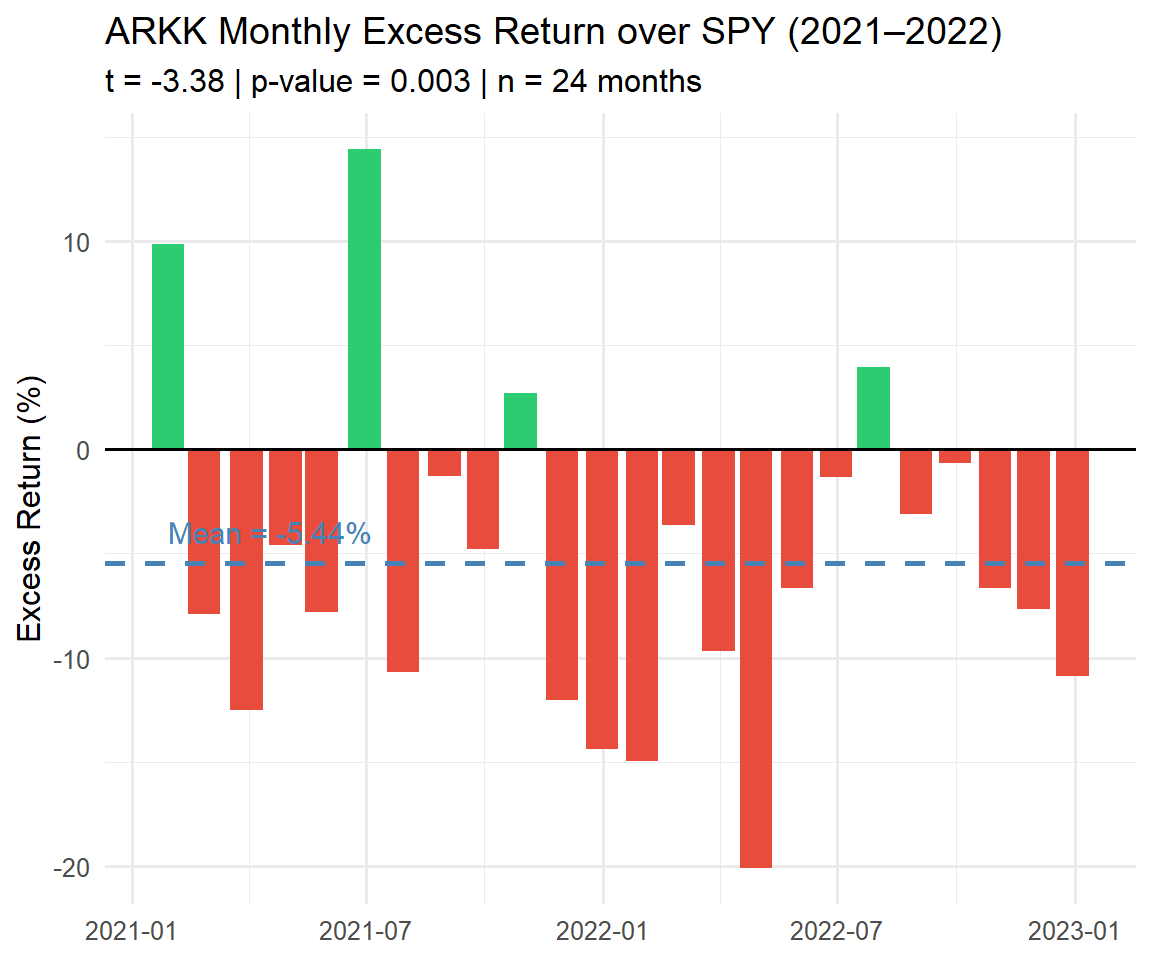
ggplot(joined, aes(x = date, y = excess * 100)) +
  geom_col(aes(fill = excess > 0), show.legend = FALSE) +
  geom_hline(yintercept = 0, colour = "black") +
  geom_hline(yintercept = ybar, colour = "steelblue",
             linetype = "dashed", linewidth = 1) +
  scale_fill_manual(values = c("TRUE" = "#2ecc71", "FALSE" = "#e74c3c")) +
  annotate("text", x = min(joined$date), y = ybar + 1.5,
           label = paste0("Mean = ", round(ybar, 2), "%"),
           hjust = 0, colour = "steelblue", size = 4) +
  labs(
    title = "ARKK Monthly Excess Return over SPY (2021โ€“2022)",
    subtitle = paste0("t = ", round(t_stat, 2), " | p-value = ",
                      round(p_val, 3), " | n = ", n, " months"),
    x = NULL, y = "Excess Return (%)"
  ) +
  theme_minimal(base_size = 12)

๐Ÿ’ฐ Case Study: Key Findings

๐Ÿ“Š Analysis Results โ€” ARKK Alpha vs SPY (2021โ€“2022)

Statistical Result:

  • Two-tailed \(t\)-test: \(H_0: \mu_{\text{excess}} = 0\)

  • ARKK underperformed SPY by ~2โ€“4% per month on average

  • \(|t|\) is large โ†’ Reject \(H_0\)

  • p-value \(< 0.05\) โ€” significant negative alpha

Why \(t\) Not \(Z\)?

  • Monthly data โ†’ only ~24 observations

  • With \(n < 30\), CLT approximation is unreliable

  • \(t\)-distribution has heavier tails โ†’ more conservative critical values โ†’ more honest uncertainty

Regulatory Implications:

  1. Performance claims: Statistically significant underperformance is legally relevant in fund disclosures

  2. Sample size matters: 24 months already yields good power when effect is large

  3. Practical vs statistical: Statistical significance โ‰  economic significance โ€” size of alpha matters too

๐Ÿ“ Quiz #1: Choosing the Test

A fintech startup has 12 months of daily active user data (\(n = 12\)). The founder claims mean DAU exceeds 50,000. Which test is most appropriate to evaluate this claim, assuming DAU is approximately normally distributed?

  • One-sample \(t\)-test with \(\nu = 11\) df, because \(n\) is small and population variance is unknown
  • One-sample \(Z\)-test, because we know the population is normal
  • Two-sample \(t\)-test with pooled variance
  • \(Z\)-test for proportions, since DAU is a count

๐Ÿ“ Quiz #2: Computing Type II Error

For \(H_0: \mu = 100\) vs \(H_a: \mu > 100\), \(\alpha = 0.05\), \(n = 25\), \(\sigma = 10\). The critical boundary is \(k = 103.29\). What is \(\beta\) when the true mean is \(\mu_a = 104\)?

  • \(\beta = \Phi\!\left(\frac{103.29 - 104}{10/\sqrt{25}}\right) = \Phi(-0.355) \approx 0.361\)
  • \(\beta = 1 - \Phi(1.645) = 0.05\)
  • \(\beta = \Phi(1.645) = 0.95\)
  • \(\beta = \Phi\!\left(\frac{104 - 100}{10/\sqrt{25}}\right) = \Phi(2) \approx 0.977\)

๐Ÿ“ Quiz #3: Sample Size Formula

A regulator wants to detect a rise in the mean latency of a broadband network from \(\mu_0 = 20\) ms to \(\mu_a = 22\) ms. They want \(\alpha = 0.05\) and \(\beta = 0.10\), and \(\sigma = 5\) ms. Which expression gives the required sample size?

  • \(n = \dfrac{(z_{0.05} + z_{0.10})^2 \cdot 5^2}{(22-20)^2} = \dfrac{(1.645+1.282)^2 \cdot 25}{4} \approx 54\)
  • \(n = (1.96 + 1.645)^2 \cdot 25 / 4 \approx 81\)
  • \(n = (1.645)^2 \cdot 25 / 4 \approx 17\)
  • \(n = (1.645 + 1.645)^2 \cdot 25 / 4 \approx 54\) (wrong, uses \(z_{0.025}\) not \(z_{0.05}\))

๐Ÿ“ Quiz #4: Pooled \(t\)-Test Setup

Two equity analysts are compared. Analyst A: \(n_1 = 8\), \(\bar Y_1 = 5.2\%\), \(S_1 = 2.1\%\). Analyst B: \(n_2 = 10\), \(\bar Y_2 = 4.0\%\), \(S_2 = 1.8\%\). Testing \(H_0: \mu_1 = \mu_2\) at \(\alpha = 0.05\). What are the degrees of freedom?

  • \(\nu = n_1 + n_2 - 2 = 8 + 10 - 2 = 16\)
  • \(\nu = n_1 - 1 + n_2 - 1 = 7 + 9 = 16\) โ€” same answer but wrong formula
  • \(\nu = \min(n_1, n_2) - 1 = 7\)
  • \(\nu = n_1 + n_2 = 18\)

๐Ÿ“ Summary

โœ… Key Takeaways

  • Z tests (large \(n\)): Unified framework โ€” \(Z = (\hat\theta - \theta_0)/\sigma_{\hat\theta}\) covers means, proportions, and their differences; use \(S\) when \(\sigma\) unknown

  • Type II error: \(\beta(\mu_a) = \Phi(z_\alpha - \delta\sqrt{n})\) where \(\delta\) is the effect size; power \(= 1 - \beta\) increases with \(n\) and effect size

  • Sample size: \(n = (z_\alpha + z_\beta)^2\sigma^2/(\mu_a - \mu_0)^2\) โ€” always plan before collecting data

  • Small-sample \(t\)-test: \(T = (\bar Y - \mu_0)/(S/\sqrt{n})\) with \(\nu = n-1\) df for one sample; requires normality assumption

  • Pooled two-sample \(t\)-test: Uses common \(S_p\); \(\nu = n_1 + n_2 - 2\); assumes equal population variances

๐Ÿ“š Practice Problems

๐Ÿ“ Homework Problems โ€” Chapter 10 (ยง10.3, 10.4, 10.8)

Problem 1 (Z test for proportion): An ISP claims its network meets QoS standards 98% of the time. In a sample of 400 service windows, 11 showed violations. Test the claim at \(\alpha = 0.05\).

Problem 2 (Type II error): For \(H_0: \mu = 5\%\) vs \(H_a: \mu > 5\%\), \(\alpha = 0.05\), \(n = 64\), \(\sigma = 2\%\). Compute \(\beta\) at \(\mu_a = 5.5\%\) and \(\mu_a = 6\%\). Comment on the pattern.

Problem 3 (Sample size): A risk manager needs to detect a rise in mean VaR from 2.0% to 2.3% (\(\sigma = 0.8\%\)) with \(\alpha = 0.05\) and \(\beta = 0.10\). How many observations are needed?

Problem 4 (Two-sample \(t\)): Two bond fund managers each have 12 months of data. Manager A: \(\bar Y = 3.4\%\), \(s = 1.2\%\). Manager B: \(\bar Y = 2.8\%\), \(s = 1.5\%\). Test \(H_0: \mu_A = \mu_B\) at \(\alpha = 0.05\) using a pooled \(t\)-test.

๐Ÿ‘‹ Thank You!

๐Ÿ“ฌ Contact Information:

Samir Orujov, PhD

Assistant Professor

School of Business, ADA University

๐Ÿ“ง sorujov@ada.edu.az

๐Ÿข Office: D312

โฐ Office Hours: By appointment

๐Ÿ“… Next Class:

Topic: Two-Sample Tests (ยง10.7, 10.9)

Reading: Chapter 10, Sections 10.7 and 10.9

Preparation: Review \(F\)-distribution table (Table 7, Appendix 3); recall Chi-squared distribution properties

โฐ Reminders:

โœ… Complete Practice Problems 1โ€“4

โœ… Verify you can compute \(S_p\) and pooled \(t\) by hand

โœ… Reflect on when \(Z\) vs \(t\) is appropriate

โœ… Work hard!

โ“ Questions?

๐Ÿ’ฌ Open Discussion

Key Topics for Discussion:

  • Why do we use \(p_0\) (not \(\hat p\)) in the denominator of the proportion Z test?

  • In finance, is a Type I or Type II error more costly when auditing fund returns? Does it depend on the auditorโ€™s role (regulator vs investor)?

  • Why does sample size appear under a square root in the Z statistic but squared in the sample size formula?

  • If \(n\) is large, why does the distinction between \(t\) and \(Z\) become negligible?