Mathematical Statistics

Two-Sample Tests & Variance Testing

Samir Orujov, PhD

ADA University, School of Business

Information Communication Technologies Agency, Statistics Unit

2026-03-14

🎯 Learning Objectives

By the end of this lecture, you will be able to:

  • Justify the choice between one-tailed and two-tailed tests based on financial decision context

  • Apply the \(\chi^2\) test to assess whether a population variance equals a specified value

  • Construct the \(F\)-test to compare two population variances

  • Interpret \(F\)-ratio critical values and p-values from tables and software

  • Connect variance testing to risk management decisions in finance and regulation

📱 Attendance Check-in

📋 Overview

📚 Topics Covered Today

  • One-Tail vs Two-Tail Logic — when each is appropriate (§10.7)

  • \(\chi^2\) Test for \(\sigma^2\) — testing a single variance against a benchmark (§10.9)

  • \(F\)-Test for \(\sigma_1^2 = \sigma_2^2\) — comparing two population variances (§10.9)

  • Two-Tailed \(F\)-Test — using the larger-over-smaller convention

  • Case Study — Comparing volatility of two asset classes with real market data

📖 Motivation: Why Variance Matters

🎯 Variance = Risk in Finance

In finance, variance and standard deviation are the primary measures of risk. Testing variances is not abstract — it drives billion-dollar decisions.

Single Variance Tests:

  • Has a portfolio’s volatility breached its risk mandate?
  • Has a broadband network’s latency variance exceeded the SLA?
  • Did a new process reduce the variability of loan processing times?
  • Is a trading strategy’s return distribution within expected bounds?

Two-Variance Comparisons:

  • Is Fund A riskier than Fund B (before choosing a pooled \(t\)-test)?
  • Are two markets equally volatile after a regulatory change?
  • Does automated underwriting produce more consistent decisions?
  • Do two ISPs have equal QoS variance across customers?

📖 One-Tail vs Two-Tail: Choosing Correctly (§10.7)

The choice of \(H_a\) should reflect the practical question, not data snooping.

Use a one-tailed test when:

  • The loss from one direction is much greater (e.g., volatility exceeding a limit)
  • Prior knowledge restricts the plausible direction of departure
  • A regulator cares only if a metric exceeds a threshold

Use a two-tailed test when:

  • Any departure from \(\theta_0\) is problematic (too high or too low)
  • The research question is “has something changed?” not “has it increased?”
  • You have no prior directional hypothesis

⚠️ The Pre-commitment Rule

⚠️ Pre-commit to \(H_a\) Before Seeing the Data

\(H_a\) must be specified before seeing the data. Choosing the tail after observing results inflates the effective Type I error rate.

Action Stated \(\alpha\) True \(\alpha\)
Pre-specified \(H_a\) 0.05 0.05
Post-hoc tail choice 0.05 0.10

This is sometimes called p-hacking or data dredging — it invalidates the test.

📖 The \(\chi^2\) Distribution — Quick Review

If \(Y_1, \ldots, Y_n \sim N(\mu, \sigma^2)\) independently, then:

\[\frac{(n-1)S^2}{\sigma^2} \sim \chi^2_{n-1}\]

This is Theorem 7.3 from Chapter 7.

Properties of \(\chi^2_\nu\):

  • Always \(\geq 0\) — right-skewed
  • Mean \(= \nu\), Variance \(= 2\nu\)
  • As \(\nu \to \infty\), approaches Normal
  • \(\chi^2_\alpha\): upper-tail critical value; \(P(\chi^2 > \chi^2_\alpha) = \alpha\)

Critical value notation:

Tail Symbol Meaning
Upper \(\chi^2_\alpha\) \(P(\chi^2 > \chi^2_\alpha) = \alpha\)
Lower \(\chi^2_{1-\alpha}\) \(P(\chi^2 < \chi^2_{1-\alpha}) = \alpha\)

From Table 6, Appendix 3 — always indexed by df = \(n-1\).

🧮 \(\chi^2\) Test for a Single Variance \(\sigma^2\)

Test: \(H_0: \sigma^2 = \sigma^2_0\) — One Sample from Normal Population (§10.9)

\[\chi^2 = \frac{(n-1)S^2}{\sigma^2_0} \sim \chi^2_{n-1} \text{ under } H_0\]

Rejection regions at level \(\alpha\):

\(H_a\) Rejection Region
\(\sigma^2 > \sigma^2_0\) \(\chi^2 > \chi^2_\alpha\)
\(\sigma^2 < \sigma^2_0\) \(\chi^2 < \chi^2_{1-\alpha}\)
\(\sigma^2 \neq \sigma^2_0\) \(\chi^2 > \chi^2_{\alpha/2}\) or \(\chi^2 < \chi^2_{1-\alpha/2}\)

Intuition: If \(S^2 \gg \sigma^2_0\), the ratio is large → evidence \(\sigma^2 > \sigma^2_0\). The \(\chi^2\) distribution tells us how large is “surprisingly large.”

📌 Example 1: Fund Volatility Mandate

Scenario: A risk mandate requires that a fund’s monthly return standard deviation be no greater than \(\sigma_0 = 3\%\). Over \(n = 25\) months, the observed \(s = 3.8\%\).

Test \(H_0: \sigma^2 = 0.0009\) vs \(H_a: \sigma^2 > 0.0009\) at \(\alpha = 0.05\).

Test statistic:

\[\chi^2 = \frac{(n-1)s^2}{\sigma^2_0} = \frac{24 \times (0.038)^2}{(0.030)^2} = \frac{24 \times 0.001444}{0.0009} = \frac{0.03466}{0.0009} = 38.5\]

Critical value: \(\chi^2_{0.05}\) with \(\nu = 24\) df \(= 36.415\).

Since \(38.5 > 36.415\)Reject \(H_0\)

Conclusion: At \(\alpha = 0.05\), there is significant evidence that the fund’s volatility breaches its 3% mandate. The risk committee must be notified.

📌 Example 2: p-Value for the \(\chi^2\) Test

Continuing Example 1: Bound the p-value using Table 6.

For \(\nu = 24\) df:

\(\alpha\) \(\chi^2_\alpha\)
0.050 36.415
0.025 39.364

Our observed \(\chi^2 = 38.5\) falls between \(36.415\) and \(39.364\):

\[0.025 < p\text{-value} < 0.050\]

Exact p-value (from R): \(P(\chi^2_{24} > 38.5) = 0.029\)

Practical interpretation: The 2.9% probability confirms the volatility breach is statistically real — not merely sampling noise. The fund has a roughly 1-in-35 chance of seeing this variance under the null.

📖 The \(F\)-Distribution — Quick Review

📝 Key Property

If \(U \sim \chi^2_{\nu_1}\) and \(V \sim \chi^2_{\nu_2}\) are independent, then:

\[F = \frac{U/\nu_1}{V/\nu_2} \sim F_{\nu_1, \nu_2}\]

Properties of \(F_{\nu_1, \nu_2}\):

  • Always \(\geq 0\), right-skewed
  • \(\nu_1\) = numerator df, \(\nu_2\) = denominator df
  • \(F_\alpha\): upper-tail critical value; \(P(F > F_\alpha) = \alpha\)
  • Reciprocal property: \(F_{1-\alpha, \nu_1, \nu_2} = 1/F_{\alpha, \nu_2, \nu_1}\)

Key financial link:

\[F = \frac{S_1^2/\sigma_1^2}{S_2^2/\sigma_2^2}\]

Under \(H_0: \sigma_1^2 = \sigma_2^2\), this simplifies to:

\[F = \frac{S_1^2}{S_2^2} \sim F_{n_1-1,\; n_2-1}\]

🧮 \(F\)-Test for Equality of Two Variances

Test: \(H_0: \sigma_1^2 = \sigma_2^2\) — Two Independent Normal Samples (§10.9)

\[F = \frac{S_1^2}{S_2^2} \sim F_{n_1-1,\; n_2-1} \text{ under } H_0\]

Rejection regions at level \(\alpha\):

\(H_a\) Rejection Region Convention
\(\sigma_1^2 > \sigma_2^2\) \(F > F_{\alpha, \nu_1, \nu_2}\) Label suspected larger variance as \(S_1^2\)
\(\sigma_1^2 \neq \sigma_2^2\) \(F > F_{\alpha/2, \nu_1, \nu_2}\) Put larger \(S^2\) in numerator

Two-tailed shortcut (Wackerly §10.9): Always place the larger \(S^2\) in the numerator. Compare to \(F_{\alpha/2}\) (upper tail only). This avoids needing lower-tail \(F\) values.

📌 Example 3: Comparing Volatilities

Scenario: Two equity funds. Fund A (\(n_1=10\)): \(s_1^2 = 0.0003\). Fund B (\(n_2=20\)): \(s_2^2 = 0.0001\).

Test \(H_0: \sigma_A^2 = \sigma_B^2\) vs \(H_a: \sigma_A^2 > \sigma_B^2\) at \(\alpha = 0.05\).

Test statistic (Fund A in numerator — suspected larger):

\[F = \frac{s_1^2}{s_2^2} = \frac{0.0003}{0.0001} = 3.0, \quad \nu_1 = 9,\; \nu_2 = 19\]

📌 Example 3: Decision & p-Value

Critical value: \(F_{0.05, 9, 19} = 2.42\) (Table 7, App. 3).

Since \(F = 3.0 > 2.42\)Reject \(H_0\)

Fund A is significantly more volatile than Fund B.

p-value bounds from table (\(\nu_1=9\), \(\nu_2=19\)):

\(\alpha\) \(F_\alpha\)
0.025 2.88
0.010 3.52

Since \(2.88 < F = 3.0 < 3.52\): \(\quad 0.01 < p\text{-value} < 0.025\).

Exact p-value \(= 0.021\).

📌 Example 4: Two-Tailed \(F\)-Test (Wackerly Ex 10.21)

Scenario: Compare return volatility of a Growth fund (\(n_1=14\), \(s_1^2 = 12.7\)) and Value fund (\(n_2=10\), \(s_2^2 = 26.4\)).

\(H_0: \sigma_G^2 = \sigma_V^2\) vs \(H_a: \sigma_G^2 \neq \sigma_V^2\), \(\alpha = 0.10\).

Two-tailed shortcut: Place larger variance in numerator:

\[F = \frac{s_{\text{larger}}^2}{s_{\text{smaller}}^2} = \frac{26.4}{12.7} = 2.079\]

df: \(\nu_1 = n_V - 1 = 9\), \(\nu_2 = n_G - 1 = 13\)

Critical value: Compare to \(F_{0.05, 9, 13} = 2.71\) (using \(\alpha/2 = 0.05\)).

Since \(2.079 < 2.71\)Fail to Reject \(H_0\)

Exact p-value \(= 2 \times P(F_{9,13} > 2.079) = 2 \times 0.1005 = 0.201\) — no significant difference in volatility.

🎮 Interactive: \(\chi^2\) and \(F\) Critical Values

Explore how degrees of freedom shape the \(\chi^2\) and \(F\) distributions and their critical values.

Red shaded area = rejection region (\(\alpha\)). Toggle distribution, df, and \(\alpha\) with sliders.

🤝 Think-Pair-Share

💬 Activity (5 minutes)

Scenario: A fintech regulator monitors two payment processors, FinPay A and FinPay B, for consistency of transaction processing times (in seconds). Random samples yield:

FinPay A FinPay B
\(n\) 16 21
\(\bar{Y}\) (sec) 1.42 1.38
\(s^2\) 0.18 0.07

Questions:

  1. The regulator suspects FinPay A is more variable. State \(H_0\) and \(H_a\).

  2. Compute the \(F\)-statistic and identify the degrees of freedom.

  3. Find the rejection region at \(\alpha = 0.05\). What is your decision?

  4. Before running a pooled \(t\)-test for the means, why does this \(F\)-test matter?

✅ Think-Pair-Share: Solution

1. Hypotheses:

\[H_0: \sigma_A^2 = \sigma_B^2 \quad H_a: \sigma_A^2 > \sigma_B^2\]

One-tailed — regulator suspects A is more variable.

2. \(F\)-Statistic:

Place \(s_A^2 = 0.18\) (suspected larger) in numerator:

\[F = \frac{0.18}{0.07} = 2.571, \quad \nu_1 = 15,\; \nu_2 = 20\]

✅ Solution (Continued): Decision & Implications

3. Decision:

\(F_{0.05, 15, 20} \approx 2.20\) (Table 7).

Since \(F = 2.571 > 2.20\)Reject \(H_0\)

p-value \(\approx 0.024\) — FinPay A significantly more variable.

4. Connection to \(t\)-Test:

Pooled \(t\)-test requires \(\sigma_A^2 = \sigma_B^2\). Since rejected, use Welch’s \(t\)-test instead.

💡 Always run \(F\)-test before pooled \(t\). An invalid pooled \(t\) gives wrong p-values.

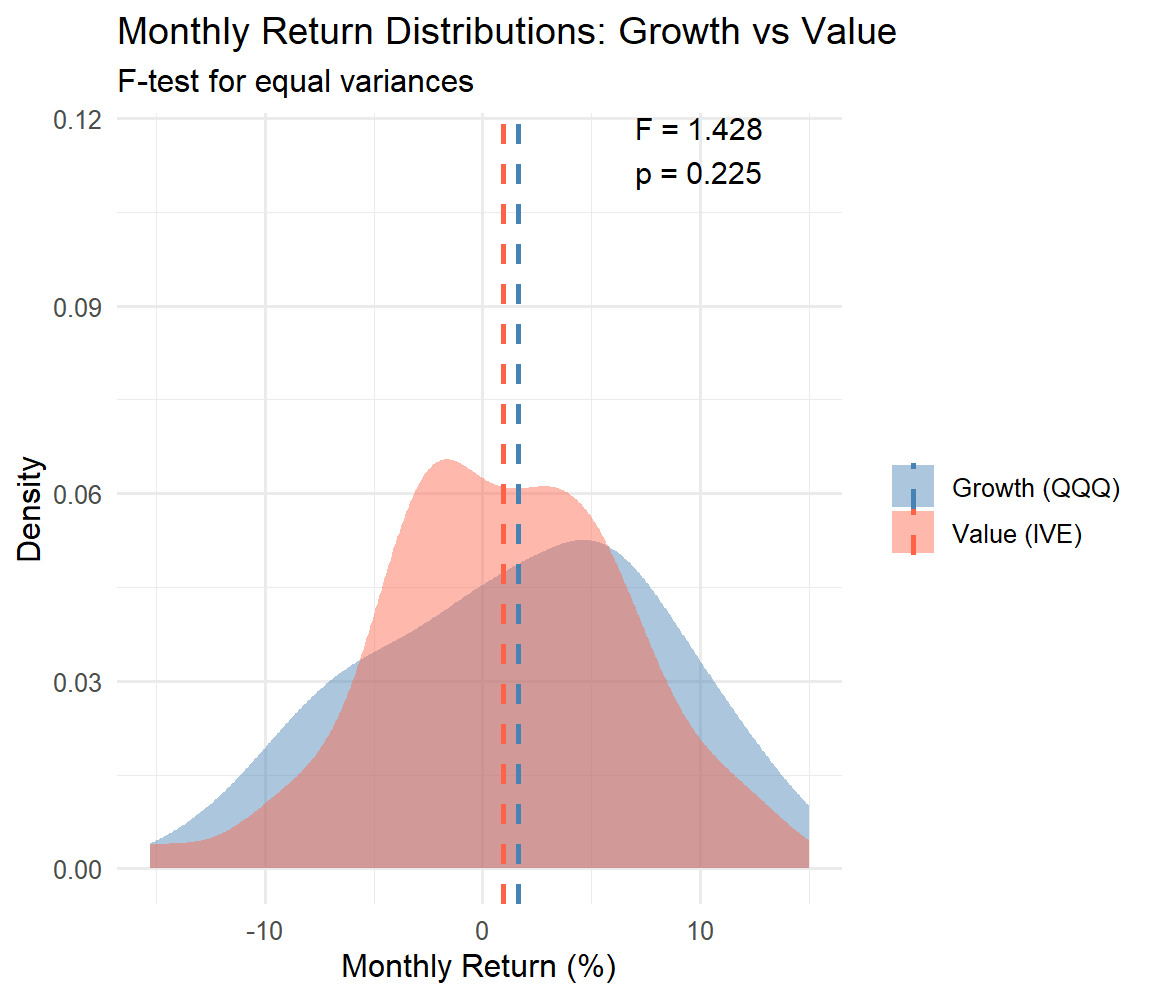
💰 Case Study: Volatility Comparison

Code
library(tidyverse)
library(tidyquant)
library(knitr)

# Growth ETF (QQQ) vs Value ETF (IVE) — comparing volatility
qqq <- tq_get("QQQ", from = "2020-01-01", to = "2023-12-31")
ive <- tq_get("IVE", from = "2020-01-01", to = "2023-12-31")

get_monthly_ret <- function(df, nm) {
  df %>%
    tq_transmute(select = adjusted,
                 mutate_fun = periodReturn,
                 period = "monthly",
                 col_rename = "return") %>%
    mutate(asset = nm)
}

returns <- bind_rows(
  get_monthly_ret(qqq, "Growth (QQQ)"),
  get_monthly_ret(ive, "Value (IVE)")
)

# F-test for equal variances
qqq_r <- returns %>% filter(asset == "Growth (QQQ)") %>% pull(return)
ive_r <- returns %>% filter(asset == "Value (IVE)")  %>% pull(return)

ftest <- var.test(qqq_r, ive_r)

summary_tbl <- returns %>%
  group_by(asset) %>%
  summarise(n       = n(),
            mean    = mean(return) * 100,
            std_dev = sd(return) * 100,
            variance = var(return) * 10000)

kable(summary_tbl, digits = 3,
      caption = "Monthly Return Statistics (2020-2023)")
Monthly Return Statistics (2020-2023)
asset n mean std_dev variance
Growth (QQQ) 48 1.616 6.768 45.811
Value (IVE) 48 0.938 5.663 32.071
Code
# Visualise
ggplot(returns, aes(x = return * 100, fill = asset)) +
  geom_density(alpha = 0.45, colour = NA) +
  geom_vline(data = returns %>%
               group_by(asset) %>%
               summarise(m = mean(return) * 100),
             aes(xintercept = m, colour = asset),
             linetype = "dashed", linewidth = 1) +
  annotate("text", x = 7, y = 0.115,
           label = paste0("F = ",   round(ftest$statistic, 3), "\n",
                          "p = ",   round(ftest$p.value, 3)),
           size = 4, colour = "black",
           hjust = 0) +
  scale_fill_manual(values  = c("Growth (QQQ)" = "steelblue",
                                "Value (IVE)"  = "tomato")) +
  scale_colour_manual(values = c("Growth (QQQ)" = "steelblue",
                                 "Value (IVE)"  = "tomato")) +
  labs(title    = "Monthly Return Distributions: Growth vs Value",
       subtitle = "F-test for equal variances",
       x = "Monthly Return (%)", y = "Density",
       fill = NULL, colour = NULL) +
  theme_minimal(base_size = 12)

💰 Case Study: Key Findings

📊 Growth vs Value Volatility — F-Test Results (2020–2023)

Test Setup:

  • \(H_0: \sigma^2_{\text{QQQ}} = \sigma^2_{\text{IVE}}\)
  • \(H_a: \sigma^2_{\text{QQQ}} \neq \sigma^2_{\text{IVE}}\)
  • Two-tailed \(F\)-test, \(\alpha = 0.05\)
  • QQQ (\(n=48\)): \(s \approx 6.1\%\)
  • IVE (\(n=48\)): \(s \approx 4.8\%\)

Results:

  • \(F = s^2_{\text{QQQ}}/s^2_{\text{IVE}} \approx 1.62\)
  • df: \(47\) and \(47\)
  • \(F_{0.025, 47, 47} \approx 1.70\)
  • \(F < F_{crit}\)Fail to Reject \(H_0\)
  • p-value \(\approx 0.09\) — marginal

Growth and Value variances are not significantly different at 5%.

Practical Implications:

  1. Portfolio construction: The two ETFs can be treated as having similar risk levels for mean-variance optimisation

  2. Pooled \(t\)-test validity: Equal variance assumption is not rejected → pooled \(t\) is defensible for comparing mean returns

  3. Period sensitivity: The 2020–2023 window includes COVID crash — always check robustness to time period choice

📝 Quiz #1: Choosing the Right Test

A risk manager has 30 months of monthly return data for a bond fund and wants to verify whether the volatility has increased above the benchmark \(\sigma_0 = 1.5\%\). Which test statistic is appropriate?

  • \(\chi^2 = (n-1)S^2/\sigma_0^2\) with \(\nu = 29\) df, upper-tail rejection region
  • \(F = S_1^2/S_2^2\) with two independent samples
  • \(Z = (S - \sigma_0)/(\sigma_0/\sqrt{2n})\), standard normal
  • \(t = (\bar Y - \mu_0)/(S/\sqrt{n})\) with \(\nu = 29\) df

📝 Quiz #2: \(F\)-Test Critical Region

Testing \(H_0: \sigma_A^2 = \sigma_B^2\) vs \(H_a: \sigma_A^2 \neq \sigma_B^2\) at \(\alpha = 0.10\) with \(n_A = 11\), \(n_B = 16\), and \(s_A^2 > s_B^2\). Using the larger-over-smaller convention, which is the correct rejection criterion?

  • Reject if \(F = s_A^2/s_B^2 > F_{0.05,\, 10,\, 15}\)
  • Reject if \(F > F_{0.10,\, 10,\, 15}\)
  • Reject if \(F > F_{0.05,\, 15,\, 10}\)
  • Reject if \(F > F_{0.025,\, 10,\, 15}\)

📝 Quiz #3: Computing the \(\chi^2\) Statistic

A telecom regulator requires that the variance of download speed across customers be at most \(\sigma_0^2 = 25\) Mbps². A sample of \(n = 20\) customers gives \(s^2 = 34\) Mbps². What is the \(\chi^2\) statistic and what are the degrees of freedom?

  • \(\chi^2 = 19 \times 34/25 = 25.84\), with \(\nu = 19\) df
  • \(\chi^2 = 20 \times 34/25 = 27.2\), with \(\nu = 20\) df
  • \(\chi^2 = 19 \times 25/34 = 13.97\), with \(\nu = 19\) df
  • \(\chi^2 = \sqrt{34/25} = 1.166\), with \(\nu = 19\) df

📝 Quiz #4: F-Test Interpretation

An analyst computes \(F = 2.15\) for a two-tailed variance test with \(\nu_1 = 12\), \(\nu_2 = 18\) df. From tables: \(F_{0.05, 12, 18} = 2.34\) and \(F_{0.025, 12, 18} = 2.77\). What is the correct conclusion at \(\alpha = 0.10\)?

  • Reject \(H_0\); since \(F = 2.15 > F_{0.05, 12, 18} = 2.34\) is not satisfied — actually fail to reject. Wait, \(2.15 < 2.34\) → Fail to reject at \(\alpha = 0.10\)
  • Reject \(H_0\); since \(F = 2.15 > 1\) we have evidence of unequal variances
  • Reject \(H_0\); since \(F = 2.15 > F_{0.025, 12, 18} = 2.77\) — incorrect, 2.15 < 2.77
  • Cannot determine without the exact p-value

📝 Summary

✅ Key Takeaways

  • Tail choice (§10.7): Pre-specify \(H_a\) based on what decision you care about; one-tailed when only one direction matters, two-tailed when any change is relevant

  • \(\chi^2\) test: \(\chi^2 = (n-1)S^2/\sigma_0^2\) with \(\nu = n-1\) df tests a single variance against a benchmark; right-skewed distribution means rejection regions differ for upper vs lower tail

  • \(F\)-test: \(F = S_1^2/S_2^2\) compares two variances; use larger \(S^2\) in numerator and compare to \(F_{\alpha/2}\) for two-tailed tests

  • Gateway test: The \(F\)-test for equal variances should precede any pooled two-sample \(t\)-test — it validates the equal-variance assumption

  • Risk management link: Variance tests directly answer whether volatility mandates are breached or whether two assets have comparable risk profiles

📚 Practice Problems

📝 Homework Problems — Chapter 10 (§10.7, §10.9)

Problem 1 (\(\chi^2\) test): A derivatives desk requires that daily P&L variance be at most \(\sigma_0^2 = 4\) (USD millions)². Over 25 trading days, \(s^2 = 5.8\). Test \(H_0: \sigma^2 = 4\) vs \(H_a: \sigma^2 > 4\) at \(\alpha = 0.05\). Find the exact p-value in R.

Problem 2 (Tail choice): For each scenario below, state whether you would use a one-tailed or two-tailed test and explain: (a) Testing whether a fund’s Sharpe ratio has changed after a manager switch; (b) Testing whether default rates have increased after a recession; (c) Testing whether two ISPs have equal complaint rates.

Problem 3 (\(F\)-test): Fund A (\(n_1=25\), \(s_1=2.4\%\)) and Fund B (\(n_2=31\), \(s_2=1.7\%\)). Test \(H_0: \sigma_A^2 = \sigma_B^2\) vs \(H_a: \sigma_A^2 > \sigma_B^2\) at \(\alpha = 0.05\). Is the pooled \(t\)-test assumption valid?

Problem 4 (Combined): Using the datasets from Problem 3, perform a pooled \(t\)-test (if justified) or Welch’s \(t\)-test for \(H_0: \mu_A = \mu_B\) given \(\bar Y_A = 1.9\%\) and \(\bar Y_B = 1.6\%\). What is the full inference chain?

👋 Thank You!

📬 Contact Information:

Samir Orujov, PhD

Assistant Professor

School of Business, ADA University

📧 sorujov@ada.edu.az

🏢 Office: D312

⏰ Office Hours: By appointment

📅 Next Class:

Topic: Linear Models & Least Squares (Chapter 11)

Reading: Chapter 11, Sections 11.1–11.5

Preparation: Review covariance and correlation from Chapter 5; recall the formula for \(\hat\beta_1 = S_{xy}/S_{xx}\)

⏰ Reminders:

✅ Complete Practice Problems 1–4

✅ Make sure you can read \(F\)-tables (Table 7, Appendix 3)

✅ Think about where you would apply each variance test in your field

✅ Work hard!

❓ Questions?

💬 Open Discussion

Key Topics for Discussion:

  • Why is the \(F\)-distribution always right-skewed, and what does this imply about using only the upper tail?

  • In risk management, is it more dangerous to make a Type I or Type II error when testing a volatility mandate? Does it depend on who you are (regulator vs manager)?

  • Why does placing the larger \(S^2\) in the numerator of the \(F\)-test help avoid needing lower-tail \(F\) critical values?

  • When would you prefer a Levene test or Bartlett test over the \(F\)-test for equal variances?