Mathematical Statistics

Point Estimation

Samir Orujov, PhD

ADA University, School of Business

Information Communication Technologies Agency, Statistics Unit

2026-03-14

๐ŸŽฏ Learning Objectives

By the end of this lecture, you will be able to:

  • Define what a point estimator is and distinguish it from an interval estimator

  • Compute the bias, variance, and mean square error (MSE) of a point estimator

  • Identify common unbiased estimators for means, proportions, and differences

  • Apply the 2-standard-error bound to quantify the precision of any point estimate

  • Interpret standard errors in financial and economic contexts, including portfolio and market-share estimation

๐Ÿ“ฑ Attendance Check-in

๐Ÿ“‹ Overview

๐Ÿ“š Topics Covered Today

  • Introduction to Estimation โ€“ Point vs. interval estimates; the role of target parameters

  • Bias & Unbiasedness โ€“ What it means for an estimator to be centered on the truth

  • Mean Square Error (MSE) โ€“ Balancing bias and variance in estimator quality

  • Common Unbiased Estimators โ€“ \(\bar{Y}\), \(\hat{p}\), \(\bar{Y}_1 - \bar{Y}_2\), \(\hat{p}_1 - \hat{p}_2\)

  • Error of Estimation โ€“ Bounding how far off our estimate could be

  • Case Study โ€“ Estimating mean stock returns and proportions from market data

๐Ÿ“– Why Estimation?

๐ŸŽฏ Motivation

In finance and economics, population parameters are never directly observed โ€” we always work from samples.

Finance Applications:

  • Estimating mean daily return \(\mu\) of a stock
  • Estimating default probability \(p\) of a loan portfolio
  • Comparing mean returns \(\mu_1 - \mu_2\) of two funds
  • Estimating market share difference \(p_1 - p_2\)

Regulatory & Policy Applications:

  • Estimating mean broadband speed across ISPs
  • Estimating fraud rate in financial transactions
  • Estimating GDP growth from survey data
  • Estimating unemployment from labor force samples

Key Question

Given a sample, what single number best represents an unknown population parameter?

๐Ÿ“– Definition: Estimator vs. Estimate

๐Ÿ“ Definition 8.1: Estimator

An estimator is a rule (often a formula) that tells how to calculate the value of an estimate based on the measurements in a sample.

\[\hat{\theta} = g(Y_1, Y_2, \ldots, Y_n)\]

Interpretation: The estimator \(\hat{\theta}\) (read โ€œtheta-hatโ€) is a random variable โ€” its value varies from sample to sample.

๐Ÿ’ก Point vs. Interval Estimate

Type Description Example
Point Estimate Single number \(\hat{\mu} = 0.13\%\) daily return
Interval Estimate Range of values \(\mu \in (0.07\%, 0.19\%)\)

A point estimator is the formula; a point estimate is the resulting number from your data.

๐Ÿ“– The Bullโ€™s-Eye Analogy

Point estimation is like firing at a target:

The Components:

Analogy Statistics
Revolver Estimator \(\hat{\theta}\)
Single shot One estimate from one sample
Bullโ€™s-eye True parameter \(\theta\)
Shot pattern Sampling distribution of \(\hat{\theta}\)

The Key Insight:

One lucky shot tells us nothing about a marksmanโ€™s skill.

Similarly, one estimate tells us nothing about an estimatorโ€™s quality.

We evaluate estimators by their long-run behavior โ€” the shape and center of their sampling distribution.

๐Ÿ’ผ A fund manager who beats the market once may be lucky. One who beats it consistently over 100 quarters is likely skilled.

๐Ÿ“– Definition: Bias

๐Ÿ“ Definition 8.2: Unbiased Estimator

Let \(\hat{\theta}\) be a point estimator for a parameter \(\theta\). Then \(\hat{\theta}\) is unbiased if:

\[E(\hat{\theta}) = \theta\]

If \(E(\hat{\theta}) \neq \theta\), then \(\hat{\theta}\) is biased.

๐Ÿ“ Definition 8.3: Bias

The bias of a point estimator \(\hat{\theta}\) is:

\[B(\hat{\theta}) = E(\hat{\theta}) - \theta\]

Finance Interpretation:

  • An unbiased return estimator: on average, we neither systematically over- nor under-estimate the true expected return

  • A biased estimator: our estimates consistently overshoot or undershoot the truth โ€” like a fund that consistently over-reports its Sharpe ratio

๐Ÿ“– Bias Illustrated

Unbiased estimator โ€” centered on \(\theta\):

\[E(\hat{\theta}) = \theta\]

The sampling distribution is centered at the true value.

โœ… Ideal starting property

Biased estimator โ€” shifted from \(\theta\):

\[E(\hat{\theta}) > \theta \quad \text{(positive bias)}\] \[E(\hat{\theta}) < \theta \quad \text{(negative bias)}\]

The sampling distribution is offset from the true value.

โš ๏ธ Systematically misleading

Two Unbiased Estimators โ€” Which is Better?

Even among unbiased estimators, we prefer smaller variance. A tight cluster around \(\theta\) beats a spread-out one, even if both are centered correctly.

๐Ÿ“– Definition: Mean Square Error

๐Ÿ“ Definition 8.4: Mean Square Error (MSE)

The mean square error of a point estimator \(\hat{\theta}\) is:

\[\text{MSE}(\hat{\theta}) = E\left[(\hat{\theta} - \theta)^2\right]\]

Key decomposition:

\[\boxed{\text{MSE}(\hat{\theta}) = V(\hat{\theta}) + \left[B(\hat{\theta})\right]^2}\]

Interpretation:

  • MSE captures total error = spread + systematic error
  • If unbiased: \(\text{MSE}(\hat{\theta}) = V(\hat{\theta})\)
  • A biased estimator with very small variance can have lower MSE than an unbiased one

Finance Analogy:

Like tracking error in fund management:

  • Bias = consistent over/underperformance vs. benchmark
  • Variance = volatility of the tracking difference
  • MSE = total risk-adjusted tracking error

๐Ÿ“Œ Example 1: Biased vs. Unbiased Variance Estimator

Problem: Given a random sample \(Y_1, \ldots, Y_n\) with \(E(Y_i) = \mu\) and \(V(Y_i) = \sigma^2\), compare two estimators of \(\sigma^2\):

\[S'^2 = \frac{1}{n}\sum_{i=1}^n (Y_i - \bar{Y})^2, \qquad S^2 = \frac{1}{n-1}\sum_{i=1}^n (Y_i - \bar{Y})^2\]

Which estimator is unbiased? Derive \(E(S'^2)\) and \(E(S^2)\).

๐Ÿ“Œ Example 1: Solution

Solution: Use \(E(Y_i^2) = \sigma^2 + \mu^2\) and \(E(\bar{Y}^2) = \sigma^2/n + \mu^2\).

\[E\left[\sum_{i=1}^n (Y_i - \bar{Y})^2\right] = (n-1)\sigma^2\]

\[\Rightarrow E(S'^2) = \frac{n-1}{n}\sigma^2 \neq \sigma^2 \quad \text{Biased!}\]

\[E(S^2) = \frac{1}{n-1} \cdot (n-1)\sigma^2 = \sigma^2 \quad \text{Unbiased โœ…}\]

๐Ÿ’ผ This is why financial software divides by \(n-1\), not \(n\), when computing volatility from historical returns.

๐Ÿ“– Common Unbiased Estimators

Target Parameter \(\theta\) Sample Size Estimator \(\hat{\theta}\) Standard Error \(\sigma_{\hat{\theta}}\)
Population mean \(\mu\) \(n\) \(\bar{Y}\) \(\sigma/\sqrt{n}\)
Binomial proportion \(p\) \(n\) \(\hat{p} = Y/n\) \(\sqrt{pq/n}\)
Difference of means \(\mu_1 - \mu_2\) \(n_1, n_2\) \(\bar{Y}_1 - \bar{Y}_2\) \(\sqrt{\sigma_1^2/n_1 + \sigma_2^2/n_2}\)
Difference of proportions \(p_1 - p_2\) \(n_1, n_2\) \(\hat{p}_1 - \hat{p}_2\) \(\sqrt{p_1q_1/n_1 + p_2q_2/n_2}\)

Key Facts

  • All four estimators are unbiased under random sampling
  • All four have approximately normal sampling distributions for large samples (CLT)
  • Standard errors decrease as sample size increases โ€” more data โ†’ more precision

๐Ÿ“– Definition: Error of Estimation

๐Ÿ“ Definition 8.5: Error of Estimation

The error of estimation \(\varepsilon\) is the distance between an estimator and its target parameter:

\[\varepsilon = |\hat{\theta} - \theta|\]

How large could the error be?

Since \(\hat{\theta}\) is approximately normally distributed (for large \(n\)):

\[P\left(|\hat{\theta} - \theta| < 2\sigma_{\hat{\theta}}\right) \approx 0.95\]

We use \(b = 2\sigma_{\hat{\theta}}\) as a 2-standard-error bound on the error of estimation.

๐Ÿ’ก Practical Rule

With ~95% confidence, the error of estimation is less than \(2\sigma_{\hat{\theta}}\).

This bound gets tighter as \(n\) increases, since \(\sigma_{\hat{\theta}} \propto 1/\sqrt{n}\).

๐Ÿ“Œ Example 2: Estimating a Default Rate

Problem: A risk officer samples \(n = 1000\) corporate loans. Of these, \(y = 43\) defaulted within 12 months. Estimate the default probability \(p\) and place a 2-standard-error bound on the error.

Solution:

Point estimate: \(\hat{p} = \dfrac{43}{1000} = 0.043\)

Standard error bound (substituting \(\hat{p}\) for \(p\)):

\[b = 2\sigma_{\hat{p}} = 2\sqrt{\frac{\hat{p}(1-\hat{p})}{n}} = 2\sqrt{\frac{(0.043)(0.957)}{1000}} \approx 2 \times 0.0203 = 0.0406\]

Interpretation:

We estimate the true default rate is 4.3%, and we are approximately 95% confident the true value lies within ยฑ0.41 percentage points of this estimate โ€” i.e., roughly in the interval (3.9%, 4.7%).

๐Ÿ“Œ Example 3: Comparing Fund Returns

Problem: Two equity funds are compared using independent samples. Fund A: \(n_1 = 100\) monthly returns, \(\bar{y}_1 = 1.2\%\), \(s_1^2 = 4.0\). Fund B: \(n_2 = 100\), \(\bar{y}_2 = 0.9\%\), \(s_2^2 = 5.5\).

Estimate \(\mu_1 - \mu_2\) and place a 2-SE bound on the error.

Point Estimate:

\[(\bar{y}_1 - \bar{y}_2) = 1.2\% - 0.9\% = 0.3\%\]

Standard Error:

\[\sigma_{(\bar{Y}_1 - \bar{Y}_2)} \approx \sqrt{\frac{s_1^2}{n_1} + \frac{s_2^2}{n_2}} = \sqrt{\frac{4.0}{100} + \frac{5.5}{100}} = \sqrt{0.095} \approx 0.308\%\]

2-SE Bound: \(b = 2 \times 0.308\% \approx 0.62\%\)

Interpretation: Fund A appears to outperform Fund B by 0.3% per month, but the error bound of ยฑ0.62% means this difference is not yet statistically distinguishable from zero. Larger samples needed!

๐ŸŽฎ Interactive: MSE Decomposition

Explore how Bias and Variance each contribute to MSE, and why a biased estimator can beat an unbiased one.

๐Ÿค Think-Pair-Share

๐Ÿ’ฌ Discussion (4 minutes)

A central bank samples 200 commercial banks and finds that 36 reported negative equity in the last quarter. A colleague proposes two estimators for the true failure rate \(p\):

\[\hat{p}_1 = \frac{Y}{n} = \frac{36}{200} = 0.18 \qquad \hat{p}_2 = \frac{Y + 2}{n + 4} = \frac{38}{204} \approx 0.186\]

Discuss with your partner:

  1. Is \(\hat{p}_1\) unbiased? What is its standard error?
  2. \(\hat{p}_2\) is known to be biased โ€” can you show why? What is its bias?
  3. Under what conditions might \(\hat{p}_2\) actually have lower MSE than \(\hat{p}_1\)?
  4. Which would you report in a regulatory context, and why?

๐Ÿ’ฐ Case Study: Point Estimates

Code
library(tidyverse)
library(tidyquant)
library(knitr)

symbols <- c("AAPL", "JPM", "XOM")
prices <- tq_get(symbols, from = "2021-01-01", to = "2023-12-31")

returns <- prices %>%
  group_by(symbol) %>%
  tq_transmute(select = adjusted, mutate_fun = periodReturn,
               period = "daily", col_rename = "r")

stats <- returns %>%
  group_by(symbol) %>%
  summarise(n = n(), mu_hat = mean(r) * 100,
            se = sd(r) * 100 / sqrt(n()),
            bound_2se = 2 * sd(r) * 100 / sqrt(n()))

kable(stats, digits = 4,
      col.names = c("Stock", "n", "ฮผฬ‚ (%)", "SE (%)", "2-SE Bound (%)"),
      caption = "Point Estimates of Mean Daily Return")
Point Estimates of Mean Daily Return
Stock n ฮผฬ‚ (%) SE (%) 2-SE Bound (%)
AAPL 753 0.0704 0.0638 0.1275
JPM 753 0.0630 0.0559 0.1117
XOM 753 0.1525 0.0693 0.1386

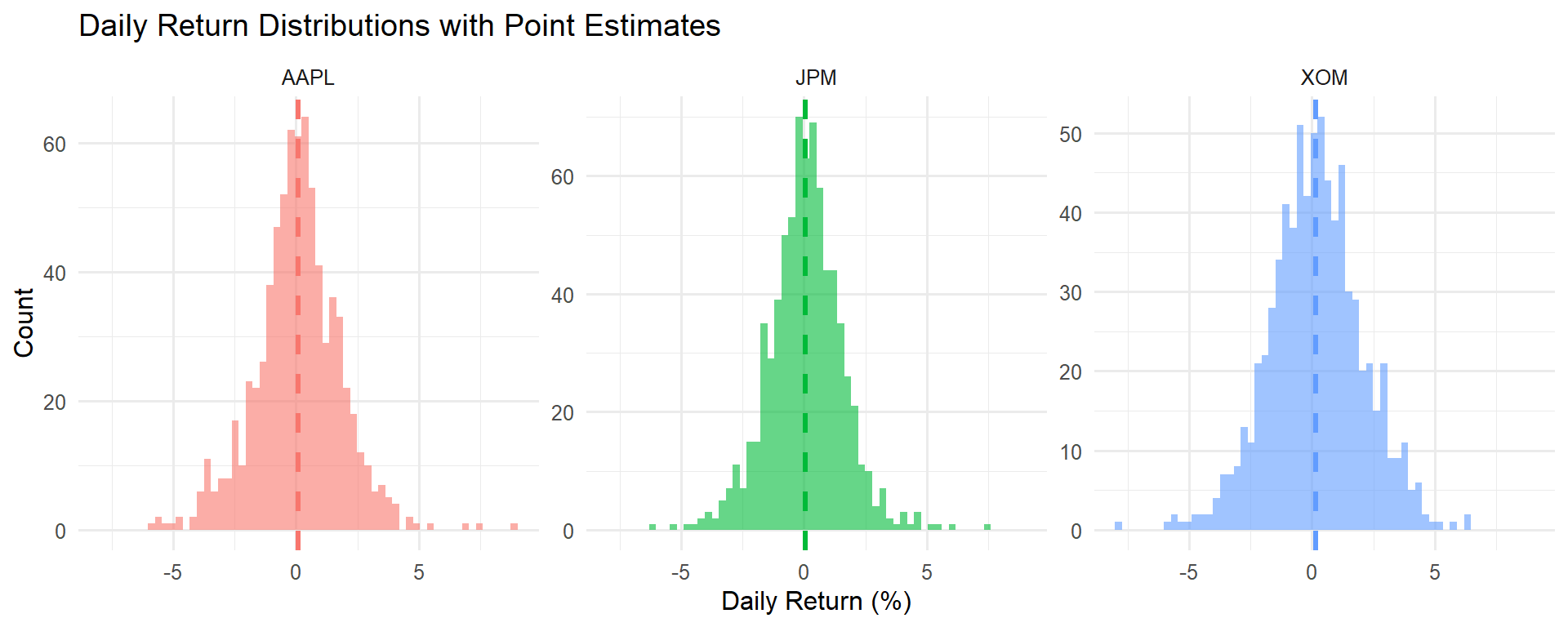
๐Ÿ’ฐ Case Study: Return Distributions

Code
returns %>%
  mutate(r_pct = r * 100) %>%
  ggplot(aes(x = r_pct, fill = symbol)) +
  geom_histogram(bins = 60, alpha = 0.6, position = "identity") +
  geom_vline(data = stats,
             aes(xintercept = mu_hat, color = symbol),
             linewidth = 1.2, linetype = "dashed") +
  facet_wrap(~symbol, ncol = 3, scales = "free_y") +
  labs(title = "Daily Return Distributions with Point Estimates",
       x = "Daily Return (%)", y = "Count") +
  theme_minimal(base_size = 12) +
  theme(legend.position = "none")

๐Ÿ’ฐ Case Study: Key Findings

๐Ÿ“Š Interpreting the Point Estimates

Point Estimates \(\hat{\mu}\):

  • Apple (AAPL): ~0.07% daily
  • JP Morgan (JPM): ~0.06% daily
  • Exxon (XOM): ~0.15% daily

All close to zero โ€” consistent with efficient market hypothesis for daily returns

Standard Errors SE:

  • SE โ‰ˆ 0.056โ€“0.069% for all stocks
  • 2-SE bounds โ‰ˆ 0.11โ€“0.14%
  • With \(n \approx 750\) observations, SE is small relative to daily volatility (~2%)
  • Larger \(n\) tightens the SE further

Takeaways for Estimation:

  1. Unbiasedness: \(\bar{Y}\) centers on \(\mu\)
  2. Precision grows with sample size
  3. 2-SE bound gives a practical confidence region
  4. Bias-variance tradeoff matters when data is limited

๐Ÿ“ Quiz #1: Unbiased Estimator

Given \(Y_1, Y_2, Y_3\) i.i.d. with mean \(\mu\), which of the following is NOT an unbiased estimator of \(\mu\)?

  • \(\frac{Y_1 + Y_2 + Y_3}{3}\)
  • \(\frac{Y_1 + Y_2}{2}\)
  • \(\frac{2Y_1 + Y_3}{2}\)
  • \(Y_2\)

๐Ÿ“ Quiz #2: MSE Decomposition

If \(\hat{\theta}\) is an unbiased estimator of \(\theta\) with variance \(V(\hat{\theta}) = 4\), what is \(\text{MSE}(\hat{\theta})\)?

  • 4
  • 2
  • 0
  • 16

๐Ÿ“ Quiz #3: Standard Error Bound

A bank estimates the proportion of clients with a credit score above 700. From \(n = 400\) clients, 280 qualify. The 2-standard-error bound on the error of estimation is approximately:

  • 0.046
  • 0.023
  • 0.092
  • 0.014

๐Ÿ“ Quiz #4: Comparing Two Estimators

Estimator \(\hat{\theta}_1\) is unbiased with \(V(\hat{\theta}_1) = 9\). Estimator \(\hat{\theta}_2\) has \(B(\hat{\theta}_2) = 2\) and \(V(\hat{\theta}_2) = 3\). Which has lower MSE?

  • \(\hat{\theta}_2\), since \(\text{MSE}(\hat{\theta}_2) = 3 + 4 = 7 < 9\)
  • \(\hat{\theta}_1\), because unbiased estimators always have lower MSE
  • They are equal
  • Cannot be determined without knowing \(\theta\)

๐Ÿ“ Summary

โœ… Key Takeaways

  • Estimators vs. Estimates: An estimator is a random variable (formula); an estimate is its realized value from data

  • Unbiasedness: \(E(\hat{\theta}) = \theta\) โ€” the estimator is centered on the true parameter; \(\bar{Y}\) and \(\hat{p}\) are unbiased

  • MSE = Variance + Biasยฒ: Total error accounts for both spread and systematic error; a biased estimator can win if its variance is much smaller

  • Common Estimators: \(\bar{Y}\), \(\hat{p}\), \(\bar{Y}_1 - \bar{Y}_2\), \(\hat{p}_1 - \hat{p}_2\) are all unbiased and approximately normal for large \(n\)

  • Error Bound: With ~95% confidence, error of estimation \(< 2\sigma_{\hat{\theta}}\); this shrinks as \(n\) grows

๐Ÿ“š Practice Problems

๐Ÿ“ Homework Problems

Problem 1 (Unbiasedness): Let \(Y_1, Y_2, \ldots, Y_n\) be i.i.d. from a distribution with mean \(\mu\) and variance \(\sigma^2\). Show that \(S^2 = \frac{1}{n-1}\sum(Y_i - \bar{Y})^2\) is an unbiased estimator for \(\sigma^2\). (Wackerly Ex. 8.1)

Problem 2 (Bias & MSE): Suppose \(E(\hat{\theta}) = 2\theta + 1\). Find \(B(\hat{\theta})\) and construct an unbiased estimator \(\hat{\theta}^*\) from \(\hat{\theta}\). (Wackerly Ex. 8.3)

Problem 3 (Comparing Estimators): \(\hat{p}_1 = Y/n\) and \(\hat{p}_2 = (Y+1)/(n+2)\). Derive \(B(\hat{p}_2)\), \(\text{MSE}(\hat{p}_1)\), and \(\text{MSE}(\hat{p}_2)\). For which values of \(p\) does \(\hat{p}_2\) dominate? (Wackerly Ex. 8.17)

Problem 4 (Financial Application): An analyst observes \(n = 252\) daily returns of a hedge fund with \(\bar{y} = 0.06\%\) and \(s = 1.2\%\). (a) Give a point estimate of the true mean daily return. (b) Place a 2-SE bound on the error. (c) Annualize your estimate (ร—252) and interpret.

๐Ÿ‘‹ Thank You!

๐Ÿ“ฌ Contact Information:

Samir Orujov, PhD

Assistant Professor

School of Business

ADA University

๐Ÿ“ง Email: sorujov@ada.edu.az

๐Ÿข Office: D312

โฐ Office Hours: By appointment

๐Ÿ“… Next Class:

Topic: Interval Estimation (Confidence Intervals)

Reading: Chapter 8, Sections 8.5โ€“8.9

Preparation: Review the standard normal table and \(t\)-distribution

โฐ Reminders:

โœ… Complete Practice Problems 1โ€“4

โœ… Review the CLT and standard normal distribution

โœ… Think about: what does โ€œ95% confidentโ€ actually mean?

โœ… Work hard!

โ“ Questions?

๐Ÿ’ฌ Open Discussion

Key Topics for Discussion:

  • Why do we divide by \(n-1\) instead of \(n\) in the sample variance?

  • Can a biased estimator ever be preferable to an unbiased one in practice?

  • How would you explain the concept of โ€œstandard errorโ€ to a non-statistician client?

  • If you double your sample size, how much does your estimation error shrink?