Mathematical Statistics

Topic 7: Properties of Point Estimators & Methods of Estimation

Samir Orujov, PhD

ADA University, School of Business

Information Communication Technologies Agency, Statistics Unit

2026-03-14

๐ŸŽฏ Learning Objectives

By the end of this lecture, you will be able to:

  1. Compare two unbiased estimators using relative efficiency and the Cramรฉrโ€“Rao lower bound

  2. Verify whether an estimator is consistent by applying Theorem 9.1 and the Law of Large Numbers

  3. Identify sufficient statistics using the Factorization Criterion (Theorem 9.4)

  4. Apply the Raoโ€“Blackwell theorem to improve estimators and find MVUEs

  5. Derive point estimators using the Method of Moments and the Method of Maximum Likelihood

๐Ÿ“ฑ Attendance Check-in

๐Ÿ“‹ Overview

Chapter 9: Properties of Point Estimators and Methods of Estimation

Part I โ€” Evaluating Estimators

  • 9.2 Relative Efficiency
  • 9.3 Consistency
  • 9.4 Sufficiency & Factorization
  • 9.5 Raoโ€“Blackwell & MVUE

Part II โ€” Finding Estimators

  • 9.6 Method of Moments (MoM)
  • 9.7 Method of Maximum Likelihood (MLE)
  • 9.8 Large-Sample Properties of MLEs (optional)

Big Idea: How do we know if an estimator is good, and how do we find the best possible one?

๐Ÿ’ก Motivation: Why Does This Matter?

The Portfolio Managerโ€™s Dilemma

A risk analyst at a Baku investment fund estimates the expected monthly return of an equity portfolio. She has collected \(n\) months of data.

  • Estimator A: Uses the full sample mean \(\bar{Y}\)
  • Estimator B: Uses only the first two observations \(\frac{Y_1 + Y_2}{2}\)

Both are unbiased โ€” but which is better?

The answer requires formal criteria:

  • ๐ŸŽฏ Efficiency โ€” which has smaller variance?
  • ๐Ÿ“‰ Consistency โ€” does it converge to the truth as \(n \to \infty\)?
  • ๐Ÿ”’ Sufficiency โ€” does it retain all information about the parameter?

Part I: Evaluating Estimators

๐Ÿ“– 9.2 Relative Efficiency

๐Ÿ“ Definition 9.1 โ€” Relative Efficiency

Given two unbiased estimators \(\hat{\theta}_1\) and \(\hat{\theta}_2\) of \(\theta\), the efficiency of \(\hat{\theta}_1\) relative to \(\hat{\theta}_2\) is:

\[\text{eff}(\hat{\theta}_1, \hat{\theta}_2) = \frac{V(\hat{\theta}_2)}{V(\hat{\theta}_1)}\]

  • If \(\text{eff} > 1\) \(\Rightarrow\) \(\hat{\theta}_1\) is more efficient (smaller variance)
  • If \(\text{eff} < 1\) \(\Rightarrow\) \(\hat{\theta}_2\) is more efficient (preferred)

Interpretation: \(\text{eff}(\hat{\theta}_1, \hat{\theta}_2) = 1.8\) means \(V(\hat{\theta}_2) = 1.8 \cdot V(\hat{\theta}_1)\) โ€” you need 80% more data with \(\hat\theta_2\) to match \(\hat\theta_1\)โ€™s precision.

๐Ÿ“Œ Example: Mean vs. Median โ€” Which Estimator for Stock Returns?

Setting

Daily S&P 500 returns are normally distributed with mean \(\mu\) and variance \(\sigma^2\).

We compare two unbiased estimators of \(\mu\):

  • \(\hat{\mu}_1\) = Sample median with \(V(\hat{\mu}_1) \approx \frac{(1.2533)^2 \sigma^2}{n}\)
  • \(\hat{\mu}_2\) = Sample mean with \(V(\hat{\mu}_2) = \frac{\sigma^2}{n}\)

\[\text{eff}(\hat{\mu}_1, \hat{\mu}_2) = \frac{V(\hat{\mu}_2)}{V(\hat{\mu}_1)} = \frac{\sigma^2/n}{(1.2533)^2\sigma^2/n} = \frac{1}{1.5708} \approx 0.637\]

Conclusion: The sample mean has ~64% of the variance of the sample median. โœ… Prefer \(\bar{Y}\) for estimating expected returns on normally distributed data.

๐Ÿ“– Cramรฉrโ€“Rao Lower Bound (Optional โ€” Exercise 9.8)

๐Ÿงฎ Cramรฉrโ€“Rao Inequality

For any unbiased estimator \(\hat\theta\) of \(\theta\), under regularity conditions:

\[V(\hat\theta) \geq I(\theta) = \left[ nE\left(-\frac{\partial^2 \ln f(Y|\theta)}{\partial \theta^2}\right) \right]^{-1}\]

An estimator achieving this lower bound is called efficient.

Finance application: For normally distributed returns, \(\bar{Y}\) achieves the Cramรฉrโ€“Rao bound โ€” it is the most efficient unbiased estimator of \(\mu\).

No other unbiased estimator can have smaller variance than the sample mean for normal data.

๐Ÿ“– 9.3 Consistency

๐Ÿ“ Definition 9.2 โ€” Consistent Estimator

\(\hat\theta_n\) is a consistent estimator of \(\theta\) if, for any \(\varepsilon > 0\):

\[\lim_{n \to \infty} P(|\hat\theta_n - \theta| \leq \varepsilon) = 1\]

Equivalently: \(\hat\theta_n\) converges in probability to \(\theta\).

Intuition for finance students: As a portfolio grows in history (more months of returns), your estimator for expected return should get arbitrarily close to the true value โ€” not drift away.

๐Ÿงฎ Theorem 9.1 โ€” Easy Consistency Check

Theorem 9.1

An unbiased estimator \(\hat\theta_n\) for \(\theta\) is consistent if:

\[\lim_{n \to \infty} V(\hat\theta_n) = 0\]

Proof sketch (via Tchebysheff):

\[0 \leq P(|\hat\theta_n - \theta| > \varepsilon) \leq \frac{V(\hat\theta_n)}{\varepsilon^2} \xrightarrow{n\to\infty} 0 \qquad \square\]

Example: \(\bar{Y}_n\) is unbiased for \(\mu\) and \(V(\bar{Y}_n) = \sigma^2/n \to 0\). So \(\bar{Y}\) is consistent โ€” this is the Law of Large Numbers.

๐Ÿงฎ Theorem 9.2 โ€” Algebra of Consistent Estimators

Theorem 9.2

If \(\hat\theta_n \xrightarrow{p} \theta\) and \(\hat\theta'_n \xrightarrow{p} \theta'\), then:

  1. \(\hat\theta_n + \hat\theta'_n \xrightarrow{p} \theta + \theta'\)

  2. \(\hat\theta_n \times \hat\theta'_n \xrightarrow{p} \theta \times \theta'\)

  3. \(\hat\theta_n / \hat\theta'_n \xrightarrow{p} \theta / \theta'\) (if \(\theta' \neq 0\))

  4. If \(g(\cdot)\) is continuous at \(\theta\): \(g(\hat\theta_n) \xrightarrow{p} g(\theta)\)

Finance application: Since \(\bar{Y} \xrightarrow{p} \mu\) and \(S^2 \xrightarrow{p} \sigma^2\), by part (b): \(S \xrightarrow{p} \sigma\) โ€” justifying use of \(S\) in large-sample CIs for volatility estimation.

๐Ÿ“Œ Example: Sample Variance is Consistent

Setting (Example 9.3)

For a random sample with \(E(Y_i) = \mu\), \(V(Y_i) = \sigma^2\), show that \(S^2_n\) is consistent for \(\sigma^2\).

Key steps:

\[S^2_n = \frac{n}{n-1}\left[\underbrace{\frac{1}{n}\sum Y_i^2}_{\xrightarrow{p}\; \mu'_2} - \underbrace{\bar{Y}^2_n}_{\xrightarrow{p}\; \mu^2}\right]\]

  • By LLN: \(\frac{1}{n}\sum Y_i^2 \xrightarrow{p} E(Y^2) = \mu'_2\)
  • By Thm 9.2(d): \(\bar{Y}^2_n \xrightarrow{p} \mu^2\)
  • Since \(\frac{n}{n-1} \to 1\): \(S^2_n \xrightarrow{p} \mu'_2 - \mu^2 = \sigma^2\) โœ…

๐ŸŽฎ Interactive: Consistency โ€” Estimator Convergence Explorer

Watch how \(\bar{Y}_n\) converges to \(\mu\) as the hedge fundโ€™s return history grows.

๐Ÿ“– 9.4 Sufficiency

๐Ÿ“ Definition 9.3 โ€” Sufficient Statistic

The statistic \(U = g(Y_1, \ldots, Y_n)\) is sufficient for \(\theta\) if the conditional distribution of \(Y_1, \ldots, Y_n\) given \(U\) does not depend on \(\theta\).

Knowing \(U\) extracts all information about \(\theta\) from the data.

Intuition โ€” Loan Default Monitoring:

Suppose we monitor \(n = 100\) loans (success = default, probability = \(p\)).

After observing the total number of defaults \(Y = \sum X_i\), no other function of the individual outcomes tells us anything new about \(p\).

\(\Rightarrow\) \(Y = \sum X_i\) is sufficient for \(p\).

๐Ÿ“– Definition 9.4 โ€” The Likelihood Function

๐Ÿ“ Definition 9.4 โ€” Likelihood

The likelihood of sample \((y_1, \ldots, y_n)\) is the joint probability (discrete) or joint density (continuous):

\[L(\theta) = L(y_1, \ldots, y_n \mid \theta) = \prod_{i=1}^n f(y_i \mid \theta)\]

Key insight: \(L(\theta)\) measures how plausible the observed data is for different values of \(\theta\).

  • For the bond default model: \(L(p) = p^y(1-p)^{n-y}\)
  • For normally distributed returns: \(L(\mu, \sigma^2) = \left(\frac{1}{\sigma\sqrt{2\pi}}\right)^n \exp\!\left(-\frac{\sum(y_i-\mu)^2}{2\sigma^2}\right)\)

๐Ÿงฎ Theorem 9.4 โ€” Factorization Criterion

Theorem 9.4 (Factorization Criterion)

\(U = g(Y_1,\ldots,Y_n)\) is sufficient for \(\theta\) if and only if the likelihood factors as:

\[L(y_1, \ldots, y_n \mid \theta) = \underbrace{g(u, \theta)}_{\text{depends on } u \text{ and } \theta} \times \underbrace{h(y_1, \ldots, y_n)}_{\text{free of } \theta}\]

Power of the criterion: Factor the likelihood, identify the part depending on \(\theta\), read off the sufficient statistic \(U\).

๐Ÿ“Œ Example: Sufficient Statistic for Inter-Trade Waiting Times (Example 9.5)

Setting

Times between large equity trades follow an exponential distribution with mean \(\theta\):

\[f(y_i \mid \theta) = \frac{1}{\theta}e^{-y_i/\theta}, \quad y_i > 0\]

Apply Factorization:

\[L(\theta) = \prod_{i=1}^n \frac{1}{\theta}e^{-y_i/\theta} = \frac{e^{-n\bar{y}/\theta}}{\theta^n} = \underbrace{\frac{e^{-n\bar{y}/\theta}}{\theta^n}}_{g(\bar{y},\;\theta)} \times \underbrace{1}_{h(\mathbf{y})}\]

\(\Rightarrow\) \(\bar{Y}\) (equivalently \(\sum Y_i\)) is sufficient for \(\theta\). โœ…

The sample mean retains all information about mean inter-trade time.

Part II: Finding the Best Estimator

๐Ÿงฎ 9.5 The Raoโ€“Blackwell Theorem

Theorem 9.5 โ€” Raoโ€“Blackwell

Let \(\hat\theta\) be unbiased for \(\theta\) with \(V(\hat\theta) < \infty\), and let \(U\) be a sufficient statistic for \(\theta\).

Define \(\hat\theta^* = E(\hat\theta \mid U)\). Then:

\[E(\hat\theta^*) = \theta \quad \text{and} \quad V(\hat\theta^*) \leq V(\hat\theta)\]

Translation: Conditioning any unbiased estimator on a sufficient statistic never increases variance โ€” and usually decreases it.

โžก๏ธ The best unbiased estimators are functions of sufficient statistics.

๐Ÿ“– Minimum-Variance Unbiased Estimator (MVUE)

MVUE Definition

An estimator \(\hat\theta^*\) is a Minimum-Variance Unbiased Estimator (MVUE) if:

  1. \(E(\hat\theta^*) = \theta\) (unbiased)
  2. \(V(\hat\theta^*) \leq V(\hat\theta)\) for all other unbiased estimators \(\hat\theta\)

Practical recipe for finding MVUEs:

  1. Use Factorization Criterion to find the minimal sufficient statistic \(U\)

  2. Find a function \(h(U)\) such that \(E[h(U)] = \theta\)

  3. \(h(U)\) is the MVUE for \(\theta\)

๐Ÿ“Œ Example: MVUE for Bernoulli Default Rate (Example 9.6)

Setting

We observe \(n\) independent loans: \(Y_i = 1\) (default) with probability \(p\).

Step 1 โ€” Find sufficient statistic:

\[L(p) = p^{\sum y_i}(1-p)^{n - \sum y_i} = \underbrace{p^u(1-p)^{n-u}}_{g(u,p)} \times \underbrace{1}_{h}\]

\(\Rightarrow\) \(U = \sum_{i=1}^n Y_i\) is sufficient for \(p\).

๐Ÿ“Œ Example 9.6: Bernoulli MVUE โ€” Solution

Step 2 โ€” Find unbiased function of \(U\):

\[E(U) = np \quad \Rightarrow \quad E\!\left(\frac{U}{n}\right) = p\]

\(\Rightarrow\) \(\hat{p} = \bar{Y} = U/n\) is the MVUE for \(p\). โœ…

No other unbiased estimator of the default rate can have smaller variance than \(\bar{Y}\).

๐Ÿ“Œ Example: MVUE for Normal Return Distribution (Example 9.8)

Setting

Monthly fund returns \(Y_i \sim N(\mu, \sigma^2)\) (both unknown). Find MVUEs for \(\mu\) and \(\sigma^2\).

Factorize the likelihood:

\[L(\mu, \sigma^2) \propto \exp\!\left(\!-\!\frac{1}{2\sigma^2}\sum y_i^2 + \frac{\mu}{\sigma^2}\sum y_i - \frac{n\mu^2}{2\sigma^2}\right)\]

\(\Rightarrow\) \(\left(\sum Y_i,\; \sum Y_i^2\right)\) are jointly sufficient for \((\mu, \sigma^2)\).

MVUEs:

  • \(\hat\mu = \bar{Y}\) โ€” unbiased for \(\mu\), function of \(\sum Y_i\) โœ…
  • \(\hat\sigma^2 = S^2 = \frac{1}{n-1}\sum(Y_i - \bar{Y})^2\) โ€” unbiased for \(\sigma^2\) โœ…

๐Ÿค Think-Pair-Share

๐Ÿ’ฌ Problem

An analyst tracks daily trading volume (in millions USD) for a stock. Volumes follow an exponential distribution with unknown mean \(\theta\) (average daily volume).

A random sample of \(n = 20\) days gives \(\sum y_i = 480\) million USD.

Questions:

  1. Using the Method of Moments, derive an estimator for \(\theta\).

  2. Using the Factorization Criterion, show that \(\bar{Y}\) is sufficient for \(\theta\).

  3. Is \(\bar{Y}\) the MVUE for \(\theta\)? Justify your answer.

  4. Compute the estimate of \(\theta\) from the data above.

โœ… Think-Pair-Share โ€” Solution Part 1

๐Ÿ“Š Full Solution

Q1 โ€” Method of Moments:

For Exponential(\(\theta\)): \(\mu'_1 = E(Y) = \theta\)

Set population moment = sample moment:

\[\theta = m'_1 = \bar{Y} \quad \Rightarrow \quad \hat\theta_{\text{MoM}} = \bar{Y}\]

Q2 โ€” Factorization:

\[L(\theta) = \prod \frac{1}{\theta}e^{-y_i/\theta} = \frac{1}{\theta^n}e^{-n\bar{y}/\theta}\]

\(= \underbrace{\theta^{-n}e^{-n\bar{y}/\theta}}_{g(\bar{y},\,\theta)} \times \underbrace{1}_{h(\mathbf{y})}\)

\(\Rightarrow\) \(\bar{Y}\) is sufficient for \(\theta\). โœ…

โœ… Think-Pair-Share โ€” Solution Part 2

Q3 โ€” Is \(\bar{Y}\) the MVUE?

  • \(\bar{Y}\) is unbiased: \(E(\bar{Y}) = \theta\) โœ…
  • \(V(\bar{Y}) = \theta^2/n \to 0\) as \(n \to \infty\) โœ… (consistent)
  • \(\bar{Y}\) is a function of the minimal sufficient statistic โœ…
  • By Raoโ€“Blackwell, \(\bar{Y}\) is the MVUE for \(\theta\)

No unbiased estimator of mean daily volume has smaller variance.

Q4 โ€” Numerical estimate:

\[\hat\theta = \bar{Y} = \frac{\sum y_i}{n} = \frac{480}{20} = \mathbf{24} \text{ million USD}\]

The estimated mean daily trading volume is $24 million.

๐Ÿ“– 9.6 Method of Moments (MoM)

Procedure

The \(k\)-th population moment: \(\mu'_k = E(Y^k)\)

The \(k\)-th sample moment: \(m'_k = \frac{1}{n}\sum_{i=1}^n Y_i^k\)

Method: For \(t\) unknown parameters, solve the system:

\[\mu'_k = m'_k, \quad k = 1, 2, \ldots, t\]

Properties of MoM estimators:

  • โœ… Always consistent (sample moments converge to population moments)
  • โš ๏ธ Often biased and not always efficient (may not be functions of sufficient statistics)
  • โœ… Simple to compute โ€” useful as first-pass estimates

๐Ÿ“Œ Example: Estimating Gamma Loss Distribution (Example 9.13)

Setting

Insurance claim losses \(Y_i \sim \text{Gamma}(\alpha, \beta)\). Estimate \(\alpha\) and \(\beta\).

Gamma moments: \(\mu'_1 = \alpha\beta\) and \(\mu'_2 = \alpha\beta^2 + \alpha^2\beta^2\)

Set equal to sample moments and solve:

\[\alpha\beta = \bar{Y} \qquad \text{and} \qquad \alpha\beta^2 + \alpha^2\beta^2 = \frac{1}{n}\sum Y_i^2\]

๐Ÿ“Œ Example 9.13: Gamma MoM Estimators โ€” Solution

Solutions:

\[\hat\alpha = \frac{n\bar{Y}^2}{\sum_{i=1}^n(Y_i - \bar{Y})^2} \qquad \hat\beta = \frac{\sum_{i=1}^n(Y_i - \bar{Y})^2}{n\bar{Y}}\]

Application: Actuaries and risk managers use these to fit loss distributions for capital requirement calculations.

๐Ÿ“– 9.7 Method of Maximum Likelihood (MLE)

๐Ÿ“ MLE Procedure

Choose as estimates the parameter values that maximize the likelihood of the observed sample:

\[\hat\theta = \arg\max_\theta\; L(y_1, \ldots, y_n \mid \theta) = \arg\max_\theta \prod_{i=1}^n f(y_i \mid \theta)\]

In practice: Maximize the log-likelihood (same solution, easier calculus):

\[\hat\theta = \arg\max_\theta\; \ell(\theta) = \arg\max_\theta \sum_{i=1}^n \ln f(y_i \mid \theta)\]

๐Ÿ“Œ Example: MLE for Default Rate (Example 9.14)

Setting

\(n\) loans, \(y = \sum y_i\) defaults observed. \(Y_i \sim \text{Bernoulli}(p)\). Find MLE of \(p\).

Log-likelihood:

\[\ell(p) = y \ln p + (n-y)\ln(1-p)\]

Differentiate and set to zero:

\[\frac{d\ell}{dp} = \frac{y}{p} - \frac{n-y}{1-p} = 0 \quad \Rightarrow \quad \hat{p} = \frac{y}{n} = \bar{Y}\]

โœ… The MLE of the default rate is the sample proportion โ€” matching intuition.

MLE confirmed: \(\hat{p} = \bar{Y}\) is both the MVUE and the MLE!

๐Ÿ“Œ Example: MLE for Normal Stock Returns (Example 9.15)

Setting

Monthly returns \(Y_i \sim N(\mu, \sigma^2)\), both unknown. Find MLEs.

Log-likelihood:

\[\ell(\mu, \sigma^2) = -\frac{n}{2}\ln\sigma^2 - \frac{n}{2}\ln 2\pi - \frac{1}{2\sigma^2}\sum(y_i - \mu)^2\]

Solve \(\partial\ell/\partial\mu = 0\) and \(\partial\ell/\partial\sigma^2 = 0\):

\[\hat\mu = \bar{Y} \qquad \hat\sigma^2 = \frac{1}{n}\sum_{i=1}^n(Y_i - \bar{Y})^2\]

โš ๏ธ \(\hat\sigma^2\) is biased (divides by \(n\) not \(n-1\)). Adjust to \(S^2 = \frac{n}{n-1}\hat\sigma^2\) for unbiasedness.

๐Ÿ“– Invariance Property of MLEs

๐Ÿงฎ Invariance Property

If \(\hat\theta\) is the MLE of \(\theta\), then the MLE of any function \(t(\theta)\) is:

\[\widehat{t(\theta)} = t(\hat\theta)\]

Finance examples:

Parameter \(\theta\) Function of interest \(t(\theta)\) MLE
Default rate \(p\) Variance \(np(1-p)\) \(n\hat{p}(1-\hat{p})\)
Mean return \(\mu\) Sharpe ratio \(\mu/\sigma\) \(\hat\mu/\hat\sigma\)
Intensity \(\lambda\) No-event prob \(e^{-\lambda}\) \(e^{-\hat\lambda}\)

๐ŸŽฎ Interactive: MLE for Normal Returns โ€” Likelihood Surface

Observe how the log-likelihood peaks at the MLE \((\bar{Y},\; S^2)\).

๐Ÿ’ฐ R Case Study: MoM vs. MLE โ€” Estimates

Method of Moments Estimates (Monthly Returns, %)
symbol n mu_MoM sigma_MoM
AAPL 36 1.453 7.827
JPM 36 1.369 7.798
XOM 36 3.241 9.250

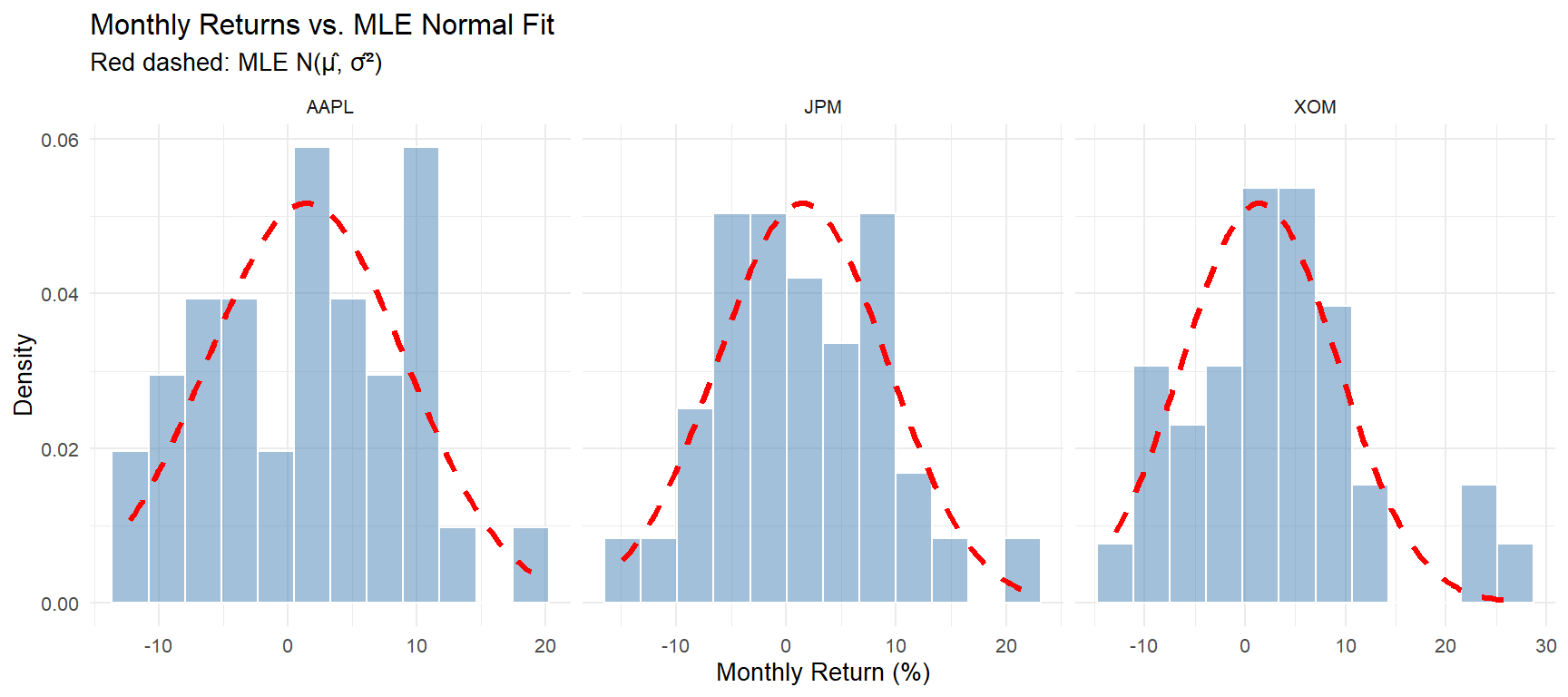
๐Ÿ’ฐ R Case Study: MoM vs. MLE โ€” Return Distributions

Code
# MLE for normal: mu_MLE = Ybar, sigma_MLE^2 = (1/n)*sum(yi-ybar)^2
mle_est <- returns %>%
  group_by(symbol) %>%
  summarise(
    mu_MLE    = mean(return_pct),
    sigma_MLE = sd(return_pct) * sqrt((n()-1)/n()),
    .groups = "drop"
  )

# Visualise: fitted normal densities vs empirical
returns %>%
  left_join(mle_est, by = "symbol") %>%
  ggplot(aes(x = return_pct)) +
  geom_histogram(aes(y = after_stat(density)),
                 bins = 12, fill = "steelblue",
                 alpha = 0.5, color = "white") +
  stat_function(fun = dnorm,
    args = list(mean = mle_est$mu_MLE[1],
                sd   = mle_est$sigma_MLE[1]),
    color = "red", linewidth = 1.2, linetype = "dashed") +
  facet_wrap(~symbol, ncol = 3, scales = "free_x") +
  labs(title = "Monthly Returns vs. MLE Normal Fit",
       subtitle = "Red dashed: MLE N(ฮผฬ‚, ฯƒฬ‚ยฒ)",
       x = "Monthly Return (%)", y = "Density") +
  theme_minimal(base_size = 10)

๐Ÿ’ฐ Case Study: Key Findings

๐Ÿ“Š MoM vs. MLE โ€” Practical Comparison

Estimating \(\mu\) (mean return):

  • MoM: \(\hat\mu = \bar{Y}\)

  • MLE: \(\hat\mu = \bar{Y}\)

  • Identical! For exponential family distributions, MoM and MLE agree on the mean

  • Both are MVUE for \(\mu\) (normal case)

Estimating \(\sigma\) (volatility):

  • MoM: \(\hat\sigma = S\) (divides by \(n-1\))

  • MLE: \(\hat\sigma = \sqrt{\frac{1}{n}\sum(y_i-\bar{y})^2}\) (divides by \(n\))

  • MLE is biased โ€” slightly underestimates \(\sigma\)

  • For risk management: prefer unbiased \(S\)

Takeaways for practitioners:

  1. MLE is consistent, invariant, and often asymptotically efficient

  2. MoM is simple and always consistent โ€” good for multi-parameter models (e.g., Gamma losses)

  3. For normal returns, both agree on \(\mu\); only differ on \(\sigma\)

  4. MVUE = the gold standard whenever achievable

๐Ÿ“ Quiz #1: Relative Efficiency

Two unbiased estimators for a fundโ€™s mean return \(\mu\) are computed from \(n = 50\) monthly observations. \(V(\hat\mu_1) = 0.10\) and \(V(\hat\mu_2) = 0.25\). What is \(\text{eff}(\hat\mu_1, \hat\mu_2)\)?

  • \(\text{eff}(\hat\mu_1, \hat\mu_2) = 2.5\), so \(\hat\mu_1\) is preferred
  • \(\text{eff}(\hat\mu_1, \hat\mu_2) = 0.4\), so \(\hat\mu_2\) is preferred
  • \(\text{eff}(\hat\mu_1, \hat\mu_2) = 2.5\), so \(\hat\mu_2\) is preferred
  • Cannot be determined without knowing the distribution

๐Ÿ“ Quiz #2: Consistency

A portfolio analyst uses \(\hat\theta_n = Y_1\) (the first observation only) to estimate mean annual return \(\mu\). Is \(\hat\theta_n\) consistent?

  • No โ€” \(V(Y_1) = \sigma^2\) does not converge to 0 as \(n \to \infty\)
  • Yes โ€” \(Y_1\) is unbiased for \(\mu\) so it must be consistent
  • Yes โ€” by the Law of Large Numbers, all estimators are consistent
  • Cannot determine consistency without more information

๐Ÿ“ Quiz #3: Factorization Criterion

For a Poisson sample \(Y_1, \ldots, Y_n\) with mean \(\lambda\), the likelihood is \(L(\lambda) = \frac{\lambda^{\sum y_i} e^{-n\lambda}}{\prod y_i!}\). What is the sufficient statistic for \(\lambda\)?

  • \(U = \sum_{i=1}^n Y_i\)
  • \(U = \bar{Y}\), since it is unbiased for \(\lambda\)
  • \(U = Y_{(n)} = \max(Y_1, \ldots, Y_n)\)
  • The sufficient statistic is \(\lambda\) itself

๐Ÿ“ Quiz #4: MLE vs. MoM

For a Uniform\((0, \theta)\) sample, the MoM estimator is \(\hat\theta_{\text{MoM}} = 2\bar{Y}\) and the MLE is \(\hat\theta_{\text{MLE}} = Y_{(n)} = \max(Y_i)\). Which statement is correct?

  • The MLE is more efficient; the sufficient statistic is \(Y_{(n)}\), so the MVUE is based on \(Y_{(n)}\), not \(\bar{Y}\)
  • The MoM is preferred because it is unbiased
  • Both estimators are equally efficient for all \(n\)
  • The MLE is biased and therefore should never be used

๐Ÿ“ Summary

โœ… Key Takeaways โ€” Chapter 9

Evaluating Estimators

  • Efficiency โ€” compare via \(\text{eff} = V(\hat\theta_2)/V(\hat\theta_1)\); prefer estimator with smaller variance

  • Consistency โ€” \(V(\hat\theta_n) \to 0\) for unbiased \(\hat\theta_n\) \(\Rightarrow\) consistent (Theorem 9.1); \(\bar{Y}\) is always consistent (LLN)

  • Sufficiency โ€” \(U\) is sufficient for \(\theta\) if the likelihood factors as \(g(u,\theta) \cdot h(\mathbf{y})\) (Factorization Criterion)

  • MVUE โ€” Raoโ€“Blackwell: best unbiased estimators are functions of sufficient statistics

Finding Estimators

  • Method of Moments โ€” equate \(E(Y^k) = m'_k\); always consistent, easy to compute, sometimes inefficient

  • MLE โ€” maximize \(L(\theta)\) or \(\ell(\theta)\); consistent, invariant \([t(\hat\theta)\) is MLE of \(t(\theta)]\), often asymptotically efficient

  • Hierarchy: MVUE \(\geq\) MLE (adjusted) \(\geq\) MoM in terms of efficiency

  • Finance link: \(\bar{Y}\) = MLE = MVUE for \(\mu\) in normal returns; \(S^2\) = MVUE for \(\sigma^2\)

๐Ÿ“š Practice Problems

๐Ÿ“ Homework (Wackerly Ch. 9)

Problem 1 (Efficiency โ€” Ex. 9.5): Let \(\hat\sigma^2_1 = S^2\) and \(\hat\sigma^2_2 = \frac{1}{2}(Y_1-Y_2)^2\) be two unbiased estimators of \(\sigma^2\) from a normal sample. Find \(\text{eff}(\hat\sigma^2_1, \hat\sigma^2_2)\).

Problem 2 (Consistency โ€” Ex. 9.20): If \(Y \sim \text{Binomial}(n, p)\), show that \(Y/n\) is a consistent estimator of \(p\).

Problem 3 (Sufficiency โ€” Ex. 9.38a): For a normal sample with known \(\sigma^2\), show \(\bar{Y}\) is sufficient for \(\mu\).

Problem 4 (MLE โ€” Ex. 9.80): For a Poisson sample with mean \(\lambda\): (a) find \(\hat\lambda_{\text{MLE}}\); (b) find \(E(\hat\lambda)\) and \(V(\hat\lambda)\); (c) what is the MLE of \(P(Y=0) = e^{-\lambda}\)?

๐Ÿ‘‹ Thank You!

Contact

๐Ÿ“ง sorujov@ada.edu.az

๐Ÿ› ADA University, School of Business

๐Ÿข ICTA Statistics Unit

Next Lecture

๐Ÿ“Œ Topic 8: Hypothesis Testing

Chapter 10 โ€” Testing large-sample means, proportions, and variances with financial applications

๐Ÿ“Œ Key Formulas

\[\text{eff}(\hat\theta_1, \hat\theta_2) = \frac{V(\hat\theta_2)}{V(\hat\theta_1)}\]

\[\hat\theta_n \text{ consistent if } V(\hat\theta_n) \to 0\]

\[L(\theta) = g(u,\theta) \cdot h(\mathbf{y}) \Rightarrow U \text{ sufficient}\]

\[\hat\theta^* = E(\hat\theta \mid U) \Rightarrow V(\hat\theta^*) \leq V(\hat\theta)\]

โ“ Discussion Questions

๐Ÿ’ฌ Open Questions

  1. In practice, when would you accept a biased but consistent estimator over an unbiased but inefficient one? Give an example from portfolio management.

  2. The MLE for \(\sigma^2\) in the normal model divides by \(n\) (biased). Yet many practitioners use it anyway. What trade-off are they making?

  3. Can you think of a financial quantity where finding the sufficient statistic would substantially simplify estimation? (Hint: think about VaR or CVaR.)

  4. How does the invariance property of MLEs help when estimating the Sharpe Ratio \(\mu/\sigma\)?