Dərdi dərdiməndə söylə
Published:
Dərdi dərdiməndə söylə
Original (Persian-Azeri)
Dərdi dərdiməndə söylə,
Dərd du, dərdi-mən, de, söylə.
İki dərd sükunət etmiş,
Necə bir bədəndə, söylə?
Yeki dərd bəlayi hicrin,
Xan olub bu təndə söylə,
Və ikinci dərd - rəqibim,
Bu hala mixənde, söylə.
Məgər əsbe sərxoş əst del?
Ki, düşüb kəməndə söylə?
Nə edər qəfəsdə quş? Çox,
Gül açıb, çəməndə söylə.
Nə zaman gələr ərusi,
Bu xərabə kəndə, söylə?
Səni, ey könül, o canan,
Necə saldı fəndə, söylə?
Bu məhəbbətin günahı,
Nə sən u nə məndə, söylə.
Acı həm, şirindir, sevda,
Tay olarmı qəndə, söylə?
Çəkəcəkdi eşq əzabın,
Hər sevimli bəndə söylə.
English Translation
Tell your grief to the grief-stricken one,
Two pains, my own pain, say, tell.
Two sorrows have settled down,
How in one body, tell?
One sorrow is the wound of separation,
It rules like a khan in this frame, tell.
And the second pain—at this condition,
My rival mocks, tell.
Is my heart a drunken horse
That fell into the lasso, tell?
What use to a caged bird if you tell it
Roses bloom in the garden, tell?
When will the wedding (bride) come
To this ruined village, tell?
You, O heart, that beloved,
How put you into the trap, tell?
This love’s guilt,
Neither in you nor in me, tell.
Bitter and also sweet is love,
Can it be equal of sugar, tell?
Must bear love’s torment,
Every loving servant, tell.
Biographical Note
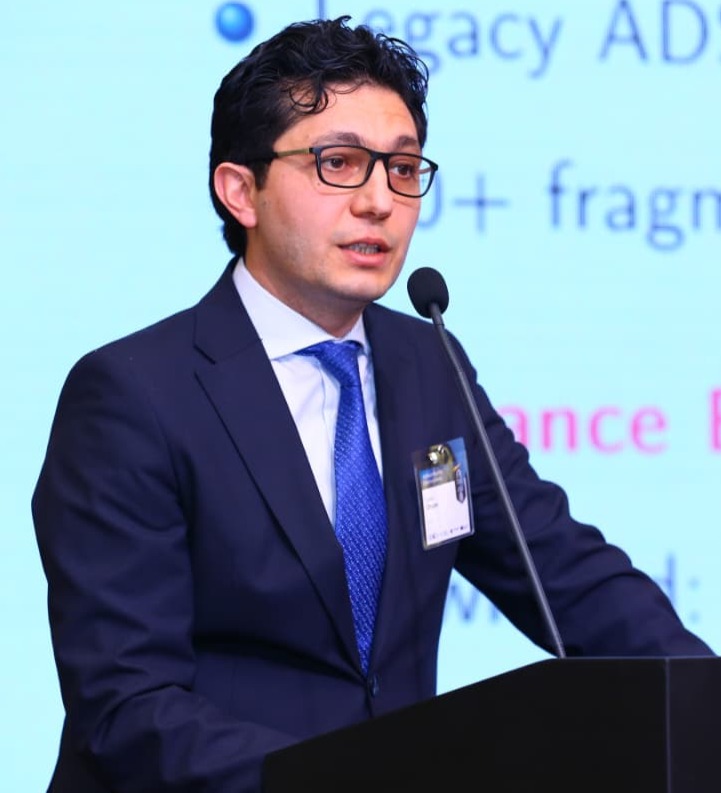
Samir Orujov holds a PhD in Applied Mathematics from UBS, France, and serves as Assistant Professor of Mathematics and Statistics at ADA University, Azerbaijan, and Head of Statistics Unit at the Information and Communication Technologies Authority of Azerbaijan. His research focuses on econometric modeling, telecommunications regulation, and natural monopoly analysis, with publications in telecommunications policy and applied economics. Beyond his quantitative work, he engages deeply with Azerbaijani and Persian literary traditions, exploring the intersection of classical poetic forms with contemporary bilingual expression. His poetry reflects the rich heritage of Azeri-Persian code-switching found in classical masters like Fuzuli, while addressing timeless themes of love, separation, and longing.
Translator’s Note
This ghazal employs deliberate code-switching between Azeri Turkish and Persian, a technique rooted in the classical Azerbaijani literary tradition exemplified by 16th-century poet Fuzuli. The recurring refrain “söylə / tell” creates rhythmic urgency while the poem interrogates the dual nature of love’s suffering—separation from the beloved and the rival’s presence.
The image of the drunken horse echoes practices depicted in Bahman Ghobadi’s films, where horses are made drunk to carry heavier loads—here the heart has been made drunk to bear unbearable love.
The line “When will the wedding come / to this ruined village, tell?” echoes the Russian proverb “Будет и на нашей улице праздник” (There’ll be a holiday in our street too), expressing ironic hope that joy will reach even the most forsaken place.
Submission Information
Publication: International Poetry Review Volume 50.2027
Status: Submitted for consideration
Rights: First world print rights granted
AI Assistance: This work was not assisted in any way by AI writing tools
Previous Publication: Not previously published; not under consideration elsewhere
Author and translator: Samir Orujov
Contact: sorujov@ada.edu.az
Website: sorujov.github.io